Since ancient times, roads have been the best way to connect cities and facilitate trade and the exchange of ideas. Today, they continue to serve that purpose. However, simply building them is not enough: to ensure they are safe and efficient, it is essential to maintain them in good condition over time. This is where the road maintenance, a set of activities that ensure the functionality, safety, and longevity of the road network.
The road maintenance It is an ongoing, complex, and technically demanding task. It goes far beyond simply patching potholes; it involves planning, preventive and corrective measures, and the management of infrastructure that is constantly exposed to wear and tear from traffic and the weather. In this post, we’ll explore the importance of the road maintenance, the types of initiatives it encompasses, who carries them out, and why it is a very important investment for the future.
The Strategic Importance of Road Maintenance
Before we get into the technical details, we need to understand why the road maintenance It's so important. Its benefits extend to many areas:
- Road Safety: A well-maintained road is a safer road. This means smooth surfaces, visible signage, functional drainage systems, and guardrails in good condition.
- Economic efficiency: The transport of goods and people depends on a smooth-flowing road network. A good road maintenance It optimizes logistics and reduces operating costs for businesses and individuals.
- Infrastructure durability: Carrying out preventive and corrective maintenance on time is much more cost-effective than having to rebuild a section of road that has deteriorated.
- User comfort: To improve the driving experience, it is just as important to road alignment design as a firm, well-maintained, even surface without imperfections.
Types of Road Maintenance
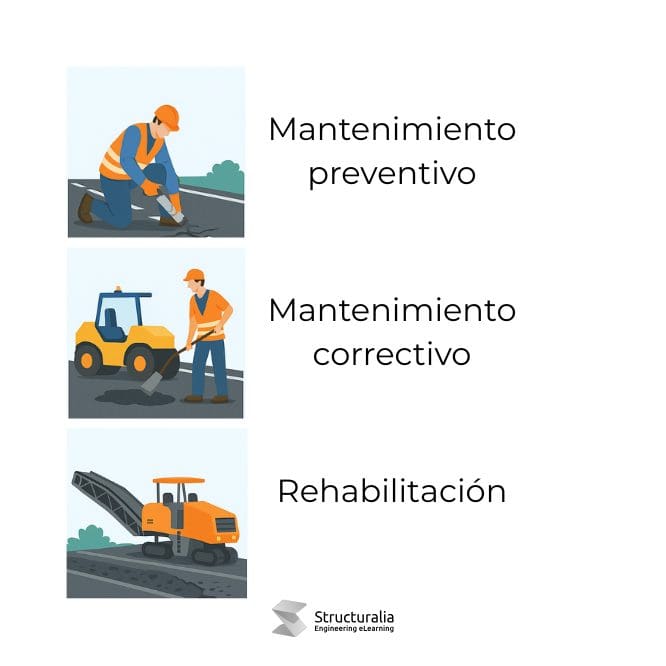
The road maintenance It consists of several interventions that we can classify into three categories:
- Preventive maintenance: These are measures designed to prevent or delay the onset of deterioration. They are based on regular inspections and an understanding of how materials behave. For example, sealing small cracks to prevent water infiltration or cleaning gutters and drainage systems to ensure they function properly.
- Corrective maintenance: It is performed once specific damage has already occurred. The goal is to repair the damage and restore the road to serviceable condition. Typical examples include filling potholes or repairing cracks. While it is necessary, preventive maintenance is always more efficient.
- Rehabilitation: These are larger-scale projects carried out when the deterioration is extensive or structural. They involve the renewal of significant layers of the pavement, the improvement of road alignments, the replacement of obsolete structures, or the modernization of entire systems.
The Role of Conservation Centers
The management and execution of this maintenance largely falls to specialized entities. A road maintenance center, also known in many government agencies as Road Maintenance and Operations Center, is the basic operational unit responsible for ensuring that the road network is in good condition.
These centers serve as the hub from which the daily operations of road maintenance. Its staff conducts periodic inspections, responds to incidents, performs maintenance tasks, and manages the necessary material and human resources. The term “operation” often refers to the comprehensive management of the railway, including the winter road maintenance, traffic management during incidents or roadwork, and assistance to users.
How can I work in road maintenance?
The road maintenance It offers many job opportunities, ranging from machine operators to specialized engineers. If you're wondering How to Work in Road Maintenance, the profiles and requirements vary depending on the position:
- Operators and crew members: They typically require vocational training (Intermediate-Level Vocational Training in fields such as Public Works and Construction), specific driver’s licenses, and training in occupational safety. Experience operating machinery and performing construction work is also often valued. The Requirements for Working in Road Maintenance Requirements for this position include being in good physical condition and willing to work outdoors and, on occasion, at night or on holidays (especially during winter road maintenance or emergencies).
- Technical Specialists: Professionals with advanced vocational training (e.g., Civil Engineering Projects) or specific technical degrees. They may be responsible for supervising work, conducting more detailed inspections, performing surveying, or managing teams.
- Engineers and plant/sector managers: Graduates with degrees in Civil Engineering, Highway, Canal, and Port Engineering, or Technical Engineering in Public Works. They are responsible for strategic planning, contract management, and technical supervision of rehabilitation projects. They must have a thorough understanding of the specific characteristics of road infrastructure.
As we can see, specialized training is very important in this sector. The Master's Degree in Highway and Road Construction and Maintenance Structuralia is a great opportunity to gain the knowledge needed for this type of work.
Challenges in Road Maintenance
Despite its importance, the road maintenance faces significant challenges:
- Funding: Often, budgets allocated for maintenance are insufficient or are the first to be cut during times of austerity, with new construction sometimes taking priority over the maintenance of the existing infrastructure.
- Network Aging: Much of the main road network was built decades ago and requires increasingly extensive repairs.
- Climate Impact: Extreme weather events accelerate the deterioration of infrastructure.
- Technological innovation: The adoption of new technologies, such as sensors for predictive maintenance, is essential, but it requires a significant investment.
The Future of the road maintenance This involves smarter management, supported by data analysis to optimize interventions, the use of recycled materials, and more sustainable techniques.
Investing in maintenance is investing in the future
Ultimately, road maintenance is much more than just a repair task. It is a strategic investment that ensures the safety of road users, economic efficiency, and travel comfort. From the daily work carried out by staff at a maintenance center to long-term planning, every action helps keep our roads in the best possible condition. Neglecting road maintenance is jeopardizing our future; investing in it is building it on a solid and secure foundation.