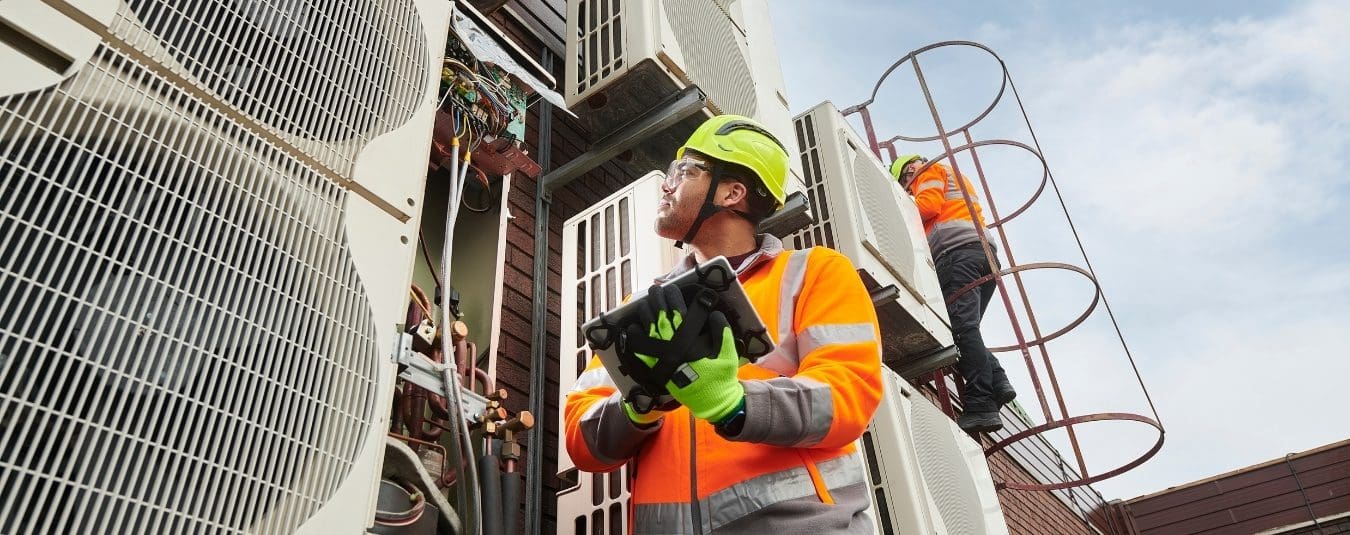
The industrial maintenance It has evolved from a reactive cost center into a strategic driver of efficiency and productivity. With the advent of Industry 4.0, robotics and automation are no longer the future, but rather the operational foundation of the present.
Discover how the implementation of Predictive Systems 2.0, cobots, and digital twins is transforming workshop tasks into smart asset management, ensuring business continuity and drastically reducing unplanned downtime.
It's important to start by asking yourself How is robotics used in industry today?
From the Traditional Workshop to Smart Maintenance
For a long time, machinery maintenance relied on experience: listening for a noise, noticing a vibration, or keeping the schedule of periodic inspections up to date.
Today, sensors and connected systems tell you exactly how each machine is performing. Operators work with real-time information. Every vibration, every degree of temperature, and every unit of energy consumption generates data. And that data tells a story: when a part begins to wear out, which component needs attention, or when it’s best to shut down a line before it fails.
Here's how the predictive maintenance.
Predictive Maintenance 2.0: Sensors, AI, and the Path to Zero Failures
The Predictive Industrial Maintenance (PdM) It has reached a new level of sophistication thanks to the integration of Artificial Intelligence (AI). Version 2.0 is based on the widespread installation of sensors (industrial IoT) that monitor vibrations, temperature, energy consumption, and noise levels. These sensors generate vast amounts of data that are impossible to analyze manually.
You might be interested in the following: Types of Speed Sensors and Their Applications in Industrya.
This is where the advanced automation and AI. Machine learning algorithms analyze these data patterns to predict failures with unprecedented accuracy and foresight. They not only indicate that something is going to go wrong, unless when, and they even suggest why. This level of predictability brings us closer to the ideal of zero unplanned failures, maximizing the uptime of critical machinery.
Collaborative Robots (Cobots) as Diagnostic Assistants
The Collaborative Robots (Cobots) They are the key to introducing automation into delicate industrial maintenance tasks without requiring large safety barriers. These robots, designed to work alongside technicians, are being deployed to assist with diagnostics and inspections.
The most common applications include:
- Precision Visual Inspection: Equipped with high-resolution or thermal imaging cameras, cobots can access hard-to-reach areas to look for cracks, wear, or corrosion, transmitting the image in real time to the technician.
- Sampling: They can automate the collection of oil or lubricant samples for chemical analysis without stopping the production line.
- Repeated measurement: They ensure accuracy by continuously measuring tolerances and alignments, eliminating human error.
The key advantage is that they free up qualified staff from monotonous inspection tasks, allowing them to focus on solving complex problems that require their expertise.
Automation of repetitive and high-risk tasks
One of the most valuable impacts of the robotics In industrial maintenance, the goal is to improve employee safety. According to the Spanish Association of Robotics and Automation. Many preventive maintenance tasks are repetitive, ergonomically hazardous, or involve working in hostile environments (at heights, in extreme heat, or with exposure to chemicals).
By automating these tasks with programmed robots, companies achieve two crucial objectives: improving workplace safety (by drastically reducing accidents) and ensuring the quality of execution. For example, automated systems can clean the interiors of tanks, lubricate hundreds of points on an assembly line, or tighten fasteners in hard-to-reach areas—always with greater consistency than a human operator could achieve.
Autonomous Inspection Systems: Drones and Industrial Rovers
Autonomous mobile robotics has opened up new possibilities for large-scale asset inspection. Think of inspecting large structures such as wind turbines, smokestacks, bridges, or pipelines. Traditional systems require scaffolding and extended downtime.
Industrial drones and rovers equipped with LiDAR and multispectral sensors are taking over. These platforms:
- They streamline the inspection of assets located at heights or underground without putting personnel at risk.
- They collect three-dimensional data that makes it possible to identify small defects or deformations that are invisible to the naked eye.
- They operate on a scheduled and autonomous basis, following predefined routes to ensure comprehensive and repeatable coverage.
This automation of data collection is essential for powering Predictive Maintenance 2.0.
Integration of Digital Twins and Maintenance Planning
The Digital Twin (Digital Twin) is a virtual replica of a physical asset or process that is updated with real-time data. In the field of industrial maintenance, this technology is a game-changer. It allows technicians and planners to virtually simulate the effects of a failure or test a repair before touching the actual machine.
By integrating predictive sensor data with the Digital Twin, «what-if» simulations can be performed. If the AI system predicts a failure in 30 days, the Digital Twin allows us to model the most efficient industrial maintenance intervention, ensuring that we have the right spare part, tool, and procedure, thereby minimizing production downtime.
In this context, it is helpful to have the Big Data tools for Industry 4.0 companies.
Technician Training: From Mechanic to Cyber-Physical Specialist
The automation It does not seek to replace the maintenance technician, but rather to redefine their role. The new professional profile is that of the Cyber-Physical Technician, a specialist who must be proficient in the mechanics and electrical aspects of the systems as well as in industrial computing, data analysis, and robot management.
The inclusion of robotics It requires a significant investment in training existing staff. Today, the most valuable skills include:
- Basic Programming and Troubleshooting of Cobots.
- Analysis of vibration and thermography data.
- Industrial Cybersecurity Management (OT).
- Interpretation of Digital Twins and SCADA Systems.
Maintenance becomes a high-value function that combines practical experience with the tools of the Artificial Intelligence.
Reducing costs and increasing asset availability
The strongest argument in favor of robotics and automation in maintenance is the return on investment (ROI). The benefits are quantifiable and directly impact the company's profitability:
- Reduced operating costs: costly unplanned downtime is minimized, spare parts inventory management is optimized (by knowing exactly when they will be needed), and labor costs for low-value manual tasks are reduced.
- Increased availability: By predicting and preventing failures, machinery operates longer and more reliably. An increase of just a few percentage points in asset availability can translate into millions of euros in additional production.
- Extended service life: More precise and timely maintenance, guided by AI, reduces stress on components and significantly extends the service life of expensive equipment.
Conclusion
The inclusion of robotics And automation is not a futuristic option, but a competitive necessity of the present for the industrial maintenance sector. By adopting cobots, autonomous systems, and the power of digital twins, companies not only protect their assets but also transform their workforce into analysts and strategists. Smart industrial maintenance in Industry 4.0 ensures efficiency, safety, and, ultimately, a crucial competitive advantage in the market.