
I'm sure this has happened to you: you start the day with a never-ending to-do list, run from one place to another, and yet you still feel like you haven't made any progress on that endless list you set out to finish by the end of the day. Maybe you’re studying, working, and also trying to make time for your personal life, but everything seems to pile up and your frustration grows. Instead of looking for a drastic change overnight, what if you started by Small but steady improvements?
That is precisely what the Kaizen method: a philosophy of continuous improvement that allows you to move forward little by little, with simple steps like spending five minutes planning your day, reducing distractions, or reviewing your progress. The sum of these small actions can have a real impact on your productivity and well-being.
What Is Kaizen?
The word Kaizen It comes from Japanese and means «change for the better.» It is not a one-time technique, but rather a philosophy of life and work focused on continuous improvement through small, sustained advances over time. The main idea is that every process—whether personal or professional—can be gradually refined.
When applied to the workplace, Kaizen promotes the elimination of waste, efficient use of resources, and the active participation of all members of an organization in the pursuit of improvement. On an individual level, it encourages people to review their routines, habits, and projects in order to continuously optimize them.
The 10 Fundamental Principles of Kaizen
- He challenges the status quo and rejects convention when it adds no value.
- Think about solutions, not limitations.
- Replace excuses with lessons learned from your experiences.
- Correct mistakes right away.
- Prioritize doing it over doing it perfectly.
- Your creativity is more valuable than the money you invest.
- Turn adversity into wisdom.
- Ask “Why?” at least five times to get to the root of a problem.
- Try to improve a little every day.
- Learn from collective experience, not just individual experience.
The Origins of the Kaizen Philosophy: From Industrial Japan to Personal Development
The Kaizen philosophy gained popularity in Japan after World War II, when companies such as Toyota adopted this approach to rebuild their industrial base. The goal was to improve quality and competitiveness through a system that involved all workers in identifying problems and proposing solutions.
This methodology has shown that sustained progress does not depend on major revolutions, but rather on the accumulation of small, daily actions. Over time, the Kaizen philosophy has extended beyond the business world and has begun to be applied to personal management, learning, and individual productivity. Something similar occurs with methodologies such as BIM, which have transformed the way we work in engineering and construction, as explained in the article BIM: A Methodology That Breaks New Ground.
How to Apply the Kaizen Method, or Continuous Improvement
When you start a new task, your motivation is high. But maintaining that motivation over time requires discipline. Breaking down large goals into smaller ones is essential to fulfilling the two pillars of Kaizen: gradual progress and continuity.
Philosophy is based on one premise: everything can be improved. Nothing is ever finished or perfect; it's always possible to make positive changes. This approach helps you stay focused on your goals without falling into the demotivation that comes from trying to do everything at once.
In addition, Kaizen shares its philosophy with other modern management methodologies, such as agile methodologies, which are also committed to constant adaptation and continuous improvement in changing environments.
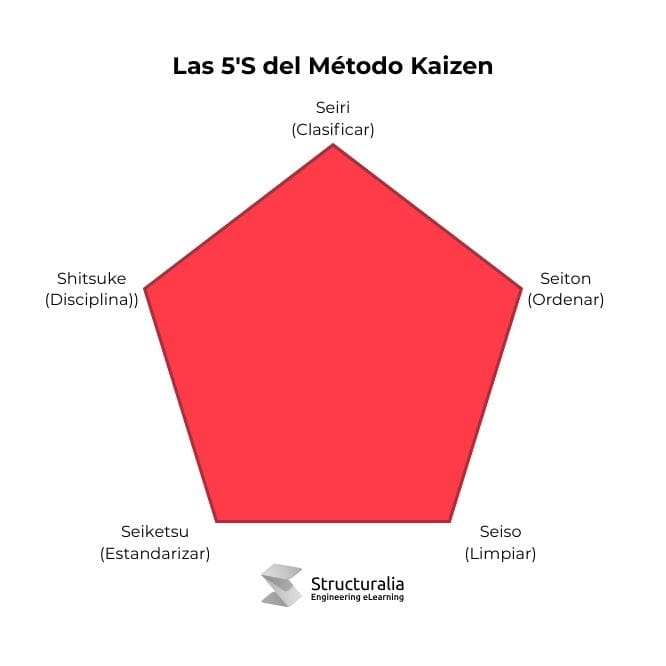
The 5 «S»s of the Kaizen Method
The the 5 «S» method» It is one of the most practical and effective tools derived from the Kaizen philosophy. Its name comes from five Japanese words that, when applied in a work environment or even in one’s personal life, aim to create and maintain an organized, clean, and efficient space. This system has become a cornerstone of continuous improvement in organizations around the world.
- Seiri (Sort): Separate what is necessary from what is unnecessary, eliminating what does not add value. An example of this might be: tidying up your desk and keeping only the useful documents.
- Seiton (Organize): Organize each item in a specific, accessible location. For example, have a well-structured digital file system so you can quickly find what you're looking for.
- Seiso (Clean): Keep your workspace clean to improve efficiency and easily spot problems. For example: Check your workspace at the end of the day and get it ready for the next one.
- Seiketsu (Standardize): Establish rules and routines to ensure that the three previous steps are followed. You can create a weekly checklist for tidying and cleaning.
- Shitsuke (Discipline)): Foster self-discipline and the habit of consistently applying the “S”s. Example: Incorporate these practices into your routine until they become second nature.
The Benefits of Applying Continuous Improvement to Your Life
- Reduces anxiety about change: Taking small steps reduces fear and resistance.
- Avoid Procrastination: Kaizen encourages daily action, no matter how small.
- Build lasting habits: Small, repeated actions become part of your routine and lead to lasting changes.
- Fosters ongoing motivation: Every achievement, no matter how small, paves the way for the next step.
- Build Resilience: You learn to adapt and improve even in challenging situations.
Practical Examples of Application
Like any philosophy, the Kaizen method—or continuous improvement—has its detractors. Some claim that because The changes are modest, the process of visualizing goals is done quite long, however, we'd like to show you some corporate examples to help you get started with this method:
- Set goals: Plan small actions with your employees; they'll be inspired by the changes achieved as a group and how these changes snowball by the end of the project.
- Practice Being Organized: Keeping your workspace clean is a good way to get started on small projects.
- Report any difficulties: During brief meetings, your team will have the opportunity to share their thoughts on the method and discuss how they can help each other with small tasks to feel more comfortable.
Ultimately, the Kaizen methodology—or continuous improvement—can revolutionize the life of anyone who practices it, one day at a time. To do this, it’s important to ask yourself: What results are you hoping to achieve with this method? What steps should you take to achieve your goals? How can you break down large tasks into smaller, manageable, and ongoing steps?