
Understand the practical application of mathematical formulas and relationships such as the Poisson's ratio It is essential for engineers.
Poisson's Ratio and Its Practical Application in Engineering
In the vast world of engineering, mathematical formulas and relationships play a fundamental role in problem understanding and solving, among these tools, the Poisson's ratio It stands out as a crucial concept that enables engineers to tackle a variety of challenges related to the deformation and elasticity of materials. This coefficient, named after the French physicist Siméon-Denis Poisson, provides a measure of the relationship between transverse and longitudinal strains, and its application extends to numerous fields, from civil engineering to aerospace engineering, providing a solid foundation for accuracy and safety in structural design and analysis calculations.
Through the Poisson's ratio, engineers can better understand how materials respond to applied forces, which allows them to anticipate and mitigate potential structural failures. This measure is invaluable in assessing the stability and durability of buildings, bridges, vehicles, and a wide range of mechanical components. By integrating the Poisson's ratio Through their analyses and designs, engineers can optimize the efficiency and safety of structures, thereby ensuring the integrity of projects and the protection of human lives.
Definition of Poisson's ratio
Poisson's ratio, an essential parameter in materials engineering, offers valuable insight into how materials respond to external forces. Represented by the symbol ν, this coefficient provides an accurate measure of the relationship between the longitudinal deformation and lateral deformation experienced by a material under load. Its calculation involves dividing the lateral strain by the longitudinal strain, thereby providing a a fundamental understanding of the material's ability to retain its shape under applied forces. In practice, the Poisson's ratio It is used to predict and control the elastic response of materials, playing a crucial role in the design and analysis of structures in various fields of engineering.
ν = -ε_(lateral) / ε_(axial)
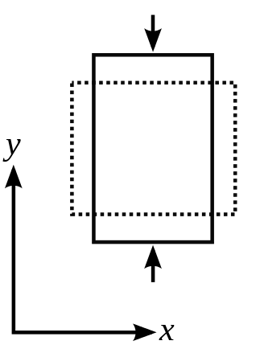 Schematic representation of axial and transverse strain defined by Poisson's ratio. Wikipedia
A Practical Example of the Use of Poisson's Ratio in Concrete
The concrete, an essential material in the construction industry, exhibits a typically low Poisson's ratio, approximately 0.15. This characteristic suggests that Concrete has a limited capacity to deform laterally relative to its longitudinal deformation. when subjected to external loads. This property is extremely useful in the construction of concrete structures, since ensures reliable structural stability by preventing excessive deformation. For example, in bridge and building construction, a low Poisson's ratio in concrete significantly contributes to the strength and durability of structures, ensuring their integrity over time.
Poisson's ratio in everyday engineering practice
As we have already mentioned, in physical terms, Poisson's ratio indicates the relationship between the lateral strain and the longitudinal strain of a material. In engineering practice, the Poisson's ratio It is used to predict the behavior of materials under external loads. For example, in the design of structures such as bridges or buildings, it is important to understand how the materials used will deform. Poisson's ratio helps determine the magnitude and direction of these lateral deformations.
A common example is a beam subjected to an axial load. If we know the Poisson's ratio of the beam's material, We can predict how much the beam will deform laterally when an axial load is applied to it. This information is essential to ensuring the safety and stability of the structure.
 The Salginatobel concrete bridge was designed efficiently and safely by calculating its deformation using Poisson's ratio. Wikipedia
In conclusion, understanding Poisson's ratio and other fundamental concepts in materials engineering are crucial for ensuring safety and efficiency in the design and construction of structures, and furthermore allows you to explore new designs using innovative materials. However, in such a dynamic field, it is essential to continue learning and specializing, which is why we invite engineers to consider the Master's Degree in Structural Analysis and Design from Structuralia, which provides the tools they need to advance in their careers and tackle challenges with confidence and excellence.