Amid a global economic crisis, in which infrastructure investments have fallen to near-record lows, there are signs of a slight recovery in the global economy, which will undoubtedly have some impact on the public works projects already being planned for the near future in both Latin America and Europe.
With this in mind, we will now review, How to Properly Prepare a Base Course for Subsequent Construction Using Hot Asphalt Mixes, one of the most essential activities in linear public works projects, both for the construction of new roads and for the maintenance of existing ones.
We will begin by discussing pavement rehabilitation work and then review the bond that must exist between the layers. Finally, we will examine how to use the reprofiling technique, which is useful for meeting the requirements of the IRI (International Roughness Index).
Cleaning the Surface
The first step we'll need to take is visually inspect the condition of the support. To do this, we will assess the extent of the damage and determine the steps needed to correct any deficiencies that could cause problems with the layer we are going to apply.
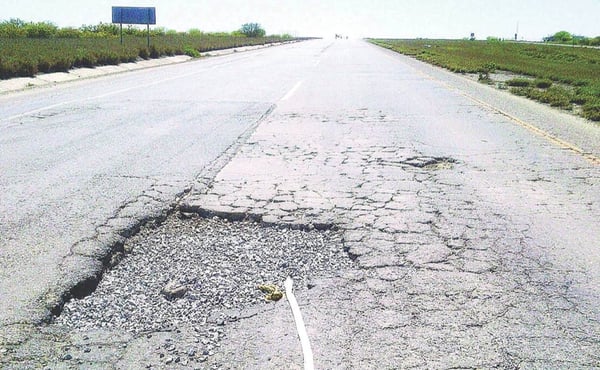
In this regard, the exuded surfaces lead to the formation of plastic deformations and ligant may possibly rise to the surface; therefore, it is essential to remove it by milling and then replace it with a new mixture.
Areas that are located in such locations must also be eliminated excessively cracked. This type of damage is usually caused by fatigue failure of the underlying layer, which must therefore be replaced to ensure that traffic loads are properly transmitted throughout the entire pavement structure.
Interlayer adhesion
The various layers that make up the pavement must work together as a unified whole, so they must be bonded using an emulsion spray, which is given different names depending on the type of substrate: if it is a granular material, irrigation is referred to as primer and its function is to penetrate as deeply as possible in order to bind the granular base and provide surface cohesion.
Sometimes, emulsions of slow break, but the ones that are actually recommended for this type of treatment are the cationic primer emulsions. These are low-concentration emulsions and, therefore, have low viscosity and a high flux content, which is what actually gives them their ability to penetrate the base. It takes quite some time—at least 24 hours—for the binder to penetrate the granular material and lose some of its solvents before the agglomerate layer can be spread.
Between two layers of asphalt Irrigation is called adherence and the recommended emulsions are those made from quick break, as in the previous case, cationic binders are the most commonly used. They have a higher binder content than primer binders, and fewer fluxing agents are used in their manufacture. The waiting time before covering with aggregate is significantly shorter; in fact, when pavers with a built-in watering ramp are used, the process is carried out immediately ahead of the spreading of the mixture.
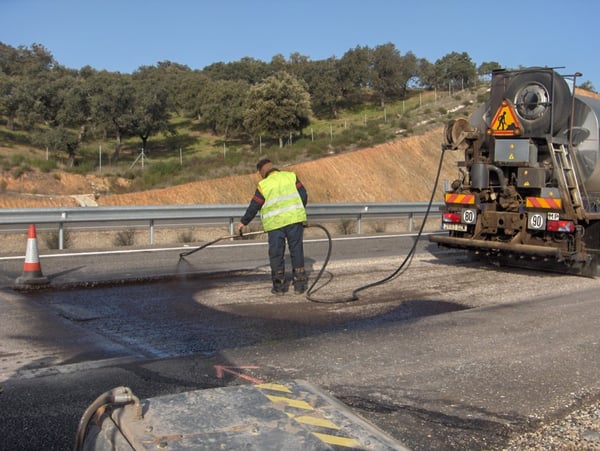
As mentioned earlier, the purpose of these treatments is to bond the two layers together, so it is essential that, eAt the time the mixture is placed, the bonding water has not been lost, neither in whole nor in part, due to truck traffic. Since this is not always easy to achieve, heat-activated emulsions are frequently used. These emulsions are manufactured with very hard binders that do not adhere to tires at room temperature but melt and bond to them when exposed to the hot mix.
It is important to note that before applying these treatments, you must also ensure that the substrate is free of mud, loose particles, or contaminants that could prevent proper adhesion between the layers. If any are present, they must be removed.
Reprofiling
Another point to keep in mind is the surface regularity of the existing surface. From the standpoint of IRI compliance, it may be necessary to apply a reprofiling layer or, as appropriate, to perform patching or other relevant treatment to achieve a uniform profile, both longitudinally and transversely. This is essential when the layer to be laid is the final layer of the pavement.

When, due to the aforementioned irregularities in the substrate, we encounter uneven thicknesses and fail to address them, once the new layer is complete, those same irregularities will remain (albeit less pronounced). The The degree of foaming in an asphalt mixture is typically in the range of 20–25%., so to achieve a thickness of 4 cm, we’ll need to set the screed to about 5 cm at the outlet of the screed. After the compaction process, most of the section will have the planned 4 cm; however, if the screed passes over an area with significant potholes or depressions, the initial thicknesses—if the profile has not been corrected beforehand—will increase; assuming the pothole is 3 cm deep, after compaction it would have decreased to 2.4 cm, meaning we would end up with a profile that is about 0.6 cm lower in this area. Hence the The Importance of Proper Reprofiling prior to applying the new layers.
If you'd like to learn more about the installation of asphalt mixtures, feel free to check out our graduate program, now with new prices:
Header photo: Jacinto L. García.