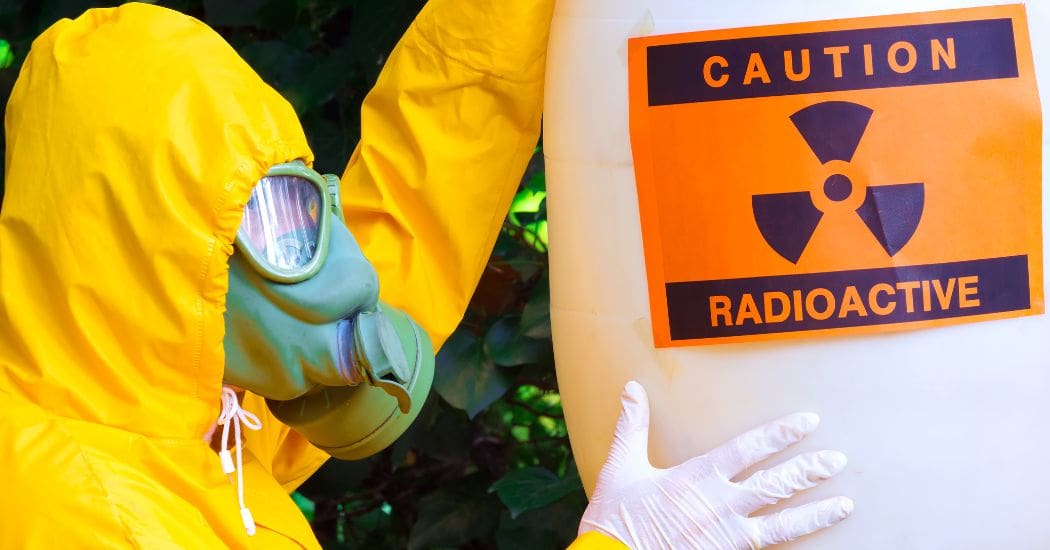
Did you know that some types of waste can remain hazardous for thousands of years? Nuclear energy, modern medicine, and certain industries produce materials that cannot simply be discarded. The radioactive waste pose a critical challenge for engineering, the environment, and public safety.
In this article, we take an in-depth look at the types of radioactive waste, its treatment, storage systems, and the key role played by professionals specialized in its management.
What is radioactive waste?
It is considered that radioactive waste any waste material or product that contains or is contaminated with radionuclides (unstable atoms that emit radiation) in concentrations or activity levels exceeding those established by the competent authorities, and for which no intended use exists. In other words, these are materials that no longer have any practical use but continue to emit radiation.
This waste is generated primarily in:
- Nuclear Power Plants, as a result of the nuclear fission process and the management of spent fuel.
- Hospitals and medical centerss, where radioactive isotopes are used in cancer treatment, diagnostic radiology, and nuclear medicine.
- Industries, in processes such as sterilization, measurement, and quality control.
- Research centers, where radioactive materials are handled for scientific and technological development.
Characteristics of Radioactive Waste
They possess a number of physical and chemical properties that make them particularly hazardous to human health and the environment if not properly managed. Let’s take a look at the main characteristics that determine their classification, treatment, and final disposal:
- Emission of ionizing radiation: They can damage living tissue and require specific protective measures.
- They have a variable half-life: Some disappear in a matter of days; others, over thousands of years.
- They generate waste heat: especially high-level radioactive waste, which must be refrigerated.
- They exist in different physical states: solids, liquids, or gases, which affects how they are treated.
- Depending on their origin, they can be: nuclear, industrial, medical, or research.
- They can pollute the environment: Some radionuclides disperse easily if they are not properly contained.
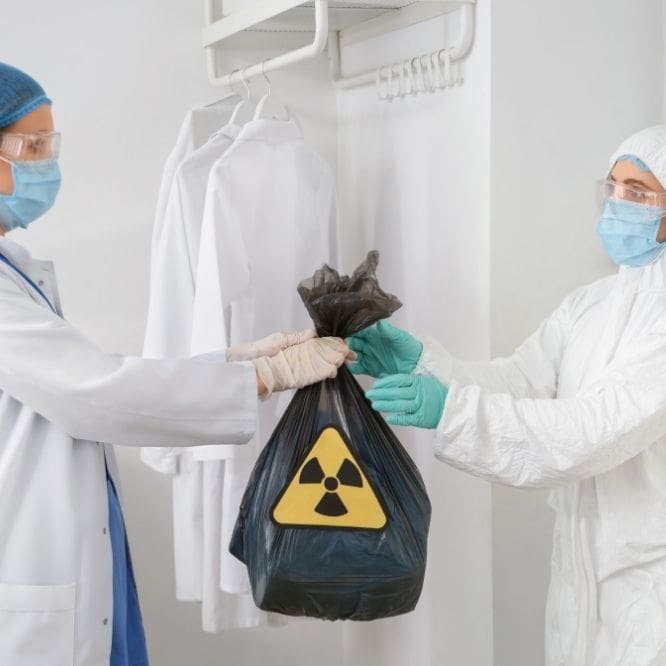
Types of Radioactive Waste
Based on their radionuclide concentration and the time it takes for them to become safe, we classify them into two main groups:
Low- and Intermediate-Level Waste (LILW)
- They exhibit moderate radioactivity.
- They do not generate significant heat.
- They contain isotopes with short or medium half-lives (less than 300 years).
- They are commonly found in hospitals, laboratories, and certain phases of nuclear facility maintenance
Their treatment involves compaction, solidification, or encapsulation, and they are typically stored at surface facilities. In Spain, El Cabril It is the national standard for this type of waste.
High-level radioactive waste (HLW)
- They emit large amounts of radiation for thousands of years.
- They generate waste heat, so they require active or passive cooling.
- These include spent nuclear fuel and reprocessing waste.
This type of waste cannot be stored above ground. Solutions such as the following are being explored: deep geological repositories, capable of containing them for periods exceeding 10,000 years.
Radioactive Waste Management: Key Processes
The management of radioactive waste involves complex technological processes to reduce its volume and hazardousness and to ensure safe storage:
- Classification and Segregation: based on their activity level and half-life.
- Treatment: to reduce its volume or stabilize its shape (compaction, solidification, evaporation…).
- Fitting Out: encapsulated in drums or stable matrices to facilitate handling.
- Temporary storage: They are stored for decades in specialized facilities while a final solution is determined.
- Final Disposition: Long-lived, high-activity waste requires deep underground repositories, which are still under development in many countries.
Challenges and the Future of Nuclear Waste Management
The biggest challenge facing the nuclear waste management is their persistence over time. Some isotopes can take thousands of years to become harmless, which calls for solutions sustainable technologies and social acceptance of storage systems.
If you'd like to broaden your perspective, you can also check out our Guide to Environmental Considerations in Engineering, a key tool for understanding how to integrate sustainability into every phase of a technical project.
In addition, it is necessary to continue investing in:
- Research on nuclear transmutation technologies.
- New reactor designs that produce less waste.
- Strategies for minimization at the source.
One of the most promising developments in this regard is the development of new nuclear infrastructure, such as the world's first floating nuclear power plant, which opens up new possibilities for energy generation and management in remote or hard-to-reach areas.
Specialized training: the key to safe management
The management of radioactive waste requires highly trained personnel. At Structuralia, we offer advanced technical training in nuclear energy, sustainability, and the environment, designed for those who wish to lead the transformation of the energy sector with a responsible and safe vision. One of our most notable offerings is the Master's Degree in Petroleum, Natural Gas, and Petrochemicals, designed for professionals seeking to specialize in key processes within the energy industry, including waste management in complex, high-impact contexts.