Application of Engineering Fundamentals, Markets, and EPC Projects
Francis Gallardo, in his Master's Thesis (TFM) from the Master's Degree in Engineering, Markets, and EPC Contracts in the Oil, Natural Gas, and Petrochemical Industries, applies the knowledge gained to analyze the operations of an International Oil Company (IOC). Through this study, he explores EPC project engineering, the dynamics of the energy market, and its role in the transition toward a more sustainable model. Below, we present the key aspects of his research.
In the Master's Degree in Engineering, Markets, and EPC Contracts in the Oil, Natural Gas, and Petrochemical Industries, The characteristics and the Performance of the Oil, Gas, and Petrochemical Sectors, as well as the processes for the production of biofuels, renewable fuels, or more sustainable fuels, the use of the natural gas (both from natural gas fields and synthetic natural gas) as a basis for electricity generation and its role in the hydrogen production chain, as well as the integration of all these processes with emissions capture technologies (CCSU: Carbon capture, storage, and use). For these sectors, the analysis covers both the technical and engineering foundations and the factors that shape the dynamics of their global markets.
This, from the perspective of the energy sector's role in the transition toward a sustainable quality of life, in accordance with the principles set forth in the Paris Agreement 2030.
Similarly, the course delves into project management, illustrating the organizational and administrative leadership and management involved in the development of large-scale engineering, procurement, and construction projects.
Based on these topics, this master’s thesis (TFM) was written, titled Fundamentals of Engineering, Markets, and EPC Contracts in the Oil, Natural Gas, and Petrochemical Industries, applied to the Case Study of an International Oil Company (IOC), whose overall objective is to apply the skills acquired in the topics described above through the analysis of various
situations and scenarios encountered in the sectors in which an international oil company (IOC) operates.
To illustrate the research process we followed and the information we obtained, we will present some excerpts from the case studies and their analyses.
Refinery Complexity and Refining Margin
The The refinery's complexity index indicates the scope, capacity, and capital intensity of the processes downstream of the atmospheric distillation unit. This allows us to classify refineries into a range of categories from simple to very complex, and one of the practical applications is that it gives us an idea of the types of crude oil the refinery can process and its capacity to
utilization of this resource. The more complex the process, the heavier the crude oil it can process and the more valuable the products it can produce.
It is necessary to know the complexity index of the two refineries owned by IOC
To do this, based on a set of known data, it was necessary to perform a series of calculations using the following equations:

This allowed us to arrive at the results shown in the following table:
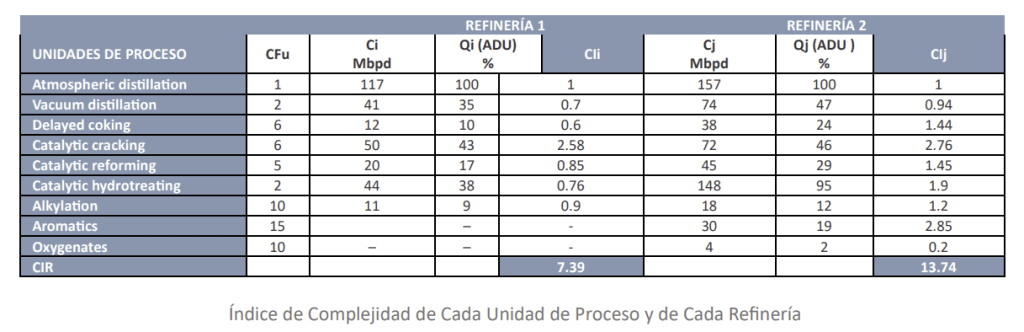
Where:
- Unit Complexity Factor (UCF).
- Process unit capacity (Ci).
- Unit capacity relative to atmospheric distillation capacity (Q ADU %).
- Unit Complexity Index (CI).
- Refinery Complexity Index (CIR).
According to the tabulated data, the complexity index value for each refinery falls within the range 5 < CIR 14).
Crack Spread and Refinery Profitability
The crack spread is a simple metric used to estimate the refining margin at a given time and under specific market conditions. It is based on the difference between the market prices of one or two products from the production mix and the price of a barrel of crude oil. There are different combinations for the crack spread that can be created depending on the configuration one wishes to reflect. One of these is the 1:1 ratio, which measures the difference between the price of a barrel of crude oil and the price of a barrel of gasoline; it is common in refineries that maximize gasoline production. The 3:2:1 crack spread compares the prices of crude oil, gasoline, and diesel. The latter was applied to the case study.
Formula for the calculation:

Given the market data (crude oil and product prices), the objective for Refinery 1 described in the previous section is to determine the theoretical refining margin (“crack spread”) for a 3-2-1 configuration and analyze its profitability.
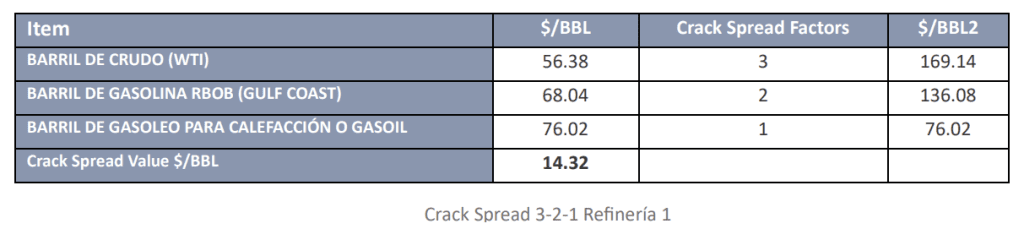
According to the table above, under these given market conditions, the crack spread for Refinery 1 is 14.32 $/bbl. We can make the following observations:
- It is a positive value, which indicates that this combination of raw material and product prices (supply and demand) at this particular point in time represents a favorable or profitable scenario.
- If it is being evaluated as a potential hedge against market risk in the futures market, then this is a favorable scenario.
Refinery Profitability
The crack spread excludes refining costs other than crude oil costs, as well as the prices and yields of the entire basket of products. Therefore, a positive crack spread does not determine a refinery’s profitability.
To analyze the profitability of a refinery's operations, the following information is required:
- Gross Refining Margin (Gross Refining Margin) based on the price and yield of the product basket.
- Variable Margin in which we deduct the variable costs of the processes (energy, chemicals, and catalysts required).
- Operating Margin from which fixed costs (labor, maintenance, overhead, insurance, and taxes) are deducted.
- The cost associated with both the purchase and transportation of crude oil (freight cost), if applicable.
Taking these factors into account, the actual refining margin can be calculated based on the refinery's configuration and utilization, and the return on investment (ROI) of an operation using a specific crude oil can also be evaluated.
As a practical exercise, if we assume—based on the requested crack spread (3-2-1), which is very common in U.S. refining operations—that this is a refinery on the U.S. Gulf Coast (US GC), we can consult several sources of information.
For example, in EIA Methodology Notes: Oil Industry and Markets Division In August 2024, a table of refining margins for various regions, including the Gulf Coast in the United States, was published. This table takes into account refinery configuration, product yields, energy costs, emissions costs (if applicable), as well as crude oil type, cost, and transportation.
Given this, we obtain a value closer to the actual value for the Refinery Margin 1. As shown in the image, this value is lower than the one calculated using the crack spread, 11.08 vs. 14.32 $/bbl, which makes sense, since it reflects all the cost and operational factors necessary to determine a refinery's actual margin.
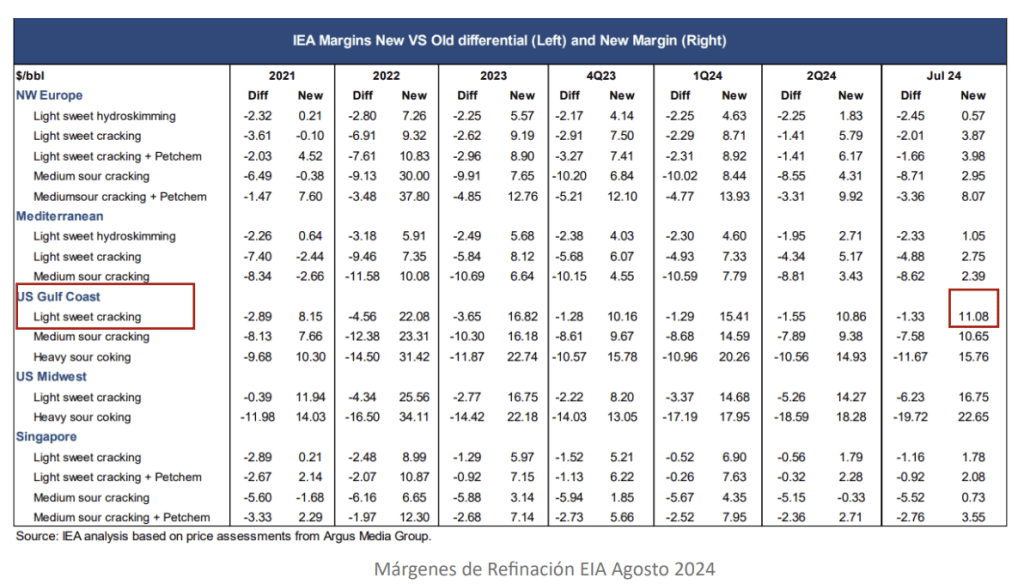
Therefore, given the actual value of 11.08 $/bbl, it can be said that the refinery's operations are profitable.
Cost Assessment of LNG Regasification Plants: Onshore and FSRU (Floating Storage and Regasification Unit)
Understanding the Estimated Capital Expenditures for the Construction of a Regasification Terminal Onshore 3 mtpa with 180,000 m³ of storage capacity, compared to a FSRU of similar capacity, both owned by the IOC, to determine which of the two facilities is the most cost-effective.
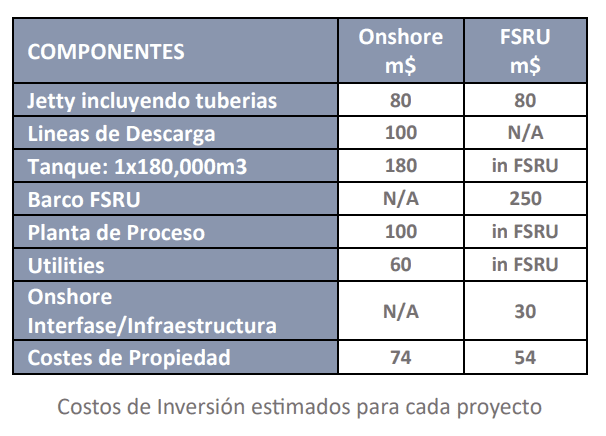
To determine which of the two facilities is the most cost-effective in terms of the investment project’s economics, based on estimated costs and the application of a series of calculation formulas, we can determine the capital expenditures (CAPEX) and operating expenses (OPEX) for each project, allowing us to compare each scenario. This comparison is illustrated in the following figure.
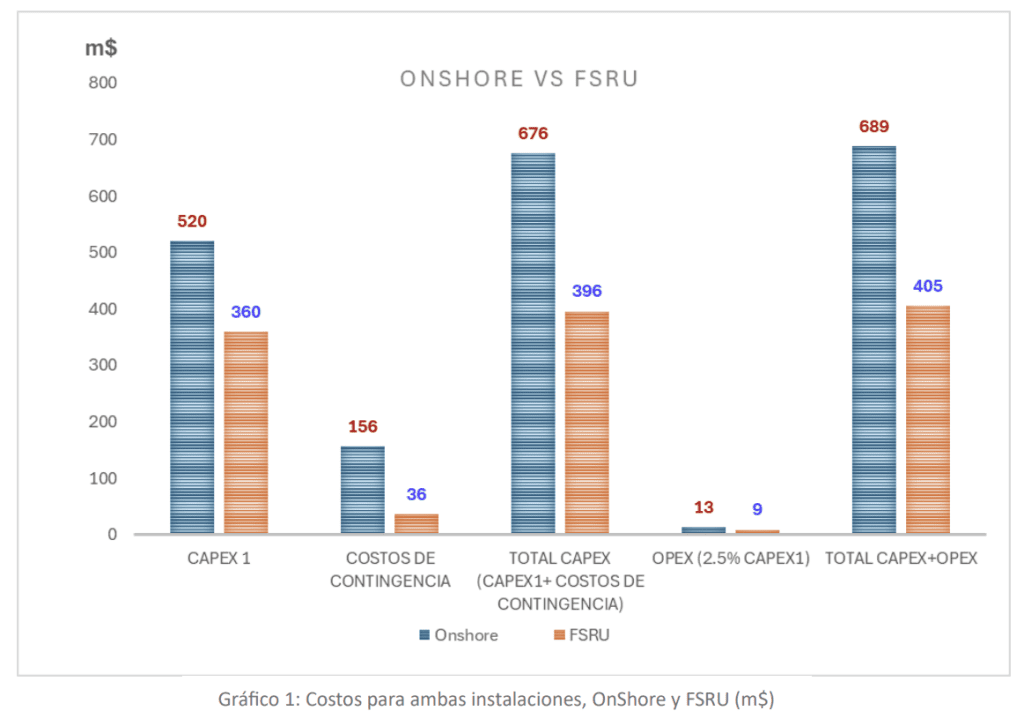
In this case, the FSRU has proven to be the most cost-effective option in all respects. Its total CAPEX+OPEX cost is 405 m$, compared to 689 m$ for the onshore facility. This is generally the case because FSRU units offer greater flexibility in terms of relocation, leases, taxes, utilities, and permits.
As for construction time, assuming that this involves the construction of a new vessel rather than the conversion of an old LNG carrier into an FSRU, the construction time—although longer than in the case of a conversion—is still shorter than that required to build an onshore facility. The latter could take between 36 and 40 months, while the FSRU would take between 27 and 36 months, which is an advantage over a conventional onshore facility.
Natural Gas Market and Prices
Henry Hub Natural Gas Spot Price
This section analyzed the behavior of natural gas market prices over a 6-year period, from 2018 to 2024. The minimum and maximum market prices for the Henry Hub Natural Gas Spot Price (Dollars per Million Btu, (monthly)), when they occurred, and what economic conditions led to them. Therefore, a detailed analysis was conducted; however, in this article we will mention only some of the best-known scenarios during that period and the behavior observed for the 2023–2024 period.
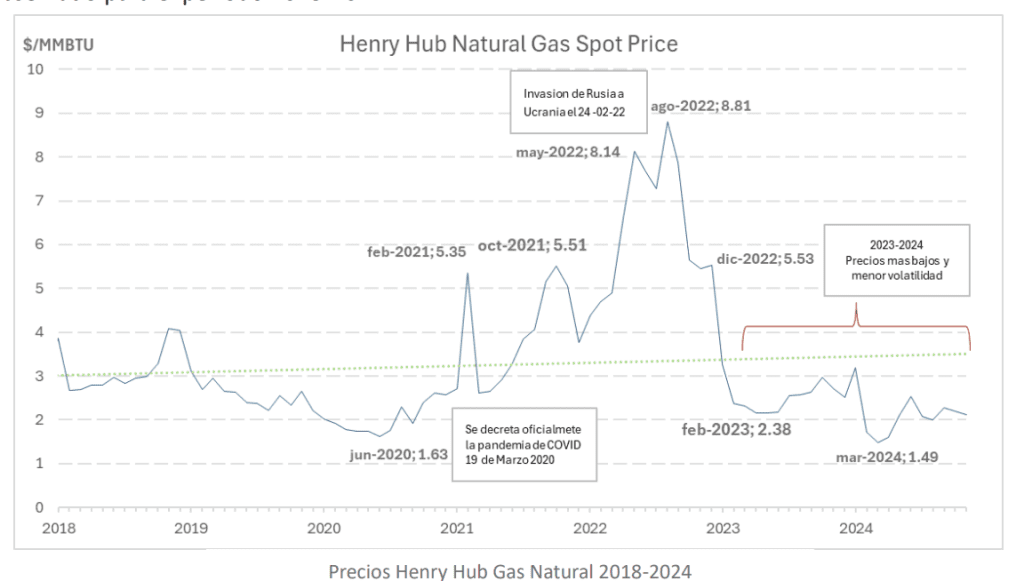
June 2020: On March 11, 2019, the WHO officially declared the COVID-19 pandemic. The decline in activity across various economic and manufacturing sectors—as part of efforts to mitigate the rise in virus infections—led to a decrease in energy consumption and, consequently, in the use of energy sources.
On the other hand, the 2019–2020 winter season—known in the energy sector as “the heating season” because it is the time of year when fuel is needed to heat homes and commercial spaces—was less severe, with milder temperatures, which led to a reduced need for fuel and, consequently, to lower levels of Natural Gas Inventories in the U.S. and Europe higher than the same season the previous year.
May 2022: Russia's invasion of Ukraine began in February 2022. The impact on prices resulting from the geopolitical situation surrounding this conflict began to be felt during this period. Russia and Ukraine are key countries in the supply of natural gas, primarily to Europe. Russia because of its reserves, and Ukraine because of its transportation and storage network, as well as its offshore reserves in the Black Sea. In the In 2021, Russia was the leading exporter of natural gas primarily for Europe and also for Asia. This conflict has led to a decline in supply; as a result, Europe and Asia are seeking and competing for LNG shipments from other regions.
The harsher weather conditions during the winter of 2021–2022 led to an increase in natural gas consumption in the U.S.
August 2022: The scenario described in the previous section continues. Factors contributing to volatility in the first few months of this year include:
- The weather and increased consumption due to colder temperatures during the winter.
- Decline in natural gas production since late 2021 due to low production levels temperatures.
- Record LNG exports from the U.S. to Europe to offset the reduction in supply from Russia. Russia is the main supplier of natural gas to the European Union and the United Kingdom through the following systems (combined capacity of 16 Bcf/d):
- Nord Stream 1 offshore (underwater in the Baltic Sea) gas pipeline to Germany.
- Through Belarus to Poland.
- Via Ukraine to Slovakia.
In addition, the U.S. has seen an increase this year in its exports of GN to Mexico. Natural gas from the U.S. to Mexico flows from the Permian production areas through the following systems:
- Chihuahua-Bahio (Samalayuca-Sasabe Gas Pipeline).
- The Wahalajara system (Waha Hub in Texas to Guadalajara).
2023–2024: We can see in the graph the difference in prices compared to previous years, and we see that it reached its lowest point in March 2024. Over the past two years, following the volatility that plagued prices in previous years, the trend has been toward lower volatility and lower prices. Such is the scenario that the The volatility was mitigated including in light of events such as the attacks on ships that occurred this year in the Red Sea. This is primarily due to three factors: lower consumption, higher production, and higher inventory levels.
Winters with higher temperatures in both 2023 and 2024, along with increased production of natural gas and natural gas liquids, reduced the extraction of Inventories in the U.S..
In Europe, meanwhile, since 2022, after being exposed to the instability caused by the decline in supply from Russia, the governments of this region decided to implement a mandatory measure—which remains in effect through March 2025—to reduce natural gas consumption by at least 15%. This measure, in addition to milder winters in both
Both 2023 and 2024 have enabled the region to reach levels of record inventory levels.
In addition, new LNG receiving facilities have been installed in Germany, allowing for continued imports of LNG cargoes primarily from the U.S. This reduces dependence on natural gas from various pipelines originating in Russia. Furthermore, new FSRUs have been commissioned to expand regasification capacity in several terminals.
However, on the path toward a sustainable energy mix, natural gas serves as a bridge in the transition from fossil fuels to renewable energy, due to its potential for generating electricity with lower emissions and also for producing hydrogen and petrochemicals. For this reason, NG and LNG projects will continue in
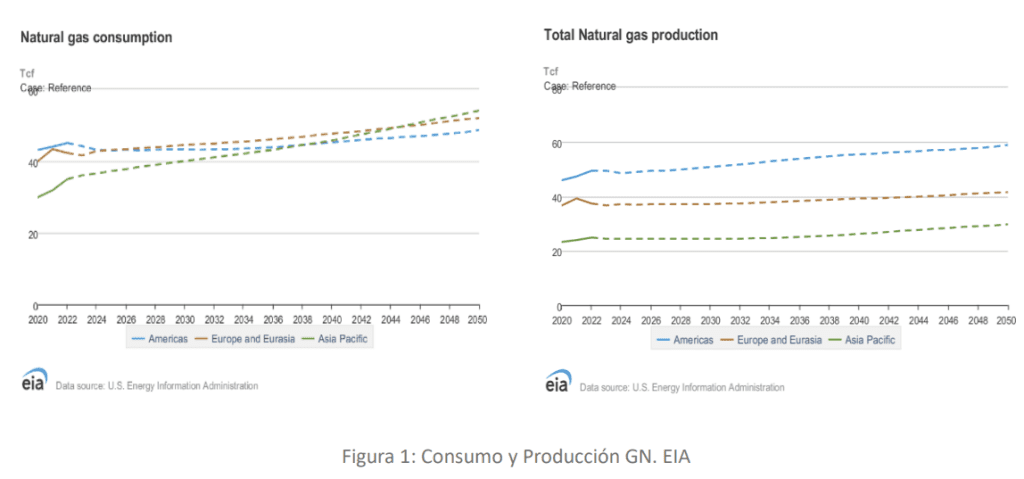
increase intended to cover consumption in future years. According to the EIA's International Energy Outlook 2023, due to factors such as economic growth in regions like India and China, consumption is expected to increase for the generation of electricity. The following figure shows the projections through the year 2050 for Natural Gas Production and Consumption, and the gap between the two is shown for Europe, Eurasia, and the Asia-Pacific region. In other words, the market yet to be tapped.
Petrochemical Industry
Demand for petrochemical compounds and derivatives is projected to grow due to their use in the production and manufacture of a wide range of compounds, materials, and tools that are of significant utility in various aspects of daily life. The design and engineering of projects to build new petrochemical plants or to integrate petrochemical processes into existing refineries require the selection of the products to be manufactured and the technologies for their production. There is the option of developing proprietary technology, which requires preliminary work by a research and development team—meaning an additional time commitment—or the option of selecting from the group
business processes or patents offered by various licensors in the industry.
In this case, you must select an intermediate or final petrochemical derivative and the commercial process (patent) used to produce it.
Propylene Oxide
The Propylene Oxide (Propylene Oxide, PO) is a colorless liquid with a very low boiling point, high volatility, and high reactivity due to its polarity and the characteristics of its epoxy ring, which readily opens when combined with other substances. It has a characteristic odor, similar to that of ether.
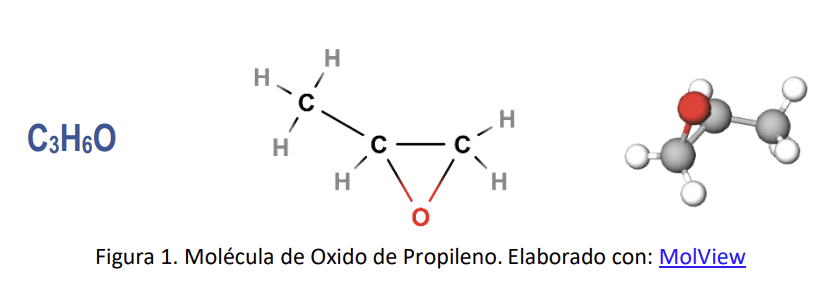
It is a compound derived from the propylene petrochemical chain. It ranks second in terms of propylene uses, after the production of polypropylene (PP) and copolymers. It serves as the starting point for the production of the following products:
- Polyurethanes and industrial solvents: from the synthesis of polyether polyol. Polyurethane foams are essential for thermal insulation (and are currently widely used in building construction due to their light weight), as well as for solvents and adhesives in construction and manufacturing, automotive parts, coatings, shoe soles, and sports equipment.
- Propylene Glycols or Propylene Glycol: In varying grades for different applications. These include antifreeze, excipients, and solvents in the pharmaceutical, cosmetics, and food industries.
More than 10 MMton of PO are produced annually worldwide.
There are two main methods for producing propylene oxide from propylene: the hydrohalogenation of propylene with chydrogen chloride and the other is through oxidation. Within the oxidation route, several patents have been developed based on the epoxidation of propylene with hydrogen peroxide (HP), and are therefore called HPPO (Hydrogen Peroxide to Propylene Oxide) processes.
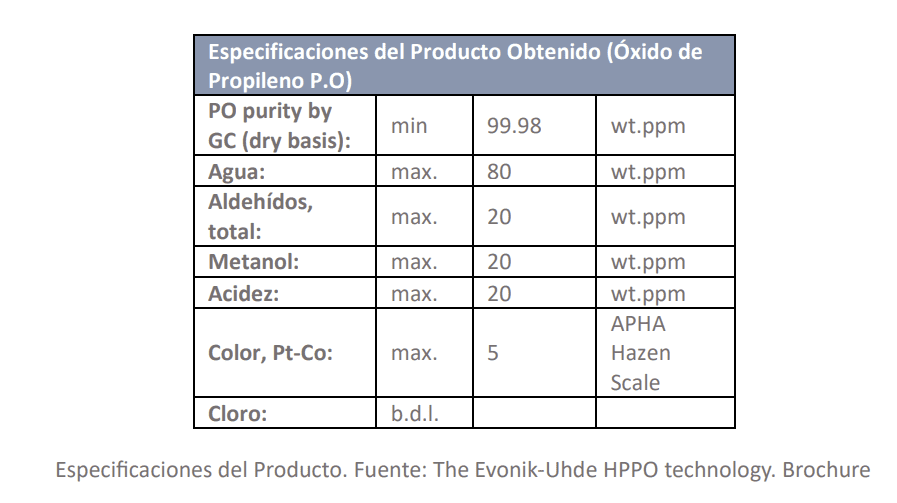
Here, it was decided to propose the Evonik-Uhde technology as the production method. HPPO Technology (Hydrogen Peroxide to Propylene
(Oxide) Evonik-Uhde for the production of propylene oxide from propylene and hydrogen peroxide.
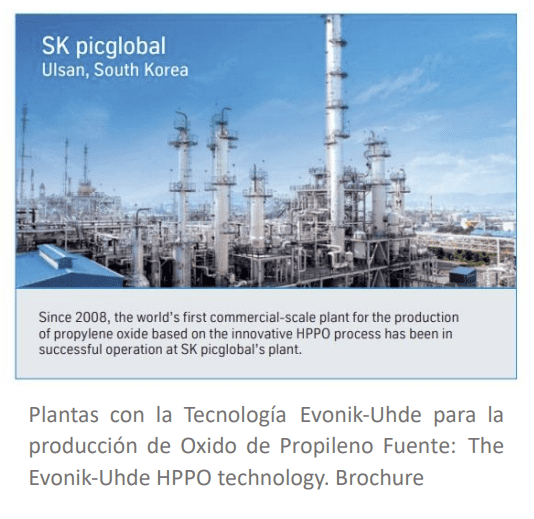
The technology has been in commercial operation since 2008, with its first plant at SK Picglobal in Korea
in the South, which currently has a capacity of 130,000 metric tons per year.
Some of the advantages cited by the technology licensors are as follows:
- It allows for the use of both polymer-grade propylene (PG) and chemical-grade propylene (PG).
- The moderately severe operating conditions of the reactor (<100 C, 30 bar) result in fewer byproducts or undesirable products compared to other production methods.
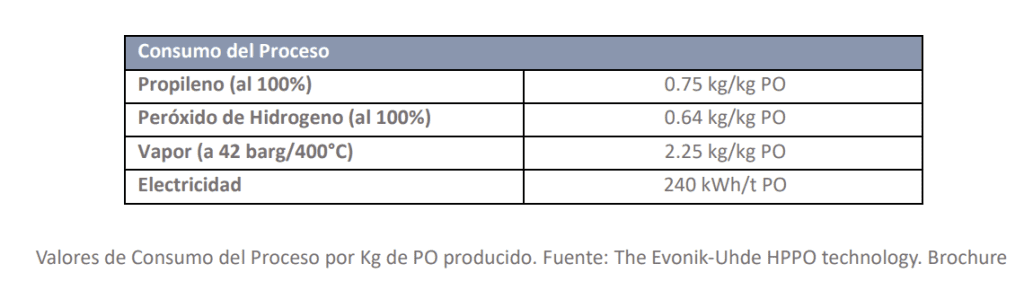
- Lower consumption of raw materials and energy (due to efficient heat transfer during the process).
- Through their patented hydrogen peroxide production technology, Evonik and ThyssenKrupp Uhde offer to optimally integrate the production plant for this compound into the design.
Process
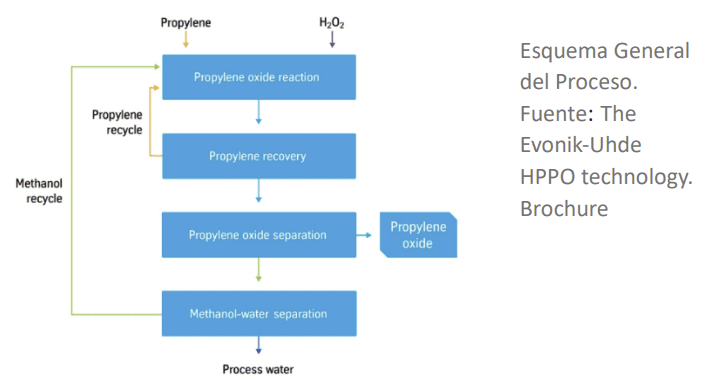
It consists of four units: Reaction, Propylene Recovery, Propylene Oxide Purification, and Solvent Recovery.
EPC Project and Contract Management
Most Common Claims Raised in EPC Contracts
An industrial project is a technical project aimed at constructing an industrial plant. In addition to having a defined timeline, scope, and cost, it must meet specific quality specifications that ensure the proper and safe operation of the product or result obtained.
Various types of contracts are used in industrial projects to carry them out. One of these is the EPC (Engineering, Procurement, and Construction) model. In an EPC project, the project owners (the client) hire a company (the EPC contractor) and assign it the responsibility for developing the detailed engineering, carrying out the procurement of
materials and equipment, and carry out the construction and commissioning of the plant.
During the course of the project, events or situations may arise that affect the agreed-upon parameters for time, cost, scope, and quality, and thus impact the smooth flow of the entire process. At best, these types of situations will lead to effective communication between the client and the contractor to take the necessary steps to resolve them and thus ensure the successful completion of the activities; if this is not possible, measures may even be taken to international arbitration or award.
Below are some examples of the most common claims raised in EPC contracts, related to time, cost, and quality. Due to their nature, some of these claims may relate to more than one of these parameters.
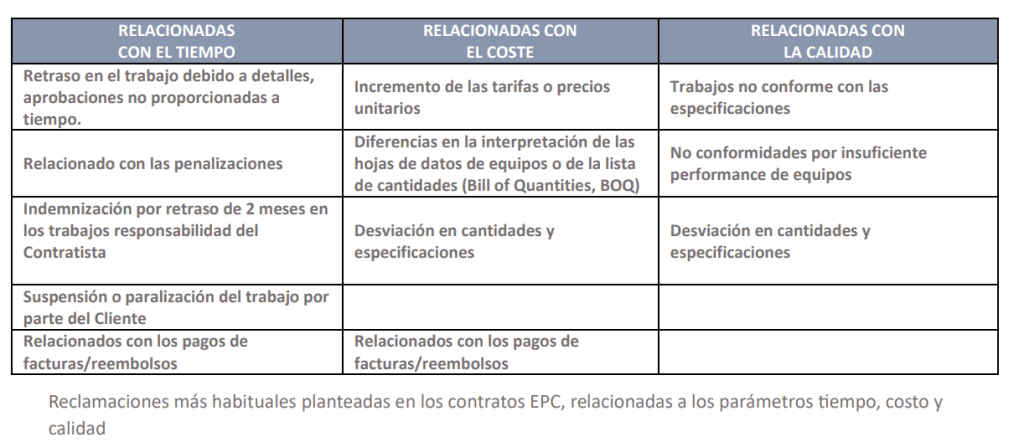
A delay means more time. In the event of a delay, activities take longer to complete than planned.
In terms of cost, errors in interpreting the quantities and specifications of equipment, materials, or resources have an impact on direct costs.
Dissatisfaction with the results of the work and the teams' performance is a direct result of shortcomings in the quality of the project.
However, let’s remember that each of these components is interconnected; a failure in any one of them can affect the others. For example, a failure in the quality of the results will lead to delays and/or associated costs. Or unexpected changes in costs can lead to additional procedures that delay the project’s development.
To avoid these situations, it is important that every role in the project’s organizational chart fulfill its responsibilities. It is important to keep in mind that project quality does not apply solely to the technical evaluation of equipment or industrial processes, but also encompasses quality control of all work procedures and methodologies applied.
Force Majeure Events
Force majeure events are significant circumstances that cause deviations from the initially agreed-upon assumptions regarding the project’s time, cost, scope, and quality.
Force Majeure: a term used to describe sudden events that make it impossible to fulfill obligations.
In general, three requirements are typically identified for a force majeure event to exist:
- External factor: The force majeure event must be beyond the control of the parties.
- Unpredictability: The event must be unexpected and unforeseeable.
- Force majeure: The event must make it impossible to fulfill one's obligations.
In addition to these three aspects, the terms of the contract drawn up in each case must always be taken into account, since it is necessary to verify whether there are any clauses regarding claims related to force majeure.
The International Chamber of Commerce states in its publication: Force Majeure Clauses and excessive burden, the following are considered presumptive cases of force majeure:
- War (whether declared or not), hostilities, invasion, acts by foreign enemies, large-scale military mobilization.
- Civil war, riots, rebellion, and revolution; usurpation of power—whether military or otherwise; insurrection; acts of terrorism, sabotage, or piracy.
- Monetary and trade restrictions, embargo, sanctions.
- An act by an authority, whether legal or illegal; compliance with any law or government order; expropriation; occupation of construction sites; requisition; nationalization.
- Pest outbreak, epidemic, disaster, or extreme natural event.
- Explosion, fire, destruction of equipment, prolonged disruption of transportation, telecommunications, information systems, or power.
- General labor disputes such as boycotts, strikes, lockouts, work-to-rule, and the occupation of factories and premises.
In the case of an extreme natural event, one example that could be highlighted is Global Tungsten & Powder Corp. v. Largo Resources Ltd.. The subject matter of the contract was the sale of tungsten concentrate. The defendant argued that a drought had prevented it from producing tungsten concentrate due to a water shortage. Although the court recognized the event as force
The court also ruled that, due to force majeure, the defendant should have fulfilled its obligation by implementing alternative measures that would allow it to secure a water supply—such as water tankers—even if this entailed higher costs.
Conclusions
- The capital intensity and the level of complexity and specialization of the units downstream of the atmospheric distillation unit in a refinery define its complexity index. For the refineries studied, the indices fall within the range 5 < CI < 14, which corresponds to complex refineries.
- The positive crack spread at Refinery 1 indicates that an operation is viable under given market conditions over a specific period. However, this is not definitive in terms of the long-term profitability of operations, since this requires a cost analysis based on the determination of the rate of return and the gross and variable margins.
and operational aspects, and how refinery operations are optimized. - Given the lower costs, the most cost-effective LNG project for the company will be the floating regasification unit (FSRU).
- The natural gas market, like the crude oil market, is highly sensitive to the natural, demographic, and geopolitical conditions prevailing at any given time. The 2023–2024 period has seen lower volatility but lower prices than in previous periods. In the coming years, the persistent gap between production and consumption rates in countries that import this raw material represents a market opportunity to be addressed through investment projects.
- Propylene Oxide (PO) is an intermediate product in the propylene petrochemical chain. Its importance lies in the fact that it is the starting point for the production of polyurethanes and propylene glycol.
- Time, cost, scope, and quality are the factors that determine the successful completion of an EPC project’s development and execution.
- A concept that appears in EPC contracts is that of “Force Majeure,” which refers to sudden events that make it impossible to fulfill contractual obligations. It must meet the requirements of external cause, unpredictability, and irresistibility.
Author's Review

Francis Gallardo: «I am a chemical process engineer and a graduate of the Central University of Venezuela. I have had the opportunity to work in the areas of production well optimization, refinery system optimization using Aspen PIMS software, and research and development in the manufacture of chemical products, including polyurethanes.»
Author's Testimony
Why did you choose Structuralia?
«It is an institution with a solid track record that makes a significant contribution to the dissemination of audiovisual and research materials, as well as to education in science and STEM fields.»
What would you highlight most about the master's program?
«What led me to choose this specialization was my interest in gaining a deeper understanding of existing industrial processes and how the global energy market is evolving, as well as in exploring new technologies.".
The course covers the industry, production processes, petrochemical integration, and the development and management of projects that enable the construction and installation of such processes, and it analyzes market dynamics—all from the perspective that the trend is toward an “energy mix” or diversity of energy sources. It analyzes the processes involved in the technologies of
biosynthetic and renewable fuels (Biofuels and Advanced Biofuels) and biorefineries, as well as technologies for utilizing natural gas and its role in hydrogen production processes and in combining these with CCSU (Carbon Capture, Storage, and Use).»Furthermore, it is not limited to processes related to the O&G and petrochemical sectors; rather, it allows students to consolidate and reinforce their understanding of the chemical processes that form the foundation of major industries."
How has it helped you, or how do you think it could help you in your current or future professional development?
«I believe that this knowledge is indispensable for engineering professionals in today's world—a world that requires the creation of industrial processes that are more sustainable and in harmony with the ecosystem. The technological, project development, and market insights I have gained allow me to contribute to the design, development, and
»the execution of processes and the related decision-making in each of these areas, with the confidence that comes from understanding current dynamics and expected trends in the industry."