Learn about the importance and the Types of Speed Sensors which are used on a daily basis in the industry.
Types of Speed Sensors and Their Industrial Applications
In today's world, where efficiency and precision are essential to maintaining competitiveness in the industry, and the various Types of Speed Sensors have become a key piece of the production puzzle. The demand for products Faster and higher-quality devices have led to a growing reliance on them, which have become increasingly sophisticated and versatile.
Let's take a brief look back through time to understand How have these sensors evolved? until it reached its current state. From the early devices that could barely measure speed in simple systems, to today's advanced technologies that allow for a accurate, real-time monitoring in a wide variety of industrial applications.
What are speed sensors?
Essentially, speed sensors are electronic devices designed to measure speed of moving objects. These objects can range from a conveyor belt in a packaging plant to the blades of a wind turbine in a wind farm. The information provided by these sensors is invaluable for optimize processes, improve safety y ensure accurate control in production.
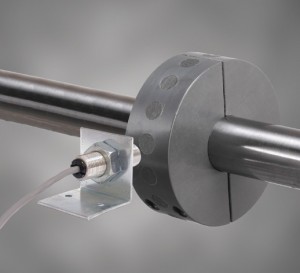 Image of the type of speed sensor most commonly found in the industry. Switches.co.za
How do the different types of speed sensors work?
Speed sensors used in various industrial settings share components that are essential to their operation. In their core, each sensor has a sensor element which detects signals related to the speed of the moving object. The captured information is processed through the sensor electronics, where amplification, filtering, and, in some cases, conversion of analog signals to digital signals. The interface unit The sensor's role is to convert the data into a format that is accessible to control and monitoring systems, while a power supply It provides the power needed for continuous operation. In addition, the sensors can include specific mechanical features and mounting connections tailored to your particular application, ensuring precise and reliable operation in a variety of industrial environments. The proper selection and integration of these components are essential for achieving accurate measurements and optimizing industrial processes.
Types of Speed Sensors
In modern industry, Accurate speed measurement is essential to ensure process efficiency and product quality. Next, we will explore some of the most commonly used types of speed sensors today:
1. Inductive Proximity Sensors
Based on the electromagnetic induction, these sensors detect nearby metal objects and can be used to measure the speed of components such as gears or pulleys in industrial machinery.
2. Optical Speed Sensors
They use light to measure speed of moving objects. These sensors emit a beam of light that is reflected off a moving object and received back. The frequency of light The reflected signal provides accurate data on the speed of that object, making it ideal for applications such as conveyor belt control.
3. Ultrasonic Sensors
Broadcast ultrasonic waves and measure the time it takes for a signal to return reflected from a moving object. This is used in applications that require noninvasive speed measurements, such as flow velocity in pipes.
4. Doppler Effect Sensors
They are based on the Doppler principle, which refers to the change in a wave's frequency when the source and the receiver are in relative motion. These sensors are used in applications such as fluid velocity, such as measuring wind speed or fluid flow.
5. Encoders
Often used in applications such as motor control, encoders provide accurate information about the rotational speed of a shaft. They can be absolute or incremental and are crucial in robotics and industrial automation.
6. Hall-Effect Sensors
These sensors detect speed by measuring changes in the magnetic field generated by a magnet or a moving ferrous object. They are widely used in applications automotive, such as measuring wheel speed in anti-lock braking systems, and for measuring electric current.
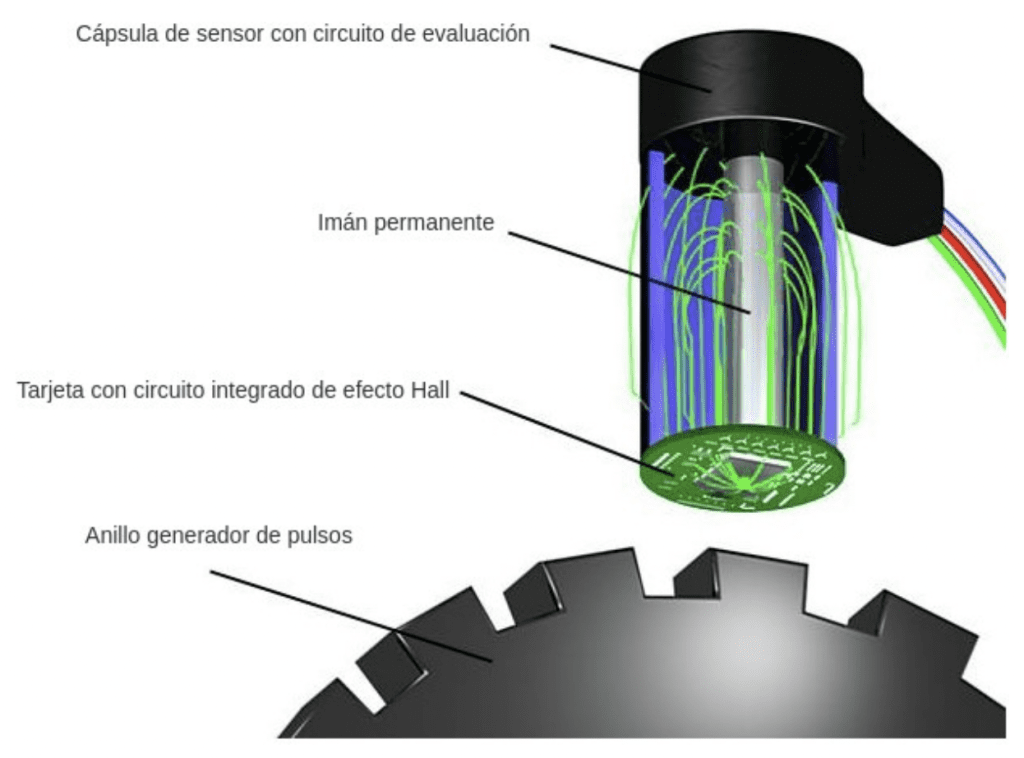
How a type of Hall-effect speed sensor works, as used in the automotive industry. Mecanicaparatodos.blog
There is a very wide variety of Types of Speed Sensors used in various industrial sectors; it is the most qualified engineers who must choose the most appropriate option to get the most out of the speed sensors. It is important to have a very clear understanding of the objective and the precision of the measurement you wish to obtain based on the process you need to monitor, and to stay abreast of the latest technologies in order to stay ahead in a world business such a competitive industrial sector as is the case in the world we live in today, where there is a growing need for professionals specializing in various areas of the Industry 4.0.
If you're interested in this field and want to compete for the best opportunities available within the Industry 4.0, feel free to check out the extensive catalog of courses and master's programs that offers Structuralia.