Had you heard of the Trompe-l'œil in architecture? In the field of architecture, there are also trompe-l'oeil designs. These buildings certainly don't go unnoticed among architects and lovers of construction industry in general.
Below, we'll explain what it is, where it comes from, and some of the best examples you can visit in Spain.
What is a trompe-l'œil? ‘To trick the eye’
A trompe-l'œil, by definition, is “a kind of illusion you use to deceive someone else by making them see something that isn't there.” Trompe-l'œil is popular in the world of gastronomy, since there are chefs and pastry chefs who design dishes that look like one thing but are actually something else. The same thing happens in architecture!
In the field of architecture and construction, it is defined as a kind of mural painting created for to simulate relief or a type of faux architecture. If done right, it can fool the human eye—that's the whole point.
Trompe-l'œil in Architecture and Construction
Trompe-l'œil has been used for centuries in architecture and construction. Sometimes it is used as a decorative element on flat facades or in empty spaces, and other times because it was more economical to paint an illusion than to build the actual element.
In fact, trompe-l'œil is considered an architectural technique in its own right, on par with other aesthetic devices that transform the perception of a building. Its effect may be reminiscent of the play on perspective that we also find in certain Types of Facades, where the design and composition define the building's character.
The Origin of Trompe-l'œil
The trompe-l'œil term «an optical illusion»comes from French" “trompe-l’œil”. Of course, in France we find examples of trompe-l'œil paintings created by the artist himself artist Patrick Commecy, through murals on buildings. But we also find trompe-l'œil paintings in Spain.
Examples of trompe-l'œil in architecture
Here are some examples of trompe-l'œil art that you can find right here in Spain—closer than you might think!
1. Madraza Palace (Granada):
One of the best examples of architectural trompe-l'œil Whatever we find in Spain, we see it in Granada. Specifically, in the Madraza Palace, which houses various departments of the University of Granada.
You can see it for yourself in the image below—no tricks or gimmicks—and judge for yourself. What do you notice? Do you think it's all real?
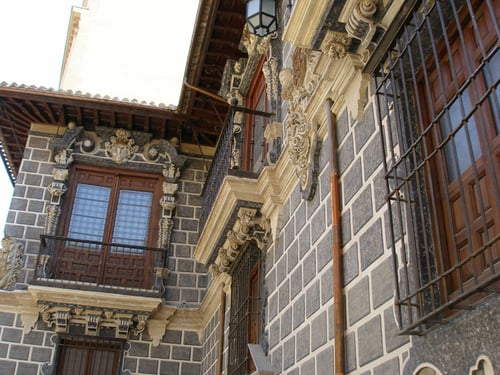
Trompe-l'œil at the Palacio de la Madraza. Source: Wikipedia
If you look closely at the image, It appears to have bricks. However, they aren't! Actually It's a drawing. The artist fools people both in photos and in person, because many people come up every day to touch it with their hands to verify that the surface is indeed smooth and there are no bricks.
It is one of the finest examples of architectural trompe-l'œil found in Spain, and its preservation and current condition are outstanding—but it is not the only one.
2. »Scene on Montera Street in the 19th Century" by Alberto Pirrongeli (Madrid)
Another of the most intriguing trompe-l'œil paintings can be found in the capital, Madrid. Specifically, it is Alberto Pirrongeli’s «Scene on Montera Street in the 19th Century,» and you can see it at 22-30 C. de la Montera, Downtown.
Although it looks like an original building, it is not actually a structure of that type; rather, it is a painting. Many people often walk down the street without noticing it—only if you touch it. This is because It is painted so perfectly that it is not easily distinguishable from a building.
You can see it in the image below (and it's not the only one):
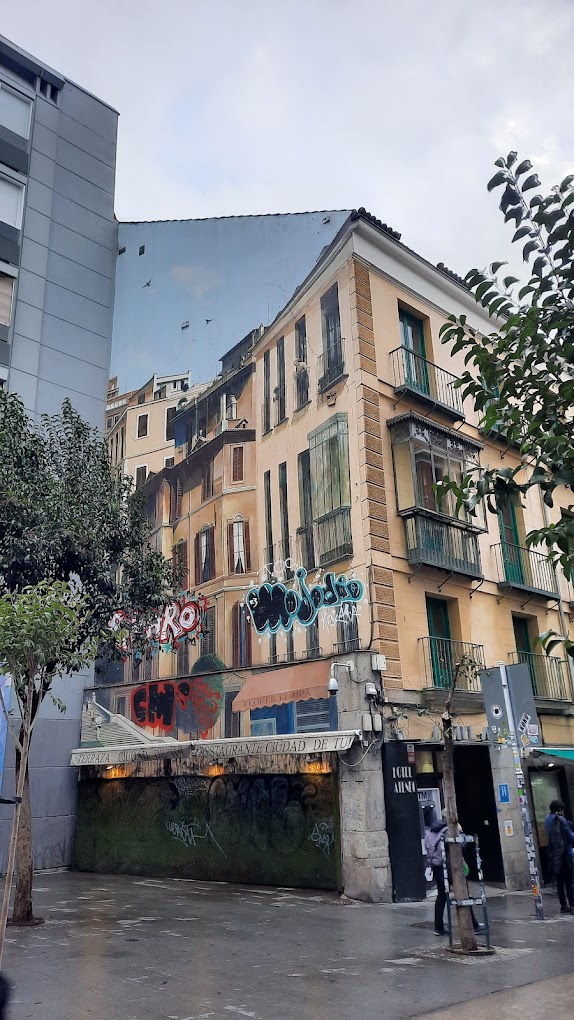
Trompe-l'œil in Madrid. Source: Google listing
Did you know that trompe-l'œil paintings are also used to cover up certain works of art?
Although we are talking about an artistic technique, trompe-l'œil also has connections to engineering and construction. Just as with modern structural solutions, such as the Ways to Reinforce a Column, trompe-l'œil illustrates how professionals have historically sought to creative and more cost-effective solutions to solve design challenges, whether functional or purely aesthetic.
This can be seen in the Facade of the Palacio de Santa Cruz, as shown in the image below:
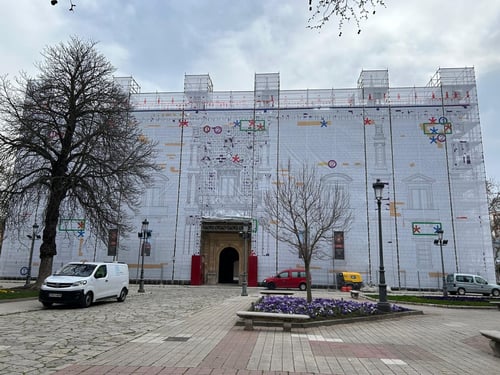
Trompe-l'œil Santa Cruz Palace
Now that you know all about the trompe-l'œil in architecture or building construction, so now all that's left is for you to tell us what you thought of these works and whether you were familiar with them. Do you have any questions? I'm sure artists will continue to surprise us with trompe-l'œil art all over the world.