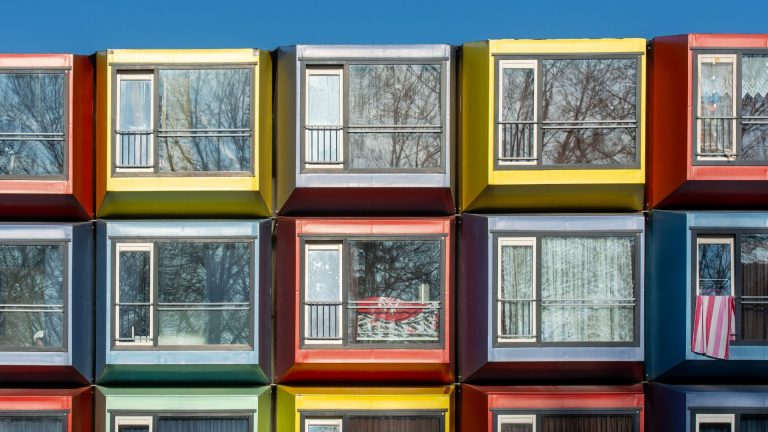
The multi-family housing It plays an important role in Spain. Discover its characteristics, examples, and the benefits of living in these buildings.
What is collective housing? Is it the future?
When talking about multi-family housing It's normal to have doubts about what it means. Although it may seem to refer to the co-living, it really has nothing to do with it, because even though you live in community Everyone has their own home. Put your doubts to rest right now!
Collective Housing: What Is It?
"Collective housing" refers to buildings with single-family homes that have common areas such as storage rooms, a garage, or a community parking lot.
This type of housing—which is very popular in Spain—is called “collective housing” because it is used by a group of people, but each household lives independently. The opposite would be single-family homes, such as building your own house.
What types of multi-unit housing are there?
Over the past century, there has been a proliferation of multi-family housing. Today, it comes in many different forms, such as:
1. Student or Senior Housing
In this type of housing, each person has their own separate bedroom, and they share common areas such as the dining room or play area.
2. Apartment or flat:
It is the most common type of shared housing. It is typically a single-story unit with a kitchen, living room, bathroom, and bedrooms. Residents usually share at least the entrance, as well as other areas such as a storage room or garage.
3. Loft:
Similar to an apartment but without interior walls. In a loft, there are no partitions, and the entire unit is a single open space. You may share the front door, mailboxes, garage, etc., with your neighbors.
4.Duplex:
Similar to an apartment but spread over two floors connected by stairs. It is also considered a type of multi-unit housing because residents live independently within the duplex while sharing common areas with their neighbors.
Thanks to the concept of collective housing, people can have their own homes independently and at the same time share common areas and split the costs. For example, a shared pool is usually much better than having to maintain one on your own.
In addition, changes in people’s lifestyles are leading them to increasingly concentrate in cities and gravitate toward this type of housing concept, which undoubtedly has many advantages

Examples of multi-family housing
Most multi-story buildings are examples of multi-unit housing, but there are others. For example, this term also refers to student housing, senior living facilities, convents, or hotels.
In all of these places, people live independently but share at least a common entrance. This isn't the case when you have a detached house, where everything is separate—even the entrance.
One example that raises questions is that of townhouses, because in some cases they may even share a homeowners' association and have a common garden area. But it really depends on each individual case.
Advantages of Collective Housing
When it comes to buying a home, some people know exactly what they want, but others aren't sure whether an apartment or a single-family home is the better choice. The former is an example of multi-unit housing, while the latter is not.
What should you choose? Collective housing has significant advantages:
1. The location is usually excellent:
Although there’s a wide variety, generally speaking, apartment living allows people to live in the best neighborhoods. For example, in an apartment in the city center, with all the main amenities close at hand. Something like the “15-minute city” concept.
2. The homeowners' association is responsible for maintenance:
Homes require regular maintenance. In the case of apartment buildings, the homeowners’ association usually handles everything. In other words, the responsibility does not fall on each individual, but rather is a collective one. For example, repairing a building’s roof among all the residents is not the same as repairing the roof of a single-family home by its sole owner.
3. Lower cost:
Although there is generally a wide variety of options—location is a key factor—the cost of apartment living is usually lower. For that reason, the vast majority of people choose apartments, although location also plays a significant role in this decision.
Because of all these advantages, apartment living even provides great peace of mind for many people, in addition to a a better quality of life and greater comfort.
For example, if you love the idea of having a pool, you might not be able to afford to build a single-family home with a pool just for yourself. However, a multi-unit residence with a pool might be more affordable for you, where you can share that experience as part of a community rather than being alone.
To make a decision, it's important to weigh the pros and cons. The important thing is that you now know what collective housing is and can determine whether or not it's the right type of building for you.
Do you have any questions about the multi-family housing? Were you familiar with this concept? Feel free to ask us any questions you may have.