In this article, we'll explain 5 Techniques you can consider when reinforcing a beam. Given the severe global economic crisis of recent years, governments have increasingly turned to the renovation of existing structures rather than the construction of new buildings.
In the years leading up to the aforementioned economic crisis, there was a global “boom” in housing and infrastructure construction, which has resulted in a wide variety of structures that now need to be maintained.
In the midst of the recovery process, and given the above, it is reasonable to expect that the investments in renovation and maintenance grow exponentially.
Along with columns or piers, beams are the most commonly used structural elements in building construction and public works; they are not immune to their own structural problems, which are almost always related to excessive bending, and therefore often need to be reinforced and repaired.
Below, we present, 5 Ways to Reinforce a Beam that every engineer should know.
Section extension
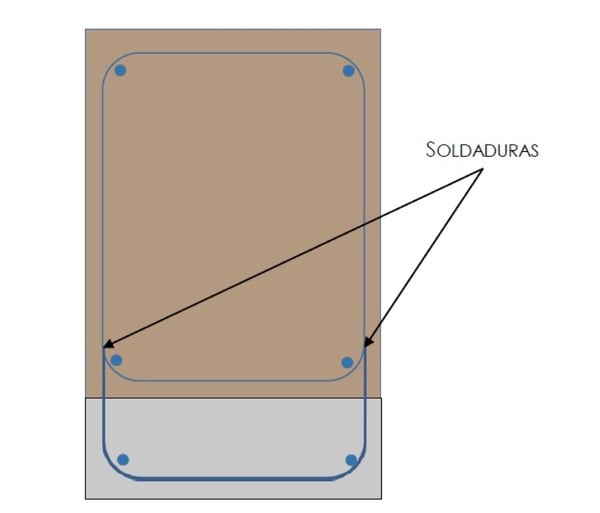
If it is physically possible, widening the section seems like a solution immediate and obvious which can resolve a problem caused by an insufficient amount of steel calculated in the design or during construction.
Advantages:
- Allows you to add reinforcement for bending.
- Low cost.
Disadvantages:
- It isn't always physically possible.
- It requires proper preparation of the bonding surface and correct welding of the new reinforcement to the existing formwork.
Reinforcement with sheets
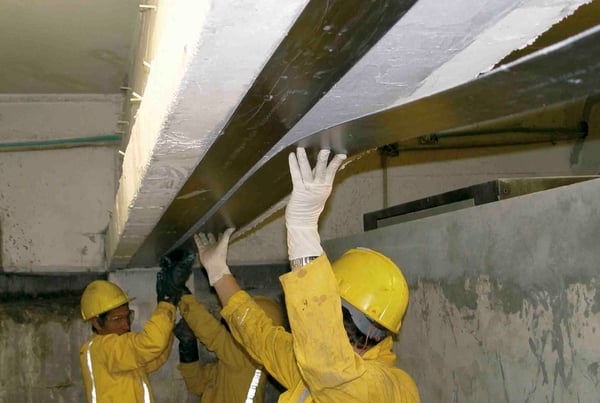
It is another of the immediate solutions that will strengthen externally reinforce our component in the event that it experiences problems caused by insufficient bending capacity. The bonded sheets will function as a exoskeleton which will absorb the excess deformation that the beam cannot handle on its own.
This technique has typically been performed using metal sheets, although in recent years, it has become common to use carbon fiber for this task, which yields better results.
Advantages:
- Simplicity and speed of operation.
Disadvantages:
- It requires the reinforcement element to bond perfectly with the beam in order for it to be effective. To achieve this, it is essential to use the specialty epoxy resins.
Reinforcement with metal profiles
If the two methods described above are insufficient to reinforce our structural element, we will have to resort to more costly techniques.
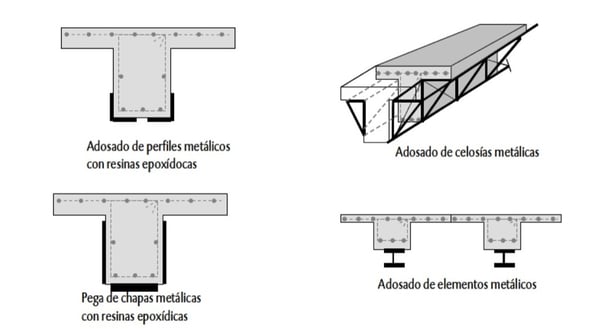
As in the previous cases, add new metal profiles to a concrete beam The existing component will require proper adhesion to ensure optimal coupling.
In the specific case where the beam to be reinforced has a T-shaped cross-section, we can use a metal lattice to support the wings, a technique widely used in bridge rehabilitation.
Advantages:
- A more extensive reinforcement.
Disadvantages:
- Higher cost than the previous alternatives.
- Proper adhesion to the beam, which requires the use of special epoxy resins.
External prestressing
Another very effective option for reinforcing a beam is the use of external prestressed reinforcement. This provides the beam with the necessary counter-deflection to counteract the excessive deflection that occurs.
This system is best suited for reinforce large bridge beams, since that is where the highest stresses occur.

Advantages:
- It does not require the use of adhesive materials, making its application much more efficient.
Disadvantages:
- High cost and operational complexity.
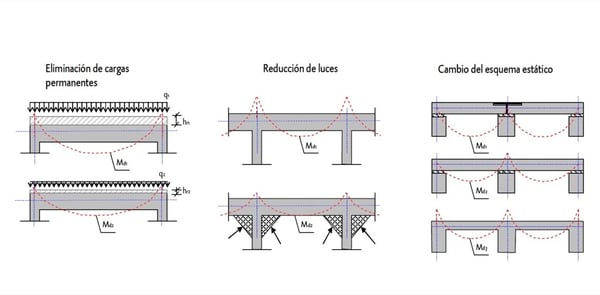
Change in the structural framework
Finally, although it is not possible in most situations, there is the option to modify the structural layout.
The main objective will be to reduce the pivotal moments factors in the area to be rehabilitated, thereby reducing the load on that section.
Given the possibility of applying this method, we find that 3 different ways to structurally modify the beam:
- Through the removal of permanent loads: achieved by milling away the top layer—if it is too thick—or by removing any vulnerable components located on top of the beam.
- Reducing the Existing Lights, using struts to create cantilevers.
- Changing the Static Schema. Designed for bridges with joints that can be eliminated, allowing for a continuous deck or even a portal frame.
Advantages:
- It definitively solves a calculation problem in a project.
Disadvantages:
- It is usually not physically possible, and even if it is, the difficulties involved drive up the cost.
As you may have noticed after reading the 5 Ways to Reinforce a Beam, most solutions require proper adhesion between the reinforcement and the structural element, since choosing the right adhesive and applying it correctly will affect the effectiveness of the chosen solution.