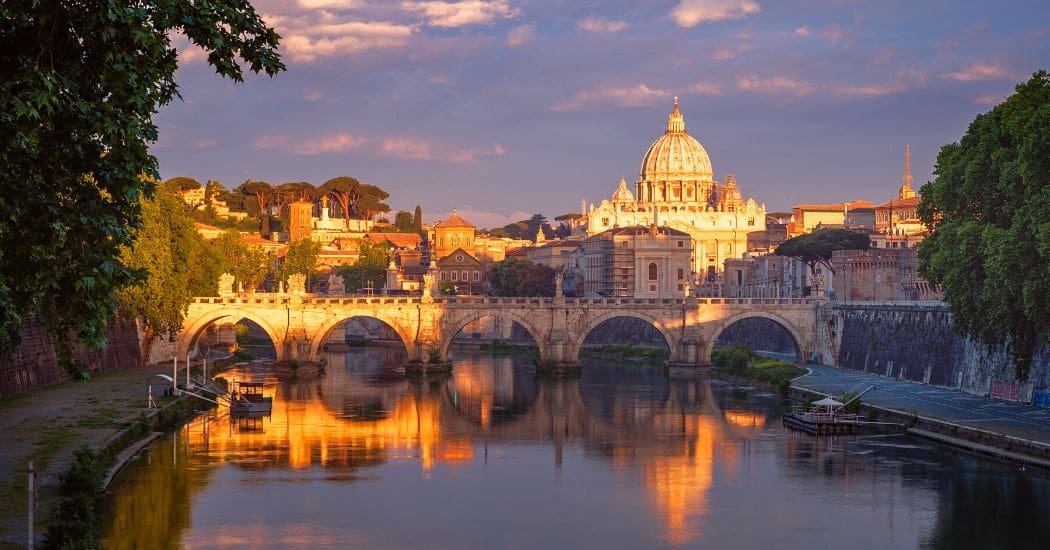
We know that when trying to select the best architects In the world of architecture, we could end up in a major controversy due to the vast array of talents and styles that have existed throughout human history.
For this reason, in this article we have chosen architects who, in our view, are the creators of a great many works that have captivated humanity with their grandeur and beauty. Most of these works have been designated by the UNESCO as a World Heritage Site. We’ve included architects from ancient times because of their impressive legacies that still endure today. Our selection aims to provide a brief chronological overview, in which we’ll mention just a few of the best Architects from around the world and their most important works.
Who are the world's most important architects?
1. Anthemius of Tralles
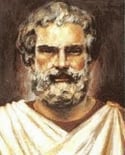 He was a Greek architect (534–474 B.C.) considered one of the the first architects in history.
One of the major projects in which he participated was the majestic Hagia Sophia in Constantinople, which served as the main venue for Byzantine imperial ceremonies. This cathedral is notable for its extraordinary dome, which rests on a square base supported by four pendentives, and is framed by forty windows that seem to hold up the dome in a sea of light.
2. Michelangelo Buonarroti
.jpg) This man, born in Italy (1475–1564), was not only a great architect but is also renowned for his masterpieces as a painter and sculptor. He is considered one of the most exceptional men who ever lived, thanks to his great talent, which he honed over nearly 70 years.
This man, born in Italy (1475–1564), was not only a great architect but is also renowned for his masterpieces as a painter and sculptor. He is considered one of the most exceptional men who ever lived, thanks to his great talent, which he honed over nearly 70 years.
Two of his great architectural works in Rome, notable for having been designated World Heritage Sites, are St. Peter's Basilica and the Sforza Chapel in the Basilica of Santa Maria Maggiore. We must also mention the majestic Farnese Palace.
 The Sforza Chapel in the Basilica of Santa Maria Maggiore. Source: descubrirelarte.es
3. Antoni Gaudí
.jpg)
He was a Spanish architect (1852–1926) considered to beThe leading figure in modern Catalan architecture. His style was characterized by a focus on finding structural solutions, which is recognized as his personal hallmark.
Gaudí’s greatest works can be seen on the Nativity Facade and in the crypt of the Sagrada Família, at Casa Batlló and in the crypt of Colonia Güell, at Park Güell, Palau Güell, Casa Milà, and Casa Vicens, which, thanks to their ingenuity and creativity, have been designated by UNESCO as World Heritage Sites.
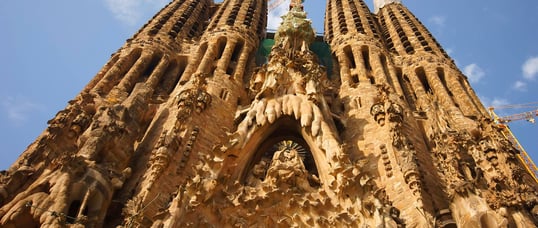 The Nativity Facade and the crypt of the Sagrada Família. Source: patrimoni.gencat.cat
4. Frank Lloyd Wright

This American-born architectural genius (1867–1959) makes our list of the world’s best architects because he is one of the pioneers of organic architecture, in which the aim is to interweave structures with nature, creating harmonious and balanced connections between them.
His most famous work that exemplifies this concept is Fallingwater, built over a waterfall on Bear Run Creek in Pennsylvania, United States.
Among his major works, UNESCO has designated the Solomon R. Guggenheim Museum (New York), Hollyhock House (Los Angeles), Taliesin in Spring Green (Wisconsin), Taliesin West (Arizona), Unity Temple (Chicago), Frederick C. Robie House (Chicago), Jacobs House 1 (Wisconsin), and, of course, Fallingwater (Pennsylvania).
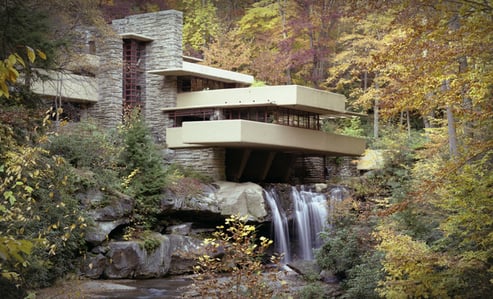 Casa de la Cascada. Source: decoesfera
5. Ludwig Mies van der Rohe
 He was a German architect (1886–1969) who pioneered modern architecture and is known for his a major architectural influence in the 20th century. The style of his works is characterized by the simplicity of its elements, where he left his architectural legacy, using primarily materials such as steel and glass. He also employed geometric calculations based on proportions. In the world of architecture, Ludwig popularized the phrase «less is more,» making it clear that anything without a practical purpose was superfluous.
His most notable works include the Riehl House, the Farnsworth House, Crown Hall at the Illinois Institute of Technology, the Barcelona Chair, Chair 533 for Thonet, the German Pavilion for the Barcelona International Exposition, the Tugendhat House, the Seagram Building, IBM Plaza, and the New National Gallery in Berlin.
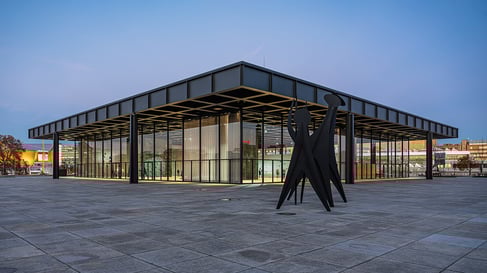
Berlin Neue Nationalgalerie Source: Wikipedia
6. Le Corbusier
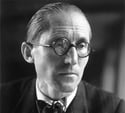
He was born in Switzerland under the name Charles-Edouard Jeanneret-Gris (1887–1965). He became a naturalized citizen of France at the age of 29 and adopted the pseudonym Le Corbusier.
He was a visionary architect who played a leading role in the architectural renaissance with his great, innovative ideas, and was regarded as the the most influential architect of the 20th century. He was also a painter and man of letters who wrote several theoretical books on architecture.
Among his most notable works are designated as World Heritage Sites are located in France:
-
-
Sainte-Marie de la Tourette Convent
-
Firminy Cultural Center
-
Notre Dame du Haut Chapel
-
La Roche-Jeanneret House
-
Frugés House
-
Villa Savoye
-
Molitorm Property
-
Cabin in Roquebrune-Cap-Martin
-
Housing unit in Marseille
-
Factory in Saint-Dié.
-
-
In Switzerland
In Belgium: The Guiette House.
In Germany the houses in the Weissenhof-Siedlung.
In Argentineto Dr. Curutchet's house.
In the India the Chandigarh Capitol Complex and, in Tokyo, the National Museum of Western Art.
7. Zaha Hadid

Dame Zaha Mohammad Hadid was born in Iraq (1950–2016) and spent most of her life in the United Kingdom. Her style was so brilliant that she became the the first woman to receive the Pritzker Architecture Prize and also the RIBA Gold Medal (British Institute of Architects). His style represents the deconstructivist movement, with influences from minimalism and Cubism. His works are characterized by curved facades and sharp angles. The primary materials he used were concrete and steel.
Within its legacy These include the Vitra Fire Station (Germany), the Rosenthal Center for Contemporary Art (USA), the Hoenheim-North Terminal and Parking Lot (France), the Bergisel Ski Jump (Austria), the Ordrupgård Annex (Denmark), the Phaeno Science Center (Germany), the Nordkettenbahn Cable Car (Austria), the BMW Center (Germany), the Puente Pavilion at the 2008 Zaragoza International Exposition (Spain), the London Aquatics Center (England), and Beijing-Daxing International Airport (China).
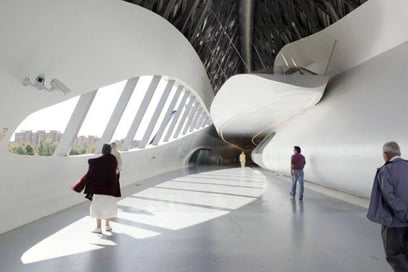 Bridge Pavilion at the 2008 Zaragoza International Exposition. Source: umacon.com
And we'll wrap up this article with one of the greatest female architects in the history of modern architecture. We hope you enjoyed our selection! And if you'd like to suggest other architects to add to this list of the world's best architects, please leave us a comment.