Originally published on August 10, 2020; updated on February 28, 2023
We explain in detail the characteristics that define IPE beams, as well as the main applications of these metal profiles.
The IPE beams are structural steel beams o for structural use which we use primarily in the industrial, commercial, and construction sectors. Its characteristics are perfectly defined by the rules UNE 36526 y UNE-EN 10034.
Thus, these structural elements stand out for having a inner surface parallel to the outer surface, both perpendicular to the web. It is a rolled product whose flanges have a constant thickness (known as “European thickness”), the main feature that distinguishes it from the IPN section.
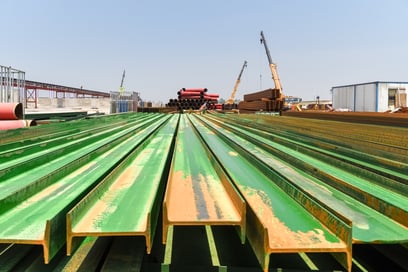
Another distinctive feature of these IPE beams is that they have a standard double-T-shaped cross-section, which is also called I. Likewise, the faces of the soul and the inner faces of the wings, which have sharp edges, have rounded junctions. Furthermore, the ratio of the wingspan to the profile height will always remain less than 0.66.
We designate these profiles using the letters IPE followed by a number, which indicates their nominal total height (h), expressed in millimeters. Thus, there are different types of IPE beams, whose series range from from IPE 80 to IPE 600. Depending on that designation, these structural elements will support a specific weight. For example, an IPE 400 is designed to support 67.96 kg/m.
Main Applications of IPE Beams
By the isotropic properties of structural steel beams or beams used for structural purposes Due to the material they are made of, these metal structures offer a better strength-to-weight ratio than concrete or wood. As a result, they can withstand much more tensile, tensile strain, bending, and compressive forces. This horizontal member is capable of supporting a load between two supports without generating lateral thrust between them.
These steel components have many and varied applications, although the most common ones involve the construction of the structural framework of industrial facilities and other buildings in order to support roofs and openings. We also use them as structural elements in bridges and for the construction of machinery and other equipment, as well as profits which we list below:
Differences Between IPN and IPE Beams
The IPN and IPE beams These are two of the most common types of steel beams used in construction. Although they share similarities, there are also significant differences in terms of their design and strength.
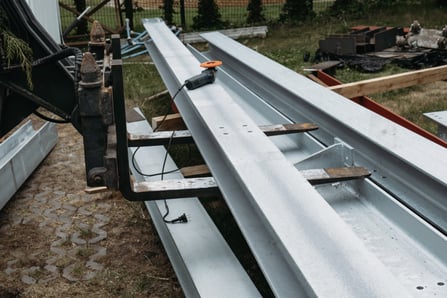
On the one hand, IPN beams have a «U»-shaped profile», with two flat faces and two curved flanges. These beams are stronger than IPE beams precisely because of this shape, which allows them to withstand heavier loads. This is why IPN beams are suitable for the construction of bridges, multi-story buildings, and similar structures.
On the other hand, IPE beams have an «I»-shaped profile with two flat flanges and two curved faces. They are lighter and easier to transport and install than IPN beams, making them ideal for applications where weight is an important factor. However, due to their design, IPE beams are less strong than IPN beams and are therefore used in applications that require less strength.
Thus, in terms of strength, IPN beams have a higher load-bearing capacity than IPE beams. This is because IPN beams have a wider cross-section, which allows them to support more weight. However, it is also important to note that the strength of any beam depends on factors such as the type of steel used and the size of the beam.
Advantages of These Metal Profiles
The use of these metal profiles in the construction industry helps us to reduce the weight of structures. Likewise, it is very easy to install, and its design is streamlined and optimized to provide the best performance.
They are flexible components that adapt to all kinds of structural needs. In addition, it is easy to keep the structures in good condition—all we have to do is apply treatments to prevent rust or treat it once it has already appeared.
Finally, another major advantage of these IPE beams is that, when construction projects require specific rolled sections, these They can be manufactured using pre-welded joints. In terms of price and ease of installation, these profiles are the most economical.
Dimensions and Grades
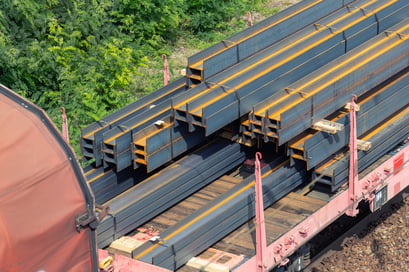
On the market, we can find a a wide variety of IPE beams in various sizes and grades. This last characteristic is expressed using the following categories: S-235 JR, S-235 JRG2, S-235 JO, S-275 JR, S-275 JO, S-355 JR, S-355 JO, S-355 J2G3, St 37.2, and St 52.3.
The most common lengths are also those of 6, 8, 10, 12, 14, 15, 16, and 18 meters, although in specific cases they can range from 5 to 24 meters. These are the ones typically supplied for most construction projects.
From Structuralia, our graduate-level training school, strives to provide high-quality continuing education to professionals such as engineers and architects. The the field of infrastructure It is one of the areas in which we have significant expertise, offering training in both the field of IPE beams as in many others.