The differential seats They can cause serious structural problems, but there are several ways to fix them.
A structure's foundations are essential to its stability, and they depend on geotechnical parameters that must be calculated for designing a proper foundation on the site. Among the most common criteria for properly designing a foundation is the differential settlement.
In geotechnical engineering, when we talk about settlement, we are referring to the allowable downward movement at any point on a structure’s foundation; generally, the goal is to calculate the serviceability limit state. When there are differential seats With significant variation among them, and being very close together, they can produce significant structural damage. These differences may be caused by various factors related to the site, or even by design errors.
Causes of Differential Seats
- An incorrect calculation in the structural design.
- Different geotechnical characteristics in very close proximity in the field.
- A sudden increase in the structure's height or in the loads.
- Improper installation of the building's foundation on the site.
- Structural modifications without prior reinforcement of the foundations.
- Unexpected rail or heavy vehicle traffic in the vicinity of the structure, and the vibrations caused by such traffic.
- Excavations carried out near the building's foundations.
- Soil desiccation or prolonged drought, typically occurring during the summer months and due to high temperatures.
- Fluctuations in the water table.
- Vegetation or trees that have grown very close to the foundations
Consequences of Differential Seating
Foundations, as we all know, support the structure on the ground, and when differential settlement occurs, it means that The structure is giving way. on one side, causing its porticos to lose their horizontal alignment. This has a very obvious effect on the structure of the buildings, which is clearly reflected in the facade.
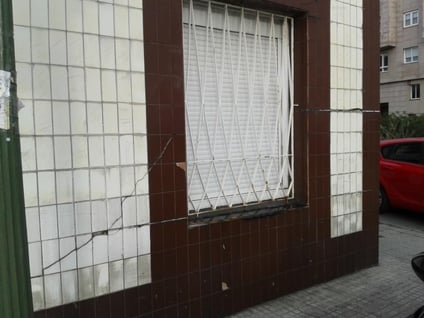 Example of a crack caused by differential settlement. Source: ReformaCoruña
This refers to the appearance of a arch-shaped crack whose center is located at the corner where the two facades of a building meet. It is clearly identifiable because it starts at the ground and runs up the wall until it reaches the corner, where it then runs back down. This phenomenon begins to be noticeable when The difference in the foundation level exceeds 2.5 cm.
Solutions for Differential Seats
When addressing solutions for a problem involving uneven flooring in a building, the first step is to apply small marks with plaster or paint so that serve as evidence of the crack; this is used to check whether the crack is still active (growing) or has stopped growing and the foundation has stabilized.
And if we happen to come across a crack “Dead”, the solution can be very simple and cost-effective; in this case, the facade and cladding must be cleaned up, and then the cracks and holes caused by settlement must be repaired and sealed using the material best suited to the type of building envelope involved.
Now, in the case of a crack “Hurray”The solution will have to be a little more invasive, since there is a risk that the structure could suffer serious damage or even collapse. One possible solution might be to apply Foundation reinforcement is done using micropiles, by drilling very deep, small-diameter holes in the ground to fill the void with cement grout or mortar.
On the other hand, another solution could be inject cement into the ground, equipment is typically used to deliver concrete at very high pressure, thereby consolidating the ground (recommended for large structures). Finally, there is a third option, which is inject expanding resins to reinforce the foundation and stabilize any differential settlements that may exist.
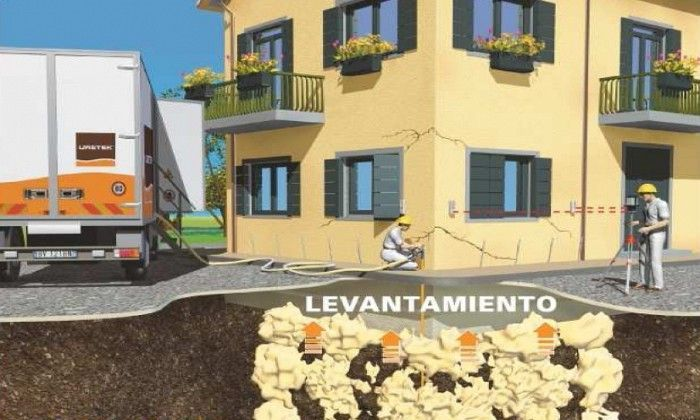
Injection of expansive resins.
To learn more about this and other musculoskeletal conditions and receive professional training on them, we recommend our International Master's Degree in Geotechnical Engineering and Foundations.