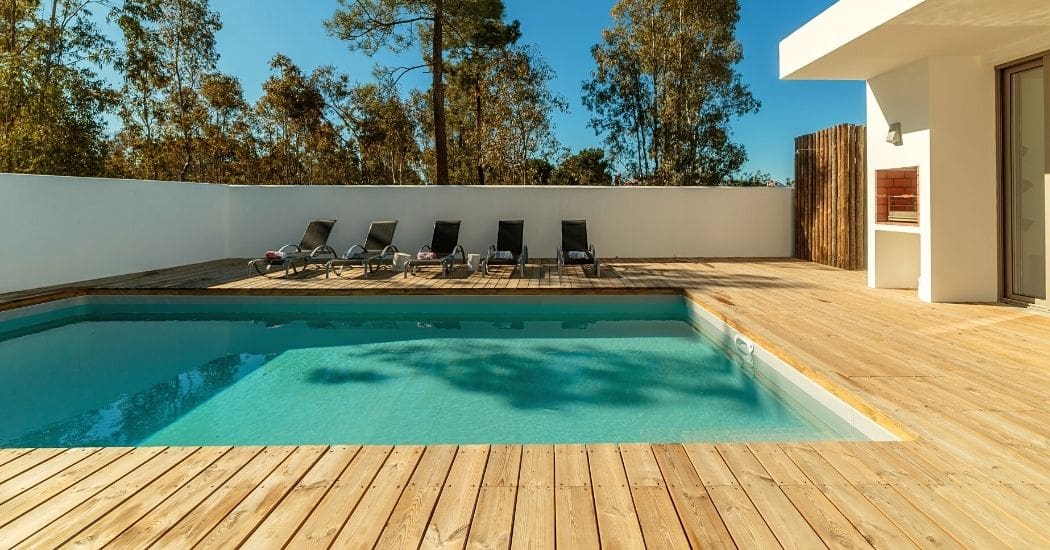
Swimming pools on residential properties have long been not only an element of leisure and recreation, but also a symbol of abundance and well-being. For these reasons, it is relatively common for homeowners or building owners to find themselves needing to install a swimming pool; unfortunately, When calculating the volume of the pool in cubic meters, we find that not all buildings have the space or structural capacity for it.
Installing or building a swimming pool is no easy task, especially in an existing building or home; the vast majority of them are not designed to be modified to accommodate such a big and heavy like a swimming pool. Space is not something we have to spare in urban areas, and tall buildings are often old and their structure is difficult adjustment to receive the load of a rooftop pool.
Calculate the volume of the pool in cubic meters
To understand how a pool will affect the building or the location where it will be installed, the first thing we need to do is identify the cubic meters (volume) of water it can hold when completely full. This is easily calculated using the mathematical formulas for calculating the volumes of conventional solids:
- Parallelepiped: The formula used for square or rectangular pools is the product of the long by the width, by the depth (or average depth).
- Oval-shaped: The cubic meters of an oval swimming pool are equal to maximum length by the maximum width, by the depth (or average depth).
- Round: The first step is to understand the diameter in plan view, to multiply it by the average depth and then by 0,79.
- Irregulars: In these cases, it's best to tDecorate the pool with simple designs to calculate—that is, any of the ones mentioned above. And then add up the volumes of the different pieces.
To find out the weight, all we have to do is something as simple as multiply the value of the cubic meters obtained by 1,000. It is also very useful to know the pool's water volume in order to determine the amount of chemicals, equipment, filters, and pumps needed to maintain the pool.
The Impact of Swimming Pools on Floors
Once we know the weight of the pool to be built—based on its volume—we will understand that the The weight of the water in a swimming pool is generally not insignificant., and therefore, the impact on the site where it is being built is not either. Its implementation requires intervention work, which which could affect the land and require containment measures.
The lack of a plan and a geotechnical study, which is why it's very common to see swimming pools supported by fill material, weak soil, in areas on slopes or in areas with highly unstable slopes that are partially supported by fill material; these are situations that pose a risk to the stability of the pool. This can lead to changes in the volume of the soil—and consequently, cracks—as well as a loss of stability, additional costs associated with stabilizing the soil and conducting new geotechnical studies, and, of course, damage to the home itself.
.jpg) Rockfall caused by a swimming pool. Source: Geocam
Rockfall caused by a swimming pool. Source: Geocam
Impact of Rooftop Pools on Building Structures
To give us an idea, a pool with an average depth of 50 cm weighs 500 kg/m2 when it is full, and the technical code stipulates that the average floor slab for residential buildings in Spain must have a strength of 200 kg/m2. Luckily, theSurface area and weight distribution play a very important role on the structural strength of the structure.
In the case of a 20-square-meter terrace (with a maximum allowable load of 200 kg/square meter), this terrace can support a total of 4,000 kg, while a small 6-square-meter pool filled with 50 cm of water weighs 3,000 kg. We can see that the surface area is crucial for supporting the weight of the pool, even so It's best to consult an architect, since many other factors can come into play, such as the type of structure, whether it is a cantilevered design, or even the pool's location on the terrace or deck.
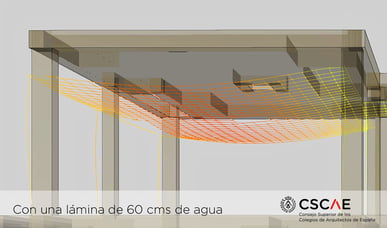 Deformation of the floor slab due to the effects of water. Source: CSCAE
All of this, of course, applies to inflatable or plastic pools, When building a swimming pool, the building's structure must be reinforced. through a project and a new structural analysis. In addition to completing all the legal procedures and obtaining the necessary permits; even so, in the vast majority of cases, building a rooftop pool is not feasible, since From a seismic standpoint, they are very harmful to the building.