
Is experience essential for How do you correctly calculate dead loads in a building? The answer is yes, since they are always present.
The weight of an object or material is defined as, the force with which this object is drawn toward the center of the Earth thanks to the the force of gravity. This is a very basic principle that plays a key role in the structural analysis of any structure, since it is precisely this principle that enables the structure not only to support its own weight but also to resist the weight of the objects, people, and materials it holds.
When analyzing the strength of a structure, we must take into account the weight of everything the building is expected to house; this weight is known as “loads”. These loads are expressed in units of weight per length or at units of weight per unit area, for example: kg/m, or kg/m².
The Loads are distributed across each of the elements which can take on the structure of a building, that is, the structural members. These members each consist of one material and a certain volumetric form, subject to one or more stresses arising from the structure's behavior when a load is applied.
 A building under construction. Source: Lifeder
Types of Cargo Based on Their Nature
In a building, there are two main types of structural loads: live loads and dead loads. As the name implies, the dead loads These are the weights of those elements that remain fixed, attached, and immobile, and are supported by the structure; in contrast, the clong live These are the ones that cannot be determined with exact precision, since they vary in size, position, and number; therefore, a statistical estimate to predict its impact on the structure.
People, snow, and wind are live loads, while doors, windows, partitions, and even the structure's own weight are considered dead loads. Both are equally important in the structural analysis, after all, it must be able to withstand the impact; buildings must be constructed to maintain stable structural integrity under any type of load, so that they can stand the test of time.
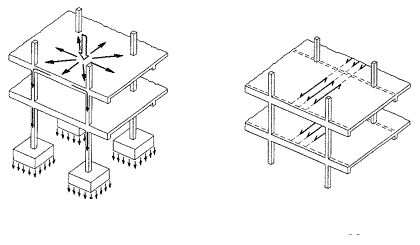
Calculation of Dead Loads
As we mentioned earlier, this type of load is determined by the weight of the materials in the building. Therefore, the accuracy of the estimate made for the project will depend on the the amount and definition of information about the materials to be used in that project; therefore, the structural engineer’s experience plays a crucial role.
Usually, you start with a preliminary estimate at the start of the project, which is subsequently modified by changes y project reviews. If the structural engineer does not have sufficient information about the materials, he or she should refer to those listed in the regional or national building codes as applicable, where, generally, a weight is assigned to each type of material. Otherwise, you must provide the approved technical data sheets for each material used.
Structuralia It offers a significant amount of educational material in this field, as well as a variety of master's degree programs that you can explore on its website.