Originally published on October 9, 2020; updated on September 24, 2022
Do you know how important it is to earn a Scrum certification? Find out what types are available and what their pros and cons are.
How can you earn Scrum certification and reap the benefits it offers?
The Scrum certification It is essential in certain work environments because it develops the ability to use one of today's agile methodologies: the Scrum. Implementing it ensures adaptability, easier interaction, speed, flexibility, and efficiency across all processes. Below, we’ll show you how to obtain this certification, the different types available, and the pros and cons of each.
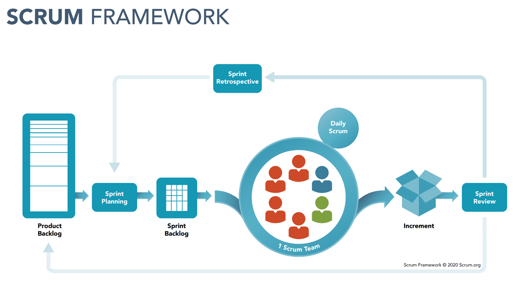 Photo: Scrum.org
How do I get Scrum certification?
When it comes to obtaining this certification, we have several options available to us. To earn it, we’ll need to be familiar with the Scrum methodology, its application, and how to implement it in the workplace, so we’ll need to get trained first. These are the most appealing options available to us:
- Take a course. There are numerous courses available to help us acquire the necessary knowledge. These courses provide standardized, up-to-date, and accurate training designed to help us earn the certificate.
- Master's Programs in Agile Methodologies. This type of training ensures that we gain a deeper understanding. It takes longer to complete these courses, but the knowledge we gain will be more profound as a result. In addition, they often incorporate other methodologies, which will allow us to round out our education.
Once we have acquired the necessary knowledge and completed these programs, we will have to take the official certification exam. Depending on the provider, the exam may be more or less difficult. In addition, Some have different levels. This is the case with the Scrum.org certifications, which are divided into Level 1 (PSM I) and Level 2 (PSM II). As an additional requirement, we need experience as a programmer.
If we successfully overcome them, We will obtain the certification, although the process doesn't quite end there. Every two years, we'll have to renew the certificate so that it doesn't expire. However, we'll be demonstrating that we have the specific, up-to-date knowledge needed to successfully implement this methodology.
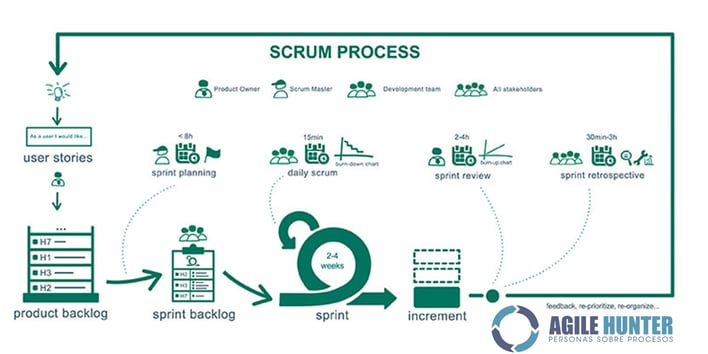 Photo: agilehunter.com
What are the benefits of Scrum certification?
Get certified It’s a wise decision from a professional standpoint, as it allows us to advance to better positions. However, the benefits it offers—even though we have to renew it every two years—more than make up for the effort. The benefits of certification Scrum are as follows:
Solid knowledge of Scrum
Passing the certification is a proof that we have the necessary skills to apply it effectively. This indicates that our understanding of the methodology and its application in the workplace is adequate. Furthermore, if we have experience with it, we will be able to fill in some gaps in its application.
Employment Guarantee
It's a way to advance one's career in the job market. We demonstrate that we have a thorough understanding of Scrum and can apply it right from the start. This increases our chances of finding a good job, and we always have a solid track record to back us up.
The organization benefits
When adopting the Scrum methodology, a series of changes must be made. In such a situation, it is essential to have qualified professionals on hand. Therefore, You'll see a return on your investment sooner. This is further enhanced by the implementation of predictable and repeatable release schedules, as well as self-managing teams—something that can be achieved with Scrum.
Greater integration in the workplace
By having the appropriate certification and expertise, we share the same vocabulary and use similar work methods to those of our colleagues. By using the same agile methodology across the board, results will be achieved more quickly, communication will be smoother, and problems will be resolved faster.
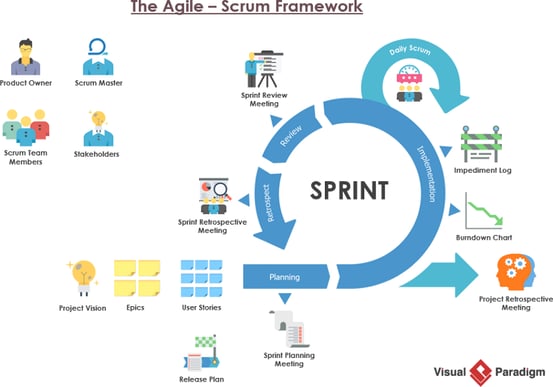 Photo: Cybermedian.com
Which Scrum certification is best?
Now that we know all its benefits, let's find out Types of Scrum Certification, as well as the advantages and disadvantages of each:
1. Scrum Alliance
Scrum Alliance It is one of the best-known organizations when it comes to awarding Scrum Certifications and whose goal is to promote the use of Scrum and Agile methodologies as tools in their work process. Some of their certifications include:
-
- Certified Scrum Master (CSM)
- Certified Scrum Product Owner (CSPO)
- Certified Scrum Developer (CSD)
- Certified Scrum Professional (CSP)
- Certified Scrum Coach (CSC)
- Certified Scrum Trainer (CST)
Pros and Cons
To finish learning about this certification, let's take a look at some of its pros and cons:
Among its pros, Scrum Alliance stands out for being well-known in the industry, so obtaining this type of certification can open doors to the workforce. In addition, you can take their courses from anywhere in the world.
On the other hand, this type of Scrum certification It also has a number of drawbacks, including:
-
-
-
Before 2012, no exams were required—only completion of a course. Currently, those interested must take an exam in a period of 90 days to obtain the certificate.
- Criticism from some professionals regarding the lack of consistency of the materials obtained.
-
Others have also criticized the fact that the preparation was not effective.
-
-
2. Scrum.org
Although Scrum.org was founded eight years later, in 2009, it is also one of the Scrum certifications most well-known and in-demand in the sector. In this case, interested parties must pass an exam, complete a training session and pass both an assessment and a interview -led by a group of experts-.
Pros and Cons
To help you decide which Scrum certification To help you decide, here are the pros and cons of Scrum.org:
-
-
-
It can be said that many professionals in the sector opt for this certification because its courses are consistent, that is, it converts those interested from beginners to experienced professionals.
- Scrum.org states that all of its courses continue the same curriculum, in other words, all students will learn the same thing.
-
-
3. Project Management Institute (PMI)
Although Project Management Institute (PMI) is not a Scrum certification in and of itself; its certificate PMI-ACP It is highly respected in the industry because it covers Scrum practices, as well as others Agile methodologies.
Pros and Cons
Among The Pros and Cons of PMI are:
-
-
- Some stakeholders in the sector appreciate that this is being taken into Previous experience counts in the workplace.
- However, the requirements are more stringent compared to the basic Scrum Master certification, as they require 21 hours of training and 2,000 hours of experience in projects.
-
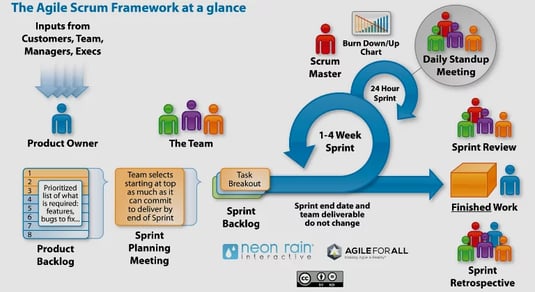 Photo: Antevenio
In short, the Scrum certification It will provide us with a solid understanding of this agile methodology, but if we master it, we’ll reap a number of benefits, making all the effort well worth it. It’s all about improving our employability; mastering it is a success in itself. For this reason, we encourage you to take a look at the Master's Programs in Agile Methodologies and, in this way, you'll be able to advance your career.