Originally published on January 28, 2022; updated on January 16, 2024.
Did you know that the ABC inventory classification Does it help improve operational processes and reduce costs? Find out how.
Benefits of Using ABC Inventory Classification
Efficient warehouse management is essential for most companies, as they store a variety of products that must be located and managed based on their importance and other relevant criteria. Organization and order play a fundamental role in the how a company operates who manages inventory.
In this regard, the ABC inventory classification It is essential for optimal resource management, saving time and money, and automating certain tasks. In this article, we’ll guide you through the fundamental concepts of this methodology and its effective application in inventory management.
What is ABC inventory classification?
The ABC inventory classification It is a method that allows us to prioritize the most important goods in a warehouse based on the value they provide and the benefits that result from it. In this way, items are classified not by volume or quantity, but by the significant economic contribution they make to the company.
This classification is based on the Pareto principle or the 80/20 rule, which indicates that with a 20% of sustained effort, it is possible to achieve an 80% in profits. In other words, effective product management leads to excellent results.
Advantages and Disadvantages of ABC Inventory Classification
The main advantage of ABC inventory classification is the way in which goods and their respective functions are organized and prioritized.
-
The following are being expedited: operational processes and everything related to the warehouse becomes a more efficient, productive process without delays.
- Inventory management is improved. In other words, there is a greater knowledge about current and out-of-stock products, thereby avoiding unnecessary searches.
- By clearly identifying the business's top-priority products, it is possible to focus on those that require a more advanced level of security and to determine which ones can minimize financial investment.
-
With all this in mind, all that remains is restructure operations and warehouse resources, so that service and wait times for locating merchandise will be significantly reduced. As a result, order fulfillment and deliveries will be more efficient.
However, while it is extremely useful, there are also some drawbacks you should keep in mind before implementing this procedure in your company:
-
Over-simplification: It divides products into just three categories, which may be too simplistic in some cases. Furthermore, these categories can be difficult to change, potentially leading to inefficient decisions in the long run.
- Implementation costs: There are companies for which it may not be profitable.
- It does not take into account demand trends or external factors: Since it is based on historical data, it does not account for potential changes in demand. Nor does it take into account market factors, regulations, or price fluctuations.
- Focus on costs, not value: It focuses on costs rather than on the strategic value of the products.
-
Risk of obsolescence: Category C products may become obsolete if they are not properly monitored.
What are the different types of ABC?
The ABC classification allows companies to prioritize their inventory management, focusing on the most important products (Category A) and ensuring that inventory levels are maintained at appropriate levels. Category C products, on the other hand, may require simpler management, as they have a much smaller impact on results.
To apply the ABC inventory classification, there are three categories that indicate storage priority based on their characteristics; let's see how they differ.
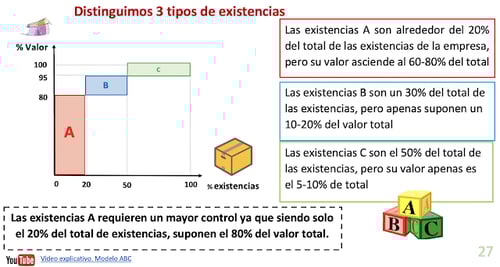 Image source: BP Blog Post
1. Class A
According to the basic storage rules, the A are associated with those products that are most commonly used or that have greater turnover and importance. In addition, the company has invested more in these assets, making them the largest source of cash revenue. It is best to conduct periodic inventory counts to calculate inventory turnover and to know how often we should restock certain products.
2. Class B
This includes products with an average turnover that, although they have a continuous flow On the market, they are less prominent than Class A products. Likewise, on store shelves, they are placed at a mid-level height where they do not occupy the top spots, but they are not completely hidden either.
3. Class C
Although there are a great many of these products, they are the ones that are less common on the market, the ones that customers rarely look for. They are located in the highest or hardest-to-reach areas. That is why they require constant monitoring to ensure they do not become obsolete inventory.
Examples of ABC Inventory Classification
This system is generally used to classify products based on their value within the inventory. Below, we show you Three examples of ABC inventory classification:
1. Example in a retail store
-
-
Category A: high-turnover, high-value products, such as high-end electronics or jewelry.
- Category B: products with moderate turnover and average value, such as brand-name clothing or electronic devices.
-
Category C: low-turnover, lower-value products, such as accessories or seasonal items.
-
2. Example in a manufacturing warehouse
-
-
Category A: raw materials essential to the manufacturing process.
- Category B: secondary materials or less important parts that are still necessary for the process.
-
Category C: materials that are of low value or that are used only occasionally in production.
-
3. Example at a pharmacy
-
-
Category A: High-cost drugs that are in high demand, such as treatments for chronic diseases.
- Category B: drugs with moderate demand and average prices, such as common anti-inflammatory drugs.
-
Category C: cheaper and less commonly prescribed medications, such as treatments for seasonal allergies.
-
In summary, the implementation of the ABC inventory classification It offers significant benefits, as it allows you to stay informed about what is happening in the warehouse and at the commercial printing press.
It might be a little hard to understand at first, so Structuralia offers the opportunity to acquire the necessary knowledge in this field. For example, through the Master's Degree in Agile Methodologies and Digital Transformationl. A great opportunity to enhance our profile and qualify for better job opportunities!