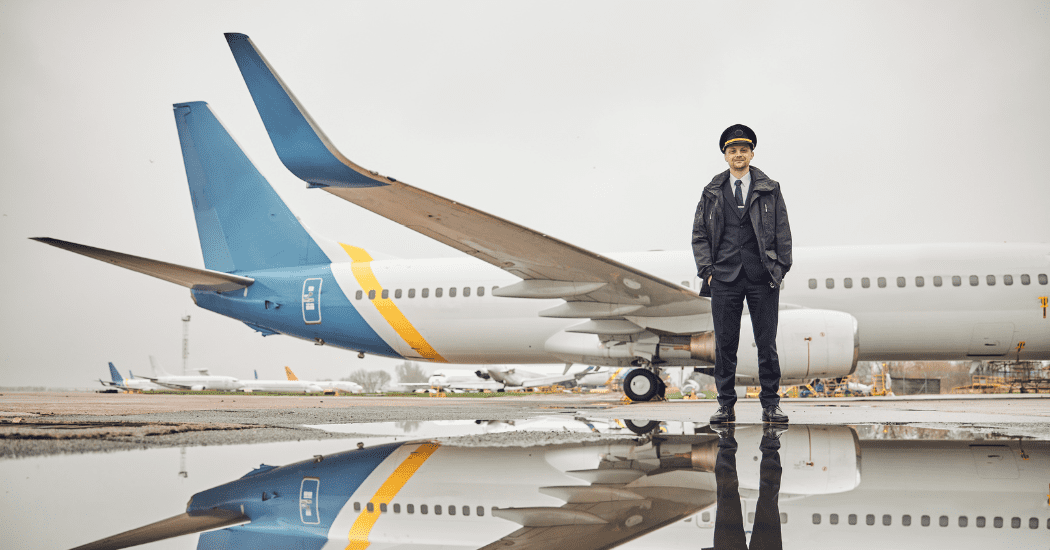
Learn about How an Airplane Works and the various systems that make it possible for us to fly in these huge machines.
How does an airplane work? Have you ever wondered about that?
Since ancient times, humanity has been captivated by the idea of rising above the earth and exploring the vast skies. Over the centuries, this passion has driven tireless efforts to understand and master the complex forces that govern flight, taking us from the dreams of the pioneers to an understanding of How an Airplane Works in the modern era, where they are now a common means of transportation.
From the earliest mythological legends to the bold attempts by the Wright brothers, history has shown us that flight is much more than just a fantasy. As science and technology have advanced, We have succeeded in uncovering the underlying physical principles that enable an airplane to take flight. From aerodynamics to propulsion, aerospace engineering has played a key role in building increasingly efficient and safe aircraft.
The physical and aerodynamic principles that make an airplane fly
An airplane's flight is governed by fundamental physical and aerodynamic principles that allow these majestic machines to soar through the skies with elegance and efficiency. Two of the key concepts are the Bernoulli's principle and Newton's law of action and reaction.
Bernoulli's principle states that When a fluid, such as air, accelerates over a curved surface, the pressure decreases. In the case of an airplane, the aerodynamic shape of the wing causes the air flowing over the wing to travel at a higher speed than the air flowing beneath it. This difference in airflow speed creates a drop in pressure over the wing, resulting in a phenomenon known as lift. Lift is the force that counteracts the weight of the airplane and allows it to stay airborne.
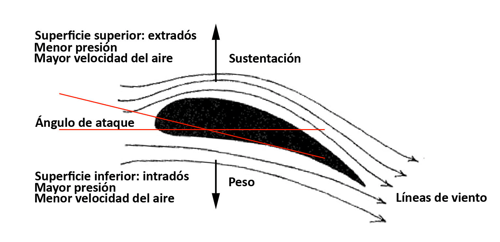
Diagram illustrating the operation of the principle of Bernoulli on the wing of an airplane. Ecos.blogalia.com
Newton's law of action and reaction, also known as the third law of motion, is another key factor in aircraft flight. According to this law, For every action, there is a reaction of equal magnitude but in the opposite direction. In the case of an airplane, the engine drives the propeller blades or the jet of gases backward, generating a forward force. In turn, as a reaction, the airplane experiences a force in the opposite direction, known as thrust. The thrust generated by the engines counteracts drag forces, such as air friction and induced drag, allowing the aircraft to move forward through the air and overcome drag to maintain its speed and altitude. These physical and aerodynamic principles come together in a delicate balance to make aircraft flight possible and give us the ability to explore the skies safely and efficiently.
Parts an airplane needs to fly
For an airplane to fly optimally, it must have a number of essential components. Next, we will explain some of the key components that enable an aircraft to fly.
1. Wings
The wing It is one of the most prominent structures on an airplane; its Its aerodynamic shape and curved profile are designed to generate lift by means of the Bernoulli's principle. Wings are made up of various parts, such as the leading edge, the trailing edge, and the ailerons. The leading edge is the front part of the wing that helps smooth out the incoming airflow, while the edge of the ledgeThis helps maintain a steady flow at the back. The spoilers, located at the wing tips, allow the aircraft to be controlled along the longitudinal and lateral axes, providing stability and maneuverability during flight.
2. Propulsion
The Propulsion System It is another essential component of an airplane's flight; it may consist of piston engines, turbine engines, or jet engines, depending on the type of aircraft. These engines generate the thrust needed to counteract drag and propel the aircraft forward. In addition to the engines, airplanes also have air intake and exhaust systems, such as air intakes and exhaust systems, which are crucial to the performance and efficiency of the propulsion system.
3. Other systems
Other essential elements include the landing gear, which facilitates safe takeoffs and landings; control systems, such as the ailerons, rudder, and elevators, which allow the aircraft to be controlled along its various axes; and the fuselage, which houses the cockpit, cargo, and passengers, and also serves as the aircraft's main structure.
Finally, we must not forget the importance of land-based infrastructure that enable the safe landing and takeoff of aircraft, as well as their maintenance and air traffic management.
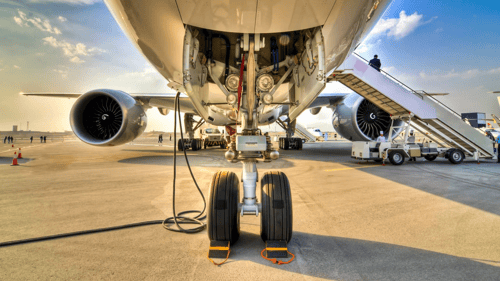
A view of the landing gear on a modern airplane. OneAir.es
Overall, All these parts work in harmony to make it possible for an airplane to fly. Each component plays a crucial role in the the aircraft's performance, stability, and safety, ensuring that it is airworthy efficiently and reliably in the skies. The design and engineering of these parts have evolved over the years to to develop increasingly sophisticated aircraft and capable of meeting the demanding requirements of modern aviation.