Originally published on August 24, 2016; updated on September 8, 2025.
Have you ever stopped to think about what happens to the water when you flush the toilet or when it runs down the shower? The fate of that wastewater is a critical issue in civil and environmental engineering. The sewer system Not only does it handle wastewater disposal, but it also serves as the first line of defense against flooding, protects aquifers, and ensures public health.
In this article, we'll explore what a sewer system is, what it's used for, what its main components are, and what recent advances are transforming its design and management.
What is a sewer system?
One sewer system It is an underground system of pipes, channels, and structures designed to collect, transport, and manage wastewater and stormwater in an urban area. The main objective of this system is to ensure the health and safety of the population by preventing disease, unpleasant odors, and flooding.
As part of the smart cities, the sewer system is being integrated with real-time sensor and control systems, enabling efficient and resilient management in the face of extreme events. This makes the network a strategic component of modern urban infrastructure (examples of smart cities)
What is the purpose of a sewer system?
Its primary function is essential to public health and the environment:
- Sanitation and Public Health: It prevents the accumulation of dirty water and waste, which in turn prevents the spread of disease, the proliferation of pests, and unpleasant odors. It is an essential element in maintaining hygiene in cities.
- Rainwater Drainage: It allows rainwater to drain quickly, preventing flooding on streets and in buildings and protecting infrastructure.
- Efficient Resource Management: Along with other urban solutions, it contributes to the rational use of water and to reducing energy consumption in cities ((key points for promoting efficient consumption).
Components of a sewer system
The collection elements collect wastewater and stormwater and convey them into the sewer system. The following factors must be considered for these elements:
- Service Connections: These are the pipes that connect the drainage systems of buildings (homes, industrial facilities, businesses, etc.) to the public sewer system.
- Sewers and storm drains: These are openings in the street that collect rainwater—that is, surface water that runs along the streets.
- Collectors: These are the largest-diameter pipes that collect water from various sewers and service connections and transport it throughout the city.
- Manholes (or inspection chambers): These are vertical manholes that provide access to the sewer system for inspection and maintenance, making it easier to clean and unclog the pipes.
- Emissaries: These are the large pipes that carry the water collected by the collectors to its final destination, whether it be a wastewater treatment plant or a discharge point into the natural environment.
- Pumping stations: They are used in areas where the slope of the land is not steep enough for water to flow by gravity. These systems pump water to higher elevations so it can continue flowing.
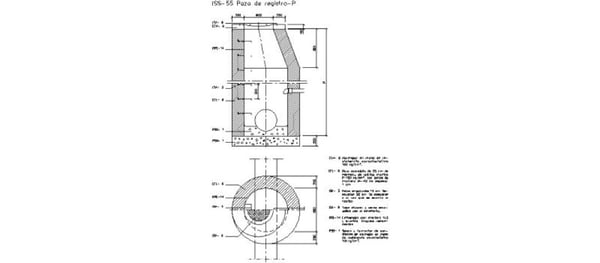
Sewer System: Manhole and Inspection Point
They are manholes, which, in non-accessible sewers, are used to insert cleaning and inspection equipment, and in large-diameter sewers, to access the interior of the sewer system.
They must be equipped with what are known as pates, which are used to climb up and down them, and can be made of different materials; plastic-coated ones are recommended, as they can prevent accidents caused by personnel falling.
Conveying element: linear channels
Transportation elements are linear conduits and are the most important components of the network. These elements are classified as accessible and inaccessible.
- Open to visitors: Their interior dimensions allow one person to pass through, and they generally have vertical walls topped by a fully oval section, although they can also be found in more complex configurations. The smaller ones usually lack a platform, so passengers walk on the floor.
- Not open to the public: A pipe is considered non-accessible when its diameter does not exceed 1.5 meters. These pipes are typically circular in cross-section and consist of prefabricated sections that may be made of different materials and connected by joints.
Special Components in Sewer Systems
These complement the work of the transport elements, enabling them to resolve critical issues, retain and regulate flow rates, and act as operational controls. They are classified as follows:
- Critical points: These are drop structures and “rapids.” They are structures built into the alignment of the collectors that eliminate or reduce the increase in kinetic energy generated within them as a result of having to overcome significant elevation differences, which could cause damage to the structure.
In sections open to the public, rapids are used, while in the tunnel sections, the use of drop shafts is a simpler solution.
- Relief, retention, and regulation: These include spillways, retention basins, and stormwater basins, which are used to regulate and store water flow.
Overflow structures are installed in combined sewer systems and are designed to discharge a significant portion of the flow generated during a storm—exceeding a predetermined threshold—into the natural environment.
Stormwater outfalls are structures whose discharge causes pollution in the receiving environment during storm events. In a modern drainage system, this issue should be gradually addressed through the installation of retention and regulation features. - Control: These are the facilities and equipment used to monitor the network's operation (rain gauges, flow meters, water quality meters, etc.).
- Other items that are part of the networks and are due to special circumstances: pretreatment facilities, pumping stations, discharge chambers, ventilation shafts, etc.