Did you know that railroad construction can be even more sustainable? Here's why.
Railway Infrastructure: The Sustainable Mobility of the Future?
A country's rail infrastructure remains key to its development, starting with the first locomotives invented in the early 19th century, and every day they are getting faster and more efficient. Currently, there are More than 1,300,000 km of railway infrastructure worldwide to connect commercial and tourist routes, and although it may come as a surprise, it is the best option we have for sustainable mobility.
What are railway structures?
When we talk about the railway structures We are referring to all the infrastructure involved in the operation of a country's rail network (stations, bridges, viaducts, tunnels, maintenance and storage facilities, etc.). Generally, the vast majority of these infrastructure projects arestate-owned property, but the construction and maintenance of these railways are carried out by private companies that have the experience and specialized equipment needed to build railway infrastructure.
Some facts about the sustainability of rail infrastructure:
- The current secretary of Ministry of Public Works' Department of Infrastructure, Transportation, and Housing, Pedro Saura, states that in Spain, the transportation sector accounts for the 27% on Greenhouse Gas Emissions. At the same time, the Spanish government proposes to commit to a target of reducing these emissions by 32% by the year 2030.
- According to data provided by Adif (Railway Infrastructure Administrator), a passenger traveling by car consumes 5 times as many equivalent liters of gasoline per kilometer that if you travel the same distance by train, and ceabout 20 times more, if that passenger travels by plane.
- Adif also points out that, in the case of freight, transporting one metric ton by road consumes four times as many liters of gasoline equivalent as transporting it by rail, and 1,380 times as much if the cargo is transported by air.
How can we build rail infrastructure in a sustainable way?
We know that rail transportation itself is the most efficient option, but What about railroad construction?. The focus on other modes of transportation, such as airplanes and cars, has directed all economic efforts toward keeping those other infrastructures up to date, while railway infrastructure has been somewhat neglected. However, in light of new evidence, there are proposals that continue to champion rail and emphasize sustainability to establish it as the preferred mode of sustainable transportation.
1. LIFE HUELLA Project
This project aims to drastically reduce the carbon footprint of railroad construction by involving major companies in the sector in the development of a consolidated assessment methodology within a smart tool. This freely accessible online tool It allows for a detailed environmental assessment of the processes involved in construction and it helps inform decision-making during the planning phase by taking into account environmental impact criteria, beyond purely economic considerations.
2. Barcelona-Sants Station
Adif Alta Velocidad has developed a preliminary design for the expansion and improvement of the Barcelona-Sants station, which calls for the reorganization and transformation of the passenger terminal and the plaza Catalan Countries in Barcelona, which aims to become a model for sustainable mobility at the European level. The project introduces plenty of green space, and it focuses on the user as the central figure, offering a wide range of recreational, cultural, and economic activities that it shares with the rest of the city.
The roof of the new building, which is designed to be highly efficient, in fact will allocate 14,000 m2 of power-generating panels photovoltaic, generating 3.8 GWh/year of renewable energy for self-consumption. And when all measures are taken into account, this station aims to achieve energy savings equivalent to 48% compared to average stations.
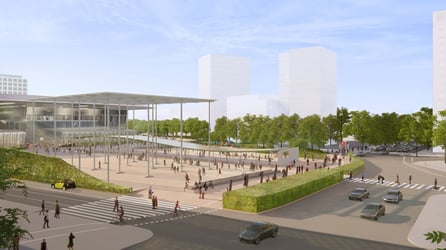 Infographic of the Barcelona-Sants Station project. Adif
Over the past decade The focus is shifting back to the construction of rail infrastructure, despite having taken a back seat for several years, as we mentioned earlier. The benefits of this type of transportation are driving both the European Union and other global organizations to invest in and promote this sector to meet the goals set to reduce our environmental impact in the coming years.
In light of these facts There is a growing demand for professionals specializing in this sector and with even higher quality, to meet the demands of the new—and increasingly sustainable—, railway structures. If you're interested in specializing as an engineer in this sector, Structuralia offers several top-tier professional training options, such as the Master's Degree in the Design, Construction, and Maintenance of Railway Infrastructure and Facilities.