Author: Alejandro López Vidal, Technical Director of ANDECE
The terms «sustainability» and “sustainable development” are mentioned in virtually all activities that affect resource use, energy consumption, or have an impact on the local area. Although “sustainability” is often equated with environmental issues, we must not overlook the fact that Any sustainable approach must also incorporate economic and social aspects. In this context, environmental product declarations (EPDs) are emerging and are increasingly cited in regulations and in public and private specifications for the procurement of construction materials. This is the case in countries such as France, Belgium, and the Netherlands, which are already developing their own national legislation to encourage the use of EPDs. It is estimated that in Europe alone, there are already more than 2,000 EPDs for construction products.
More and more companies decide that they can go beyond strict legal compliance and implement environmental management systems. One of the tools that can be used to improve products is Life Cycle Assessment (LCA), which analyzes all stages of a product’s life cycle—from the extraction and processing of raw materials, through production, marketing, transportation, use, and maintenance, to final disposal when the product reaches the end of its useful life. The sum of all material and energy inputs and waste and emissions outputs constitutes the product’s environmental impact:
- Environmental impact indicators: global warming potential (carbon footprint), stratospheric ozone depletion potential, land and water acidification potential, etc.;
- Resource consumption indicators: use of renewable and/or non-renewable primary energy, net use of tap water, etc.;
- Waste and effluents: disposed hazardous waste, materials for recycling, etc.
The LCA serves as the technical basis for the PAMs, which in turn are developed in accordance with the so-called product category rules (PCRs)—a set of specific rules, requirements, and guidelines for developing PAMs for one or more product categories (for example, precast concrete elements).
It is recommended that the assessment of a construction product or material’s sustainability be conducted within a specific context (construction site or project, geographic area, etc.), covering as many phases of the building’s life cycle as possible, in accordance with the «cradle-to-grave» approach. This is because approximately 80% of a building’s environmental impacts occur during its use phase, while the remaining 20% is distributed among impacts generated during material manufacturing, construction, and those resulting from the building after the end of its useful life.
With this approach, it turns out that some products that one might think are less sustainable actually yield more positive values on environmental indicators when their overall contribution is considered. In the case of concrete products, the industry is aware of the environmental impacts arising from cement manufacturing and, to a lesser extent, from the use of steel; significant progress has been made in recent decades to reduce the environmental burden in these areas. Therefore, the analysis should, whenever possible, cover the entire life cycle of the product or the structure in which it is incorporated. Without this comprehensive view, factors such as maintenance, durability, and energy savings—which, in the case of precast concrete elements, are factors in their favor—cannot be taken into account.
It is worth highlighting the work of the AENOR's Spanish Committee AEN/CTN 127, which is responsible for overseeing standards for precast concrete products and whose technical secretariat is managed by ANDECE, has recently published the document UNE 127757:2016IN, which will serve as a reference model for precast concrete companies that wish to prepare their DAPs and submit this information as required by their customers.
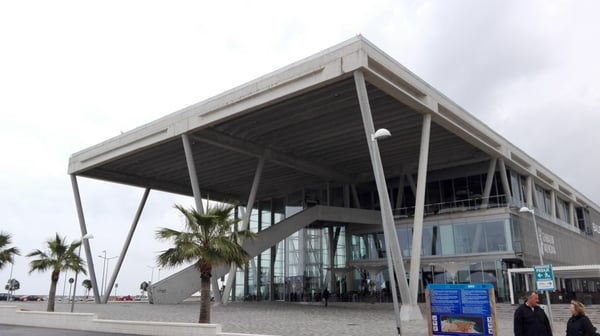
Figure.—Denia (Alicante) Maritime Station. One of the most unique recent projects designed with
prefabricated components high-strength concrete
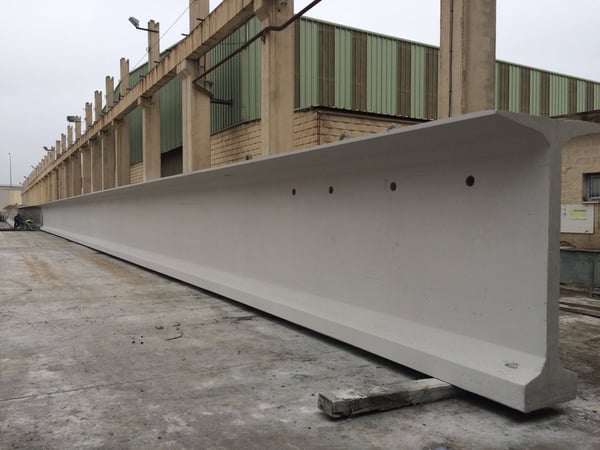
Figure.—A 55-meter-long double-T beam for the new CAMPOFRÍO building in Burgos. This is an example of
technological advances in prefabrication, in terms of design and improvements in materials.
Courtesy of PRECON
This document enables the quantification of the environmental impacts of precast concrete products. An effective way to carry this out is on a sectoral basis; that is, a specific group of companies that manufacture and market certain products with similar functional characteristics (for example, railroad ties) would come together to develop their Environmental Product Declarations (EPDs). These sector-specific DAPs would be particularly useful for engineers during the initial project phase, when it is necessary to assess the environmental impact of a typical product without knowing the exact model or brand. They will also help improve competitiveness by enabling companies to bid on projects certified under environmental assessment systems (such as LEED or BREEAM), which award credits for the use of products with certified EPDs or LCAs, in addition to serving as a marketing and promotional tool in markets or sectors that are more environmentally conscious.
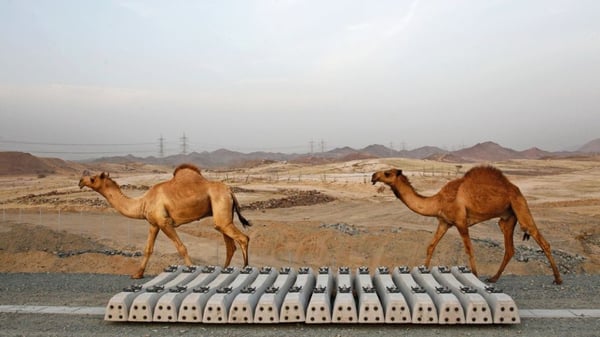
Figure.—Railroad ties stacked and awaiting installation in the largest civil engineering project that
carried out by Spanish companies, Medina–Mecca High-Speed Rail Line. Source: El País
This topic is covered in depth in the course «Specialization in Sustainable Construction with Precast Concrete,» which is part of the International Master's Degree in Construction Solutions Using Precast Concrete in Spanish, organized by STRUCTURALIA and ANDECE.
If you'd like to learn more about this topic, we invite you to join our upcoming webinar, «Environmental Declarations for Precast Concrete Products,» which will take place on April 28 at 4:00 p.m. (UTC +2). Reserve your spot here.