
The difference between a pillar and a column It lies in the aesthetic and structural nature of each one.
Both words are commonly used in architectural and construction jargon in a very casual way, merging both concepts into a single meaning, we are referring to the vertical support element in a portal frame structural system. But the reality is that There is a difference between a pillar and a column as separate architectural elements..
We are talking about two of the oldest elements in architecture, as well as the most primitive definition of a building: a roof supported by two pairs of columns or pillars. And it is precisely from antiquity that the distinction between the words “column” and “pillar” originates, since Nowadays, the distinction between the structural and aesthetic elements is not as significant., because the column has lost the aesthetic significance it once had in classical architecture.
Vertical Elements of Classical Architecture
In this regard, by reviewing the history of architecture, we can clearly identify three terms used to describe architectural elements with similar characteristics:
Column:
A word borrowed from Latin, composed of *culmen* (summit, peak), describing a cylindrical architectural element with a specific function primarily aesthetic. Even so, it can be attached to or cover a structural element.
Pilar:
The etymology of this word, which also comes from Latin, is more closely related to the stacking of various sturdy elements. This gives us a clue that this architectural element is designed to support loads, historically, they are made of materials with high compressive strength, such as stone, brick, or steel. They can take on various shapes or cross-sections: circular, square, rectangular, cruciform, etc.
Pilastra
It is an architectural element that is also often confused with a column or pillar. It is defined as a cylinder embedded in a wall, formerly used for purely aesthetic purposes.
Types of Columns in Antiquity
As we have already mentioned, the column is a fundamental and characteristic element of classical architecture, which reached its peak in the architecture of the Ancient Greece and Roman Architecture, yet it continued to evolve and reinvent itself throughout the various periods of art and architecture. Here are the most well-known variations of the column:
Corinthian columns:
It was a column with a height-to-diameter ratio of 10, whose capital was adorned with acanthus leaves and caulicles, topped by a cornice with corbels.
Doric-style columns:
This column, with a height-to-diameter ratio of no more than 8, had a very simple capital and a frieze decorated with metopes and triglyphs.
Ionic-order columns:
About nine diameters high, it was characterized by a capital adorned with large volutes and denticles on its cornice.
Columns with a composite order:
The capital of these columns features Ionic volutes accompanied by two rows of acanthus leaves, with Corinthian proportions, and finally, the cornice is adorned with dentils and corbels.
 Example of the Corinthian order. Source: artegriego2728
Pillars in Modern Construction
Starting in the 20th century, architecture underwent a drastic change, thanks in part to industrialization and the discovery of new materials. This resulted in a much more utilitarian style of architecture that sought to move away from the symbolic architecture of past centuries, leaving out several elements that aren't very functional like the column.
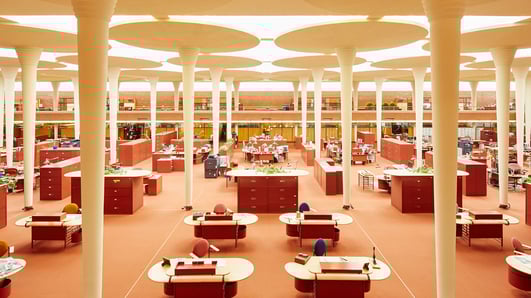 Columns in the Johnson Wax Building by Frank Lloyd Wright, 1936. Source: SC Johnson
That is why, from this point on, The pillar becomes the standard in construction and architecture, since it no longer plays a central aesthetic role in the space. The most influential architects of the era—such as Le Corbusier, Frank Lloyd Wright, and Mies van der Rohe—set aside “ornament“ in architecture; reinforcing the pillar as a vertical support element due to its purely functional nature.
As we have seen, the gradual blurring of the conceptual line separating the two terms is due to a stylistic evolution y Technology in Architecture and in the conventional construction. Contemporary architecture does not use elements that are purely decorative, such as the column in classical architecture, although in some cases it may incorporateSymbolic aspects of ancient columns.