In the International Day of Education, the debate over the value of learning is usually approached from a general perspective. However, for technical professionals, engineers, and architects, the conversation is more specific: What kind of education creates real opportunities today?, has a tangible impact on one's professional career and serves as a catalyst for change and growth in the future.
In this article, we analyze precisely that approach. Based on data from the white paper “The Role of Online Education in Employment Opportunities in Spain and Latin America”, we examine how education has become a tool for building the future, especially in the field of STEM education, where learning is directly linked to employability, the ability to adapt to change, and professional growth.
STEM Education: When Learning Leads to Professional Impact
The STEM education plays a central role in this new scenario. Science, technology, engineering, and mathematics account for a large portion of the demand for education because they are directly linked to the sectors that drive economic growth, innovation, and infrastructure development.
The study's data reflect that real impact: more than 54 % of the students found a new job or got a promotion after completing the training.
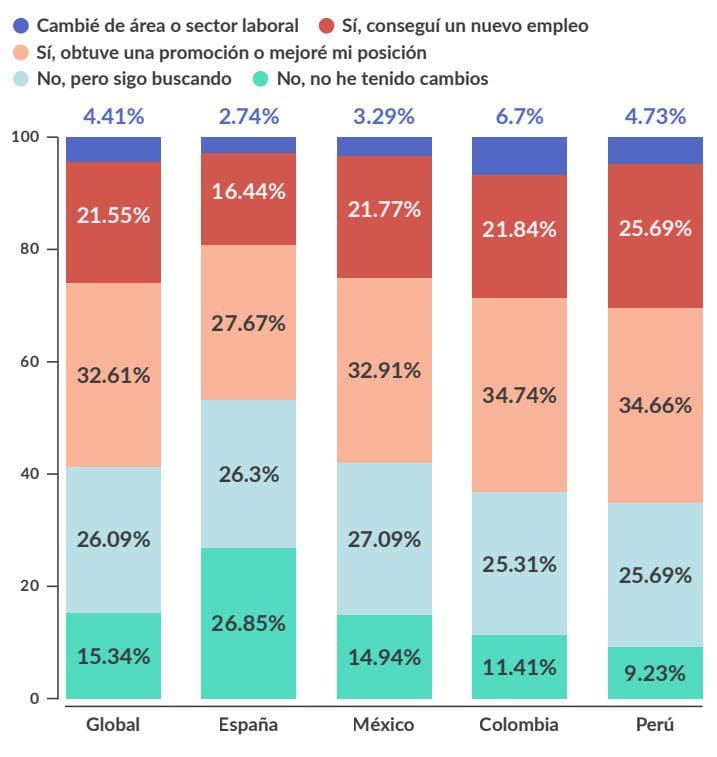
Work-related outcomes following online training.
Source: White Paper “The Role of Online Education in Employment Opportunities in Spain and Latin America”, p. 97.
These figures explain why the STEM careers They serve as a catalyst for career advancement. Technical skills gain value when they translate into the ability to solve complex problems, take on new responsibilities, and make more informed decisions.
Architecture and Education: Learning for an Evolving Job Market
Architecture is a clear example of how education serves as a tool for professional development. The relationship between architecture and education has changed profoundly. Today, study architecture It involves much more than simply acquiring traditional knowledge.
The field of architecture It has expanded into areas such as:
- advanced project management,
- digital environments and BIM,
- sustainability and energy efficiency,
- urban planning and development.
In this context, continuing education is no longer merely a supplement but has become a fundamental component of an architect’s professional career.
Online Education: Flexibility That Delivers Real Impact
The online education It has established itself as an effective model for continuous learning, especially for STEM professionals. The white paper demonstrates that digital training is not only widely accepted but also yields tangible results:
- More than 80 % of the students says their salary has improved since completing their training. Nearly one 28 1Q-3Q achieved wage increases of more than 15 1Q-3Q.
- Most of those who improved their employment situation did so in less than six months after completing the training.
- 81 % would repeat the online training, mainly because of the flexible schedule.
In addition:
- 85.1 % of the institutions believes that online training offers a quality comparable to that of in-person training.
- More than 87 % of employers recognizes online degrees as fully valid.
The online education platforms They thus become a key infrastructure for technical learning, making it possible to integrate training and professional practice without losing touch with the real-world job market.
Creating Real Opportunities Through Training
The analysis leads to a clear conclusion: education has an impact when it brings about transformation. It is not about studying just for the sake of studying, but rather about learning to create concrete opportunities, improve employability, and support professional growth in a changing environment.
From this perspective, Structuralia It views education as a tool for building the future. A technical education that is practical and aligned with the sector’s real needs enables engineers and architects not only to adapt to change but also to actively participate in shaping it.
Because when learning makes an impact, it becomes an opportunity. And today, more than ever, Education creates real opportunities.