Originally published on October 26, 2020; updated on September 28, 2022
Do you know what project implementation is? Discover its phases and its two main methodologies: Project Management and Agile.
Project ManagementProject Execution: Project Management vs. Agile
Project Implementation It's not an easy task, and the truth is that there isn't a single method or tool that is capable of ensure success on its own. What truly increases the chances of success is how well you make use of the tool, so that it adapts to the project's needs. Therefore, throughout this article, we will explore What is project implementation? or what the steps are.
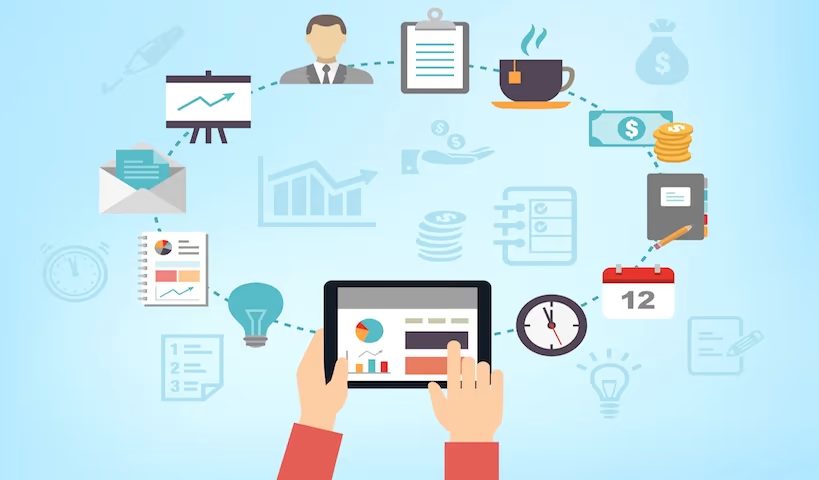 Photo: Wrike
What is project implementation?
Project Implementation refers to the time when they must be carried out all actions and strategies aimed at achieving the ultimate goal of the plan. This phase is one of the four parts into which every project is divided: Start, Planning, Execution, and Closure. For this reason, it can be said that the execution is the most important phase.
Currently, we can summarize the tools for the project implementation into two main methodologies: Project Management and Agile. The first is the most traditional and the most widely used internationally, while the second could be described as “the rising star,” as it has demonstrated significant achievements in the software and technology industry. Before exploring all of their advantages and disadvantages, it’s important to understand the phases of project implementation.
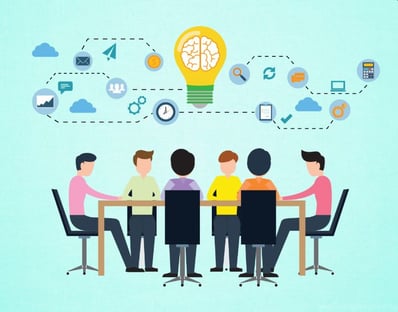 Photo: cio.com.mx
What are the steps involved in carrying out a project?
Now that we know what it is the implementation of a project, let's find out the steps that should be followed:
-
The Beginning. In this first step, the tasks scheduled for the initial phases are initiated, and the workload is distributed among the team members.
- Communication. Establish open communication among the various members and monitor the entire process. The project manager must oversee the project's implementation.
- Follow-up visits. Monitor the process to prevent potential errors through team meetings.
-
Corrections. Implement the necessary changes to correct any errors that may have occurred.
 Photo: Factufacil.es
Project Management
The key to understanding project management The “waterfall” approach is a traditional concept; that is, it is a method that takes a linear approach to project implementation, with a series of clearly defined stages within a project's life cycle. Initiation, planning, execution, and closure are, in that order, the steps a “Project Manager” must follow for any project they are working on faces.
This usually takes the form of checklist where each task that is completed and approved leads to the next, and so on (in a cascade-like manner). This is why it is a methodology in which efforts must be focused on the planning, in the get a head start, and in the documentation that allows you to verify that each step has been completed correctly.
Advantages:
-
- The Objectives They are defined very clearly, as are the steps to follow to meet them.
- Leave a very solid track record of the project, thanks to the documentation.
- A clear layout regarding responsibilities.
- Easy monitoring thanks to its linear structure.
Disadvantages:
-
- High cost of errors in the linear flow of tasks due to inflexibility.
- It depends a lot on the good ability to anticipate problems.
- Low feedback rate regarding the problems that arose during the process.
- Difficulty adapting to unexpected changes.
Agile
Project management with agile methodologies are based on the collaboration, the flexibility, the teamwork and for tasks that are not so clearly defined but are time-bound. This method was developed with the execution of software development projects in mind, where the following are carried out iteratively: “Sprints”which typically last between 2 and 4 weeks; in other words, in this case, it is not the tasks themselves that are defined, but rather their frequency.".
As a result of each Sprint There must be a product that contributes to the successful completion of the project in question. This is why it can be said that, unlike the traditional approach, Project Management, in Agile, a structure is followed nonlinear, which focuses less on planning ahead and more on constantly reviewing the project to adapt it to any unforeseen circumstances.
Advantages
-
- It is permitted flexible prioritization of objectives depending on the needs that arise along the way
- Improve quality regardless of the project's outcome
- A process that is much more transparent and collaborative
- The project participants feel a sense of ownership regarding the outcome
- Good ability to respond to unforeseen events
Disadvantages
-
- Control is lost the larger the project is
- Because of more relaxed communication, there is a risk of losing process data
- High dependence on willpower of the people involved in collaborating
- The relationship between the initial objectives and what the outcome of the project will be
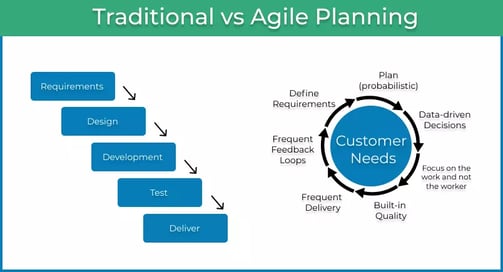 Photo: Kanbanize
Project Implementation: How to Choose Between the Two?
Without a doubt, the Traditional Project Management It is very efficient for large projects that are clearly defined from start to finish, when there is no room for flexibility.lThat said, there are times when the people involved don't need such a relaxed form of communication. And, on the other hand, agile methodologies They handle projects very well that are born into uncertainty, and when there are people willing to get involved in the ongoing and periodic review of the product, but with a medium or short range.
As we said at the beginning, No single methodology can, on its own, guarantee that a project will be completely successful.; what’s truly effective is when the chosen methodology is tailored to the project and the way those involved work. Both methodologies have yielded excellent results, but each in its own way. If you’re interested in specializing in the field of leadership, management, and project implementation Feel free to check out our Master's Degree Catalog in this field.