We'll tell you everything you need to know about the BIM methodology featuring an interesting interview with an expert engineer and architect in the industry in Latin America.
Currently, various methodologies have emerged in the fields of engineering and architecture that are becoming a fundamental pillar of project management; one of the most important is, BIM, Building Information Modeling.
The BIM is a collaborative work methodology for the creation and management of a construction project. Its goal is to centralize all project information in a digital information model created by all project stakeholders.
BIM represents an evolution of traditional drawing-based design systems, as it incorporates geometric (3D), time (4D), cost (5D), environmental (6D), and maintenance (7D) information. The use of BIM extends beyond the design phases, encompassing project execution and spanning the entire life cycle of the building, enabling its management and reducing operating costs.
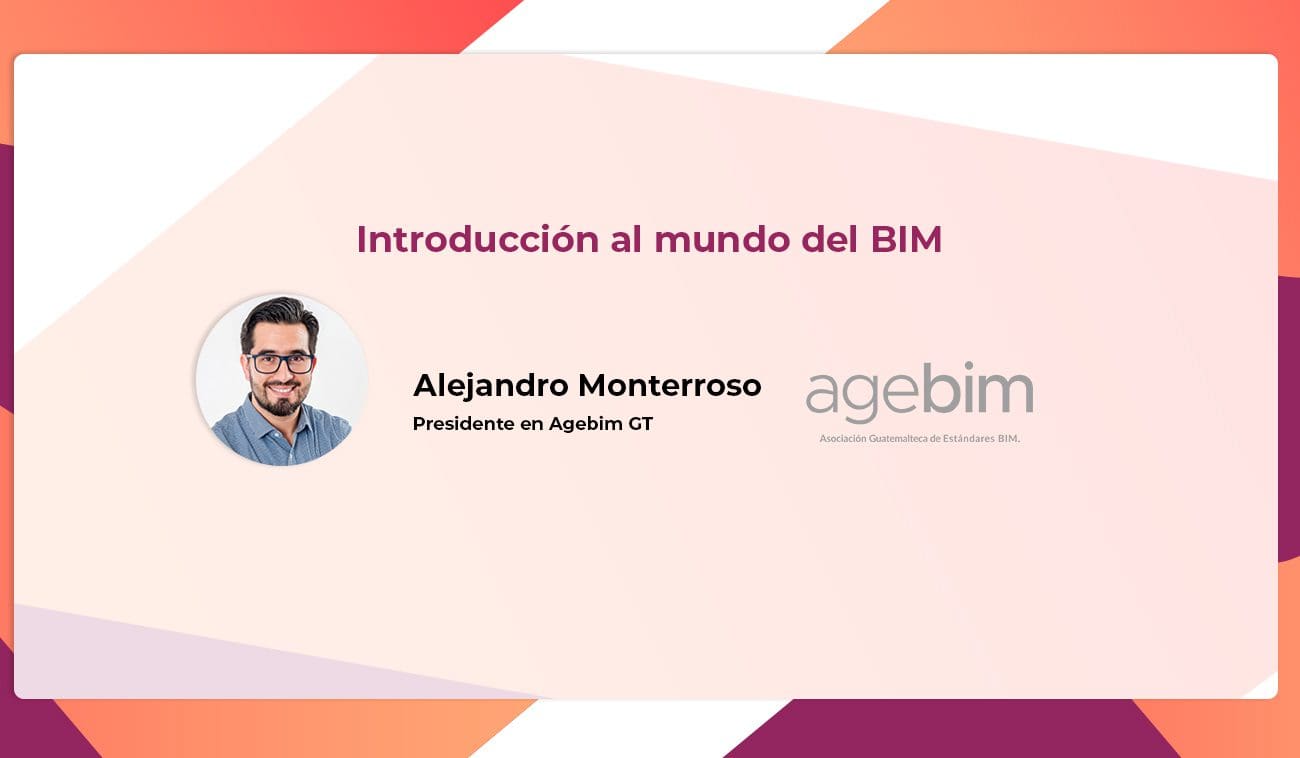
In Structuralia We recognize the importance of these new tools through our various specialized training programs. We also wanted to delve deeper into this fascinating world with an interview with one of Guatemala’s leading BIM experts. We discussed Alejandro Monterroso, General Manager and BIM Director at Danta Architecture, Guatemala; and also, President of the Guatemalan BIM Standards Association, AGEBIM. Here is an interesting interview for you.
Introduction to the World of BIM
1. Tell us a little about yourself and your professional background. Who is Alejandro Monterroso!?

«I am Architect, a college graduate. Founder and owner of Danta Arquitectura, an architecture firm that operates in Guatemala, we have about 1.2 million square meters of vertical construction projects in development. We focus primarily on building buildings and apartments. As part of the culture at the architecture firm where I work, we believe that The application of technology can help improve the way we live and the way we design projects.».
2. How did you get started in the world of BIM? What motivated that decision? What were your first steps?
«As an architecture firm, we were hoping to achieve some results, ensure the quality of the information, and we began to realize that it was taking us too long to review the drawings, check that the floor plans matched the elevations, and verify that the references for a specific detail were on the correct page. And so it was taking us too long to deliver a product that, in our opinion, ensure the quality of the information, That's when we discovered the BIM-enabled drawings y »to extract the information using a model. So we saw a great opportunity to achieve those expected results without having to spend so much time on it, and to focus more on producing and ensuring that the correlation and set of construction drawings were well coordinated and correlated.".
Why? «With drawing programs, all of that is done by hand and with software that supports BIM One of its benefits is that it isn't done by hand. The sheer number of changes requested by customers makes it difficult to manage and ensure the quality of the information. That's when we run into “Revit” in an initial project and We did everything that theory says we shouldn't do. They say you should start with a pilot project and not put too much pressure on the team so they have a chance to learn… but we did everything the other way around; we started with a project, and overnight we said: We're not going to use the drawing program anymore, Now let's start using Revit. Thanks to the fact that we have a very disciplined team that doesn't let adversity and challenges get the better of it, We managed to get the project off the ground, but it was too much stress, too much tension. That's when I realized that if I was going to be in charge of these decisions, I needed to understand more about what BIM was all about.
«After completing this first project, speaking positively, We faced challenges and learned a great deal about how we should do things and the mistakes we made. Because of that, it was important for me to have a clear understanding of what BIM was all about, and that’s how I've decided to pursue a master's degree in BIM, so that I can make the right decisions and lead the team in the right direction.».
About AGEBIM
3. Tell us more about AGEBIM. What do they do? How did AGEBIM come about, and how did you become president of the association? What are AGEBIM’s goals and mission?
«AGEBIM, We are the Guatemalan Association for BIM Standards (AGEBIM), a nonprofit organization dedicated to fostering dialogue among the private and public sectors and academia. AGEBIM’s mission is support the local industry in taking that crucial step toward digitization. We believe there is a lot of misinformation about what BIM is; since much of the communication is handled by software companies, we believe it is important to be able to to be the entity that can offer an opinion on this sector, », that it be an impartial body with no interests other than ensuring that the industry is aware of the various alternatives that exist and what they are used for.".
«In a way, we also want to raise awareness locally about all these companies that are using BIM in Guatemala, It might seem like there are only a few companies, but there are actually quite a few that are doing an excellent job with BIM. So part of this association’s role is to put these companies on the map, so that the local industry realizes this isn’t something that will happen in 10 years—because, in fact, it’s already happening and being executed very well. So that’s the goal, put these companies on the map, on the radar, and raise their profile at the local level, promote greater opportunity»This applies to companies, developers, and owners of innovative projects alike.".
The BIM in Guatemala
4. What is the current status of BIM in Guatemala? What is the state of training for engineers in Guatemala?
«Colleges and universities are making an effort, but they have very little knowledge of the subject—that is, they talk very little or not at all about BIM.". There are currently few universities that offer master's degrees in BIM Management, »They take different approaches; for example, some focus on strategy and technology but are more closely tied to management, while others focus more on skills in using the tools. There is certainly a need to go into greater depth because these are very general master’s programs.".
5. Are engineers and architects in Guatemala interested in learning about or implementing this BIM methodology?
«I think that if there's a lot of interest, what's needed are more and different options. The young people She's very open-minded when it comes to learning new things, but on the other hand, the the old school or the former engineering offices, who hold a significant share of the market aren't as open to the possibility of wanting to learn or implement methodologies differently—that is, they aren't as willing to understand how these methodologies can help bring about change. At the engineer level, some They aren't as open to learning, But all the new people—young people who have just graduated from college—have a a strong interest in learning how they can acquire new skills so they can enter the workforce. What's happening in Guatemala right now is that all the graduates aren't meeting the expectations that companies have for them, so That's where I think there's a great opportunity for anyone who wants to stand out and gain more knowledge«.
«Young people are the ones who are very knowledgeable about technology, since it's much easier for them to learn ita, it's in their DNA, compared to previous generations. So what we need to understand is that Both parts work and complement each other»There are people who have a lot of experience but who, for some reason, find it difficult to apply new tools and technologies; so these individuals can rely on new professionals who pick up new tools very quickly but lack the necessary experience.".
What's needed now is for companies to recognize and understand this what BIM can do for them.
That's why We need institutions like AGEBIM; to serve as a hub for communication and share what’s happening, what challenges we’re facing as an industry, so that people can see there are different alternatives and that we’re striving to be the entity that brings together the various companies so we can all move in the same direction.
One of the biggest challenges is people; it's hard to get people to truly share your vision—that's perhaps one of the most difficult things.
6. What is your view of engineering and architecture in the wake of the current pandemic? Has the pandemic affected this sector, and if so, how? Along this path, What have been the most difficult challenges you've had to face as an association?
«2020 was an unusual year that took all of us by surprise. In AGEBIM We have what we call our "first steps in BIM," which consist of three things:
-
- Have a file naming structure
- Have a system for organizing my information
- And knowing how to share it
Those are The first 3 steps, that we believe exist to begin implementing BIM. We believe that companies that in some way did not have a clear idea of How to Manage Your Information, it was a challenge to figure out how to adapt the way we used to work. Before, it was easy to turn to the person next to you and ask how to solve a problem, come to an agreement, or go straight to the boss, talk it over, and find an answer in five minutes. However, with the pandemic, a a large number of companies that were actually very accustomed to being physically right next to one another, were much more severely affected. I think that something essential for this to work remotely is the the way the team communicates, », you need to find solutions that enable smooth communication and can permeate the entire organization.".
«In Guatemala's local industry, things did come to a standstill; in my case, the 70% was halted across the company's projects, which was a major challenge—we had to figure out how, with the revenue we had generated in the first three months of the year, we would manage to survive until December. »We lived through it and experienced it, and with the few projects that remained, we had to keep working, but we said, 'Let's focus on the good and the positive.'".
«One of the things we realized is that I didn’t question the way we carried out projects—that other companies and engineers could work on projects from home, while we couldn’t communicate effectively to build a building. Before the pandemic, we hadn’t been able to figure that out, but now »Thanks to the pandemic, we've finally figured out that formula—or that way for everyone to do their work from home. Now everyone at our company is 100% working remotely.".
About BIM
7. If you had to explain or define: What is BIM? How would you define it briefly and simply?
«It is a methodology based on people, processes, and technology. »It's one way of doing things.".
8. ¿What have you learned over the years working with BIM?
«What we've learned most of all is that It is a process of continuous improvement, the decision you make at some point to do something a certain way—over time, you realize that there's another, easier way to do it, or that the decision you made at that moment isn't the more efficient«.
«So one of the things we've learned is that applying the BIM methodology is how to enter a cycle of continuous improvement, that you're constantly figuring out what works for you and what doesn't, and you're fine-tuning the processes. That's why I believe that companies or individuals who start implementing BIM today will always have an advantage over someone who began learning BIM five years later; that five-year gap is very difficult to close, Those who start out go through a very steep learning curve marked by trial and error. That experience of making mistakes and improving comes only with time.«.
9. What is the most difficult part of working with BIM? Based on your experience. What are the main challenges or drawbacks when implementing BIM?
«The The difference lies in the interpretation of that data when applying a BIM methodology, since allows you to make better decisions, »The fact is that the information is generated from three-dimensional databases. Since you have these three-dimensional databases, it's important that they be organized so you can use that data—extract it, filter it, and find what you need.".
«If the model is just a model and isn't organized at the data level, it will serve the purpose of You can provide a set of drawings, but you won't be able to extract or quantify information such as construction volumes, link the model to a program, develop a budget, or perform an analysis. There are many things you can do with the data, but only if it is organized. Ultimately, the amount of information or data that we can provide at the architectural firm level enables project owners to make better decisions, because sbased on informed, data-driven decisions rather than hunches. »That's the main advantage.".
«What creates value is that it's possible to eliminate the interpretation factor, when you use a drafting program, you have two lines and you have to figure out what they are—beams, their length (x), and so on. You gather information from all over and put together a puzzle, which obviously not everyone is equally capable of putting together correctly. So, an architect will surely interpret one thing, a hydraulic engineer another, and a builder yet another—and that’s where, with BIM: The Interpretation Factor Is Eliminated, because there's nothing left for him to interpret »Thanks to the data and information provided by the system, this streamlines communication and makes it possible to identify potential problems on the job site at a much earlier stage.".
«I believe there are many advantages to using this methodology for all the parties involved—not only architects, but also engineers, contractors, and, of course, property owners—since they gain a better understanding of the decisions being made and the reasons behind them.».
10. What competitive advantages do you think BIM can bring to an architecture firm? How do you think you can help the firm achieve this competitive edge over other firms?
«The hardest part is being organized, consistent, and coherent with the strategy you have, to keep going and achieve the result you're hoping for. That part about being consistent—how you need to do things. Another is to have humility ne»It takes humility to acknowledge that we don't always make the best decisions; we have to be very attentive or constantly evaluate whether what we've decided works, and if we're not getting the expected results, be able to say, 'This isn't working, so let's change the way we do it.'".
11. Viewed as an investment. There is talk that The investment pays for itself very quickly. What do you think about this? Is that really the case?
«It's relative, A large part of the implementation depends largely on the team, on the team's ability to apply new knowledge to all the processes they already know how to carry out; this process of adaptability is important because, in a way, it involves learning to do something you're supposed to already know how to do, but in a different way. This is what can tip the scales in favor of the implementation being successful or not. »It is definitely the people who make the implementation a success.".
«I also think that another important factor is the the role of the director or the board of directors, they need to understand that when BIM is implemented There is a learning curve »And there comes a time when people are learning; they're going to make mistakes, and the pace at which they produce information definitely won't be the same as it was before because they're learning to do something new. So it's important that they're involved and on board with the plan and strategy.".
12. Engineers are expected to think critically and think outside the box. How can they develop these skills? Do you think BIM is a tool that can help them achieve this?
«Implementing BIM is the language we all need to communicate effectively. Apply these methodologies allows us to eliminate the interpretation factor, »which, in a way, brings us all on the same page. I think it's very valuable for engineers to be able to understand what it's all about and how they can best design their solutions.".
The Future of BIM
13. What are the most significant challenges facing engineering and architecture professionals today? In these rapidly changing times, How can an engineer or architect reinvent themselves to make a difference?
«The greatest professional challenge for professionals is to have the ability to learn and unlearn, because as technology advances and we have to learn how to use new tools, The way architecture and engineering are practiced has changed, »Because the tools we used to have available have changed—and continue to change as technology advances—the way we calculate, design, and carry out projects has been evolving. We now have new tools, and there will be even more in the future that will allow us to analyze more data, which will enable us to make better decisions.".
«The ability to learn or the attitude of always wanting to be at the forefront»This is one of the biggest challenges—or opportunities—facing new professionals. Things are moving too fast, and it's too important for them to be able to learn.".
14. For people who are interested in specializing and continuing their training in BIM. Would you recommend studying BIM, and why?
«Of course, BIM isn't the future—it's happening today »And I think you don't have to wait long to do it, since it's so fast. It's definitely an advantage, and I highly recommend it.".
15. To wrap things up, tell us. What do you think the future holds for us with the implementation of BIM? Where does the future lie?
«For now, most companies are focusing on figuring out how to implement BIM; in other words, most companies are currently looking into how they implement these BIM methodologies within their processes, However, I believe that if any of these companies manages to implement all of these methodologies into their processes, the future is already here and will continue to be the data, that we can obtain based on three-dimensional data, and it really comes down to how we're going to use that data, how we're going to interpret it, and cHow this data will help guide us in making better decisions. ». I think that's the future—what are you going to do with all that data?".
Don't want to miss a single detail of this incredible interview? We'll be posting a short video on our YouTube channel soon, along with our new section «Structuralia Talks«.