Originally published on July 15, 2019, Updated on September 26, 2024.
The project of the Central Bioceanic Railway Corridor In Latin America, this represents a major step forward for the region in a sustainable way.
The Central Bioceanic Railway Corridor in Latin America
In the World Oceans Day, celebrated every June 8, we take time to reflect on the vital importance of these bodies of water that cover much of our planet. They are home to an incredible diversity of life and play a crucial role in regulating the climate and providing a livelihood for millions of people around the world. In this context, it is imperative to highlight the fundamental role of infrastructure that connects continents, in particular, the Central Bioceanic Railway Corridor, a mega-infrastructure project that not only represents a step forward in the economic and social integration of the regions it passes through, but also offers a model of sustainable development that respects and protects our marine and terrestrial environments.
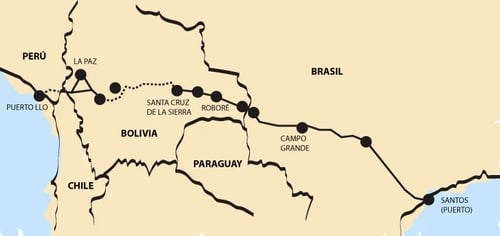 Route of the Central Bioceanic Railway Corridor. Abi Bo
The Central Bioceanic Railway Corridor
The Panama Canal marked a historic milestone for both the engineering, due to the challenge posed by its construction, as well as for the commerce, by reducing shipping time through the Atlantic Ocean to the Pacific Ocean, thereby avoiding the need to sail around South America. The Central Bioceanic Railway Corridor It aims to achieve the same goal, but in this case via land, since its construction is intended to reduce transit time and increase efficiency in the transport of goods, facilitating trade between Latin American countries and the rest of the world and, as a result, improving their economy.
Negotiations regarding the implementation of the project between Peru, Bolivia, and Brazil are well underway, and once a consensus is reached among the various countries, the international public call for proposals for the design and construction of the project.
Project Characteristics
Although the project in question does not yet have a final design, it is initially estimated that it would consist of a railroad line with a length of 3,755 kilometers, broken down as follows: 340 km in Peru, 1,894 km in Bolivia, and 1,521 km in Brazil. Once construction is complete, The Bioceanic Railway would connect Puerto Santos, located in Brazil, with the Port of Ilo in Peru, transporting more than 10 million metric tons of freight per year and more than 6 million passengers.
It should be noted that Paraguay wants to take part in this megaproject by building a route of about 500 km which will connect the Carmelo Peralta district, part of the Alto Paraguay department, with the city of Roboré in Bolivia, through which the Bioceanic Railway is expected to pass.
In Search of Foreign Funding
One of the main challenges that has arisen in carrying out this ambitious project has been the significant financial cost involved in its construction. The required investment would be between 10,000 and 15,000 million dollars, which makes it necessary to turn to foreign investors to carry it out.
In this regard, several countries have expressed interest in investing in the project, such as a private Swiss-German, Spanish, Italian, or Russian consortium. However, in the most recent stages of the negotiations, interest in has surged China, which initially ruled out participating in the project due to its high cost, estimated at $60 billion.
However, now that the initial investment required to build it has been significantly reduced, China has shown great interest in the Bioceanic Railway because it is the main destination for Brazil’s exports, and once it is put into service, it will would reduce the time required to transport raw materials by 25 days between the two countries.
What is holding up construction of the Central Bioceanic Railway Corridor?
Although the Central Bioceanic Railway Corridor promises a number of economic and social benefits, It is not without its challenges and controversies. Among the main drawbacks are the environmental and social challenges associated with building the railroad through sensitive areas, such as tropical rainforests and habitats of endangered species. In addition, securing funding and coordinating efforts among the countries involved can be difficult. As for the latest news, We are pleased to report that progress on the project continues, although at a varying pace due to the challenges mentioned above. Efforts have been made to address environmental and social concerns, but debates persist regarding the project's feasibility and long-term impact.
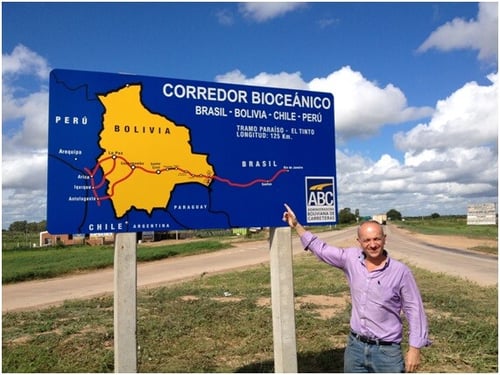 Signs marking the start of construction for the Central Bioceanic Railway Corridor. JulianSastre
In conclusion, it is crucial that we tackle projects such as the Central Bioceanic Railway Corridor with seriousness and consideration, recognizing both its potential benefits and its challenges. It is essential that, within the framework of the World Oceans Day, let us highlight the importance of these infrastructures and commit to ensuring that they are developed in a sustainable manner that respects our marine and terrestrial environments. By doing so, we not only promote the economic and social integration, but we also contribute to the preservation and protection of our oceans, ensuring a more prosperous and equitable future for generations to come.
If you're passionate about the world of railroads and want to be part of major projects like this one in the future, you can specialize with our Master's Degree in the Design, Construction, and Maintenance of Infrastructure and Facilities for Railroad Lines with which you'll learn everything you need to know.