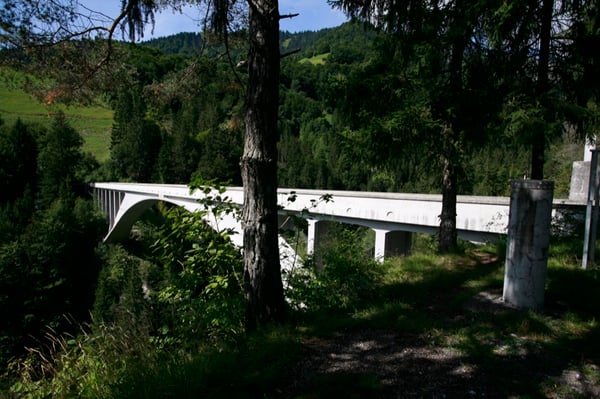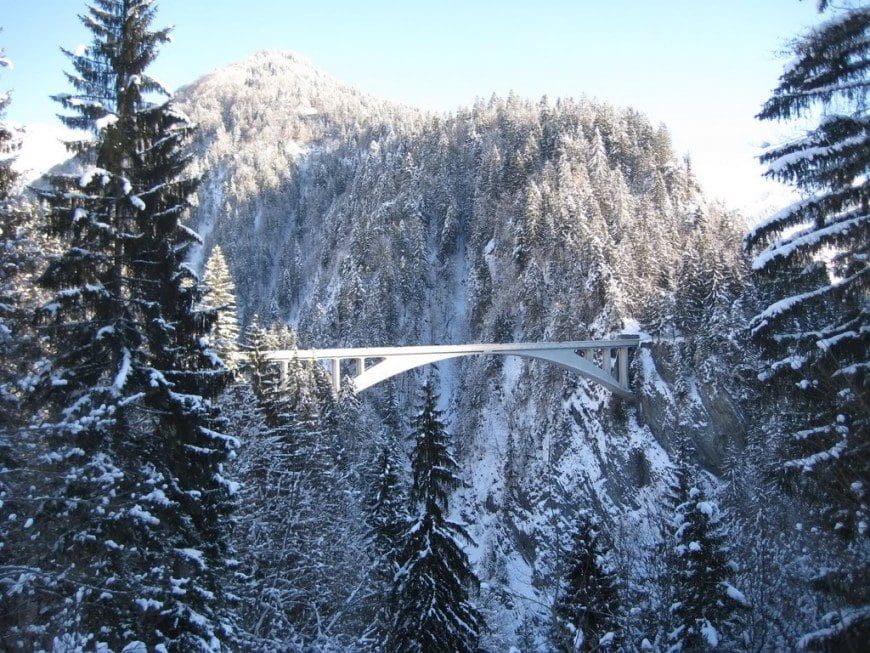
The year is 1929, and we are in the Alpine valley between Schiers and Schuders, Switzerland. This would be the iconic setting for what would go on to be recognized as one of the world’s greatest engineering marvels. We are talking about the Salginatobel Bridge, designed by engineer Robert Maillart.
It combines in a single structure all the aesthetic qualities a bridge can embody, and its integration into the surrounding environment reflects a level of refinement never before seen in this type of infrastructure. Indeed, it is no surprise that the ASCE (American Society of Civil Engineers) declared it International Historic Civil Engineering Landmark in 1991.
Structurally, it is a very slender arch bridge with an upper deck, 132 meters long. It is perhaps the most notable of the bridges built with hreinforced concrete. Much of its originality lies in the triarticulation supported by ball-and-socket joints at the abutments and at the keystone of the arch, where the two half-vaults meet as they extend into the void.
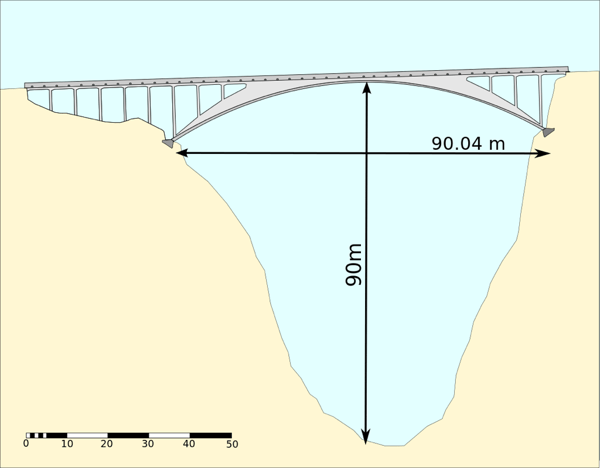
The clean lines of its design, combined with the tranquility that surrounds it, make this a unique setting where the dynamism The structure's design is immediately apparent to visitors.
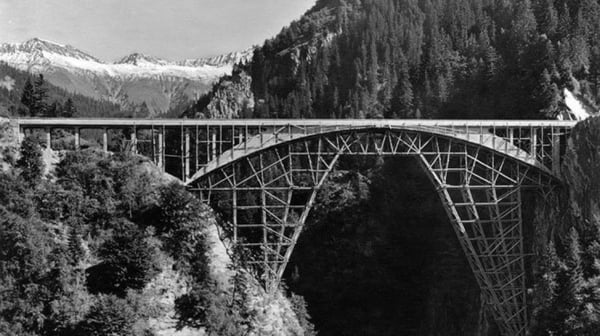
Special mention should be made of the wooden formwork which made the construction of the bridge possible—a masterpiece overshadowed by the beauty of the bridge it supported.
We’ll leave you with a quote from Maillart himself, which helps us understand the concept of reinforced concrete reflected in his works:
«Reinforced concrete does not grow like wood, is not rolled like steel, nor does it have joints like masonry; rather, as a material poured into molds, it could be compared to casting, whose distinctive forms—born of long experience—could teach us a great deal about how to transition from one structural element to another in a progressive and continuous manner, avoiding any angular breaks. It is this holistic vision, integrating the parts into the whole, that defines the beauty of the forms.»