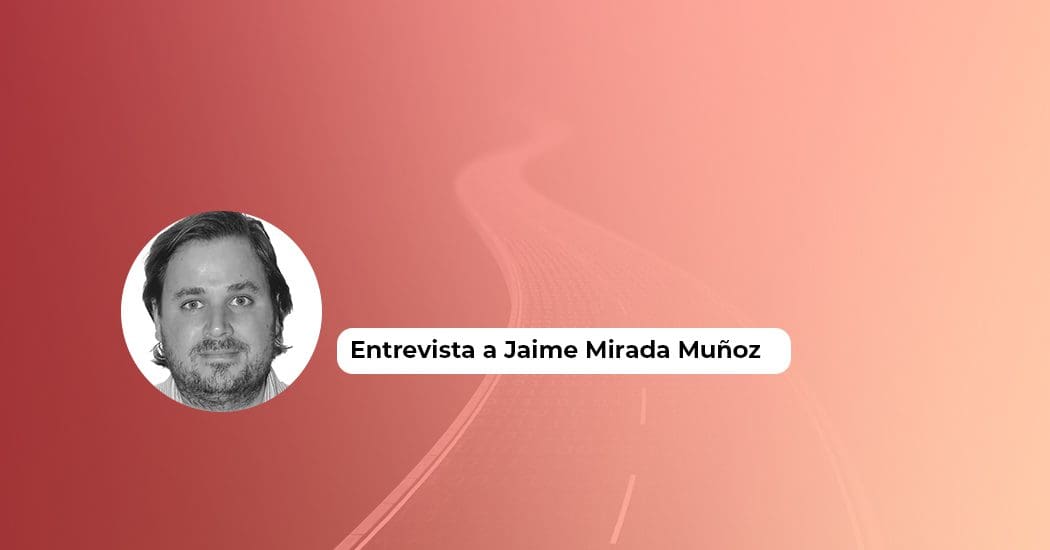
Interview: Every challenge is an opportunity to leave a lasting mark on the railway world and the profession of Completion Engineer.
We delve into the vibrant world of civil engineering, road maintenance, and the railway industry through the eyes and experience of a passionate industry leader. In an insightful conversation, we’ve had the privilege of immersing ourselves in the fascinating journey from Jaime Mirada Muñoz, a distinguished alumnus of the Master's Degree in Highway Maintenance and Road Engineering, as well as an enthusiastic participant in the courses offered by the corporate training platform Pharos, from Structuralia.
Interview: Exploring the Path to Success as a Completion Engineer
A deep and inspiring interview in which we uncover the secrets behind success as a Completion Engineer, exploring the tireless dedication that has led him to become a leader in his field. Join us on this journey where experience and passion take on a global scope and become the canvas for engineering, where every challenge is an opportunity to leave a lasting mark on the landscape of rail infrastructure.
Based on your experience… Could you briefly tell us about your professional background? In what industry have you worked, and what have been your main roles and achievements?
«I am Civil Engineer from Alfonso X el Sabio University in Madrid. Since 2017, I have been working at Norway. During my time in Norway, I worked for the Spanish company for almost five years OHLA, then, a little over a year at an Italian joint venture called SA.PI.NOR and since August 2023, I have been working at the state-owned company head of the Norwegian railway infrastructure agency Bane NOR SF. The main industry I have worked in is the railroad industry. I have worked both as a geotechnical engineer and as Completion Engineer.
My greatest achievement has been growing as an engineer and as a person, especially because I've always been surrounded by great professionals who have taken the time to teach me and help me gain experience.»
You currently work at Bane NOR SF, a company in the rail industry… Can you highlight any particular experience or project in which you've applied your expertise?
«The project I'm currently working on is in Moss, about 60 km south of Oslo. The project is the construction of a new double-track railway line called Sandbukta-Moss-Såstad. It is approximately 10 km long. Although the master's program I completed with Structuralia focuses on the field of highways (MMaster's Degree in Conservation and Highway Engineering), since railway projects are linear in nature, they share many similarities with highway projects.
.jpg) There are two initiatives I'd like to highlight. The first, which we are currently implementing, is the construction of hundreds of cJet Grouting Columns as a technique for reinforcing and improving the ground. The master's program devotes one of its modules to slope stability, and within it, this technique is thoroughly described and illustrated with real-world examples from other projects.
There are two initiatives I'd like to highlight. The first, which we are currently implementing, is the construction of hundreds of cJet Grouting Columns as a technique for reinforcing and improving the ground. The master's program devotes one of its modules to slope stability, and within it, this technique is thoroughly described and illustrated with real-world examples from other projects.
The second point I want to highlight is that, despite being in different countries and involving different fields (roads and railroads), There are very similar approaches to operation and maintenance. EThe master's program devotes a module to the Organization of Maintenance, which covers GSM (Systematic Maintenance Management). One of the activities of GSM is to take inventory of all the components of a highway. As “Completion Engineer” »It's one of the tasks I also have to carry out: taking inventory of all the components of the rail project so that, once everything is finished, all this information can be used for its operation and maintenance. In my case, the rail infrastructure registry is called Maximo (BaneData)."
What do you consider to be the biggest challenges as a “Completion Engineer,” and how have you addressed or overcome these challenges throughout your professional career?
«I feel very fortunate to be able to work as a “Completion Engineer.”. This profession allows you to see every single element of the project, and everything must be perfectly executed, identified, and documented. And this is where one of the biggest challenges arises. This requires you to be in constant contact and collaboration with all departments; for example, with the Department of Engineering to ensure that all elements have been identified and classified, with the Construction department to ensure that everything has been executed in accordance with the design and the various procedures, conducting joint pre-inspections to identify any outstanding tasks or areas requiring improvement, followed by final inspections once everything is completed and ready to be handed over to the client for a portion of the project.
Also, with the Quality Department to ensure that all tests have been performed and that the documentation is accurate and available.
And finally, with the Cost Department in order to complete the certification. Therefore, it’s a challenge because it requires you to keep many things in mind at the same time and to understand various disciplines (hydraulics, geotechnical engineering, structural engineering, electrical engineering, etc.).
Therefore, It's a challenge to get everything done on time and with the highest possible quality. To overcome this challenge, I believe there have been three key factors: the first has been to work hard and always help out as much as possible. Second, keeping in mind that each department has its own schedule and deadlines; I think it has helped me a lot to always ask for things in the best possible way and to be empathetic toward everyone’s workload. Finally, I believe the third key factor was having studied Civil Engineering and to be constantly learning. This education provides you with a broad overview of all civil engineering disciplines and thus helps you gain a better understanding of each of these activities.«
What skills and knowledge do you consider most important for success as a “Completion Engineer,” and how have you continued to develop them throughout your career?
«As Engineer Víctor Yepes said in an article, The secret to success lies in the following five points:
1. Maintain a child's curiosity
2. Surround yourself with people who are better than you
3. Be generous in sharing knowledge
4. Work really hard and
5. Enjoy what you do.
 And these five points are the ones I try to put into practice in my daily life. Maintaining a childlike curiosity makes me want to keep learning and growing every day. Being surrounded by colleagues who are better than you means you can learn an incredible amount from them. Being generous in sharing knowledge has always led me to try to pass on everything I’ve learned—for example, when I’ve been mentoring someone or when a new colleague has joined the department. Working really hard is one of the most rewarding things there is, because it allows you to truly appreciate the work you’ve done. And to enjoy what you do.
In my case, I've been incredibly lucky that my family showed me some amazing things about this profession when I was a kid. Then in college, seeing some teachers who taught with such passion It has made me fall even more in love with this profession. All of this, combined with a positive attitude, has allowed me to grow as an engineer and to enjoy this profession, even when there have been difficult moments.«
In the field of Highway Maintenance and Operations Engineering, sustainability and efficiency are critical issues… How do you incorporate these principles into your approach to work, and how do they influence the decisions you make during a project?
«The idea of trying is always on our minds to improve every day, both in terms of sustainability and efficiency. These two factors provide significant added value. Furthermore, they can contribute significantly to better results and lower costs due to their greater efficiency. To achieve this, each and every one of us must, first and foremost, be aware of the guidelines and regulations currently in force, especially those ratified under the 2015 Paris Agreement.
Second, be aware of which construction techniques are the most sustainable and efficient given the significant impact they have. For example, with the project we are currently carrying out, Jet Grouting Columns have a significant climate impact due to their substantial consumption of water and cement, since this binder has a carbon footprint ranging from 600 to 1,000 kg of CO2 per kg of binder. Fortunately, Norway is investing in projects and research aimed at reducing the carbon footprint, such as the comprehensive research being conducted by the Norwegian Geotechnical Institute (NGI) in collaboration with the Norwegian University of Science and Technology (NTNU) and other partners, with financial support from the Research Council of Norway (RCN). As a “Completion Engineer,” I always try to share this information with the Site Engineers, since they have greater authority and decision-making power over the work being carried out on-site.«
When you gained access to the PHAROS OHLA platform… What motivated you to start your continuing education?
«I remember perfectly when the head of HR sent the email with the entire catalog of courses available on PHAROS for all OHLA employees. It was a very pleasant surprise for me to see all the training opportunities available that were within my reach.
.jpg) There were three factors that particularly motivated me; the first is the one I mentioned earlier. I have a childlike curiosity, and one of the wonderful things about this profession is that it requires you to be constantly learning, keeping up with the new technologies and techniques that are constantly emerging.
There were three factors that particularly motivated me; the first is the one I mentioned earlier. I have a childlike curiosity, and one of the wonderful things about this profession is that it requires you to be constantly learning, keeping up with the new technologies and techniques that are constantly emerging.
Second, at that time, OHLA was bidding quite aggressively for several highway projects and Having additional training in road construction was a plus for me.
The third factor, which the cost of all this training was run by OHLA. That says a lot about This company knows that its greatest asset is its employees and that offering them this training can only yield benefits for both the company and the employees.
Why would you recommend studying with the Pharos platform for businesses? Can you mention some highlights from your experience regarding the quality of education, the content, or the course approach?
«In my case, there was one thing that set me apart. All the training in PHAROS is designed for working professionals. In other words, it is a training program that is fully compatible with one's professional activities. When you have a career and a family, your free time is quite limited. In my case, I tried to study every day that I had some energy left, and always after putting my daughter to bed.
When I started my training, I chose three courses related to roads (which, as it turned out, were part of the Master’s Degree in Road Maintenance and Operations Engineering). There are several points worth noting; first of all, All of the available documentation was perfectly organized, structured, and, for the most part, up to date.
Second, everyone The modules included presentations that summarized the information, making them very easy to follow.
And finally, the exams at the end of each topic. In my case, reaching this point was an extra source of motivation, since it allowed me to see to what extent I had been able to apply what I had learned.«
In your case, you had part of your training at Pharos recognized as courses toward a Structuralia master’s degree… What motivated you to take the plunge and complete the Master's Degree in Highway Conservation and Operations Engineering?
«As I mentioned earlier, it was by chance that the courses I had chosen in the OHLA training program, be part of the Master's Program in Highway Maintenance and Operations Engineering.
There were three things that encouraged me to take the remaining courses and earn my degree. The first was asking my father, since there was also another master's program available that was more focused on the construction side. For some reason, we found the conservation program more appealing and perhaps a little more comprehensive.
The second, I hope to return to Spain someday, Although it's quite difficult at the moment. Norway has a very ambitious infrastructure plan, and that means endless career opportunities. Plus, Norway offers so many advantages, both socially and professionally, which makes it even harder to return. But If I could go back to Spain, I'd be incredibly interested in working as the COEX Director and I've noticed that, in all job postings related to Highway Maintenance and Operations, Having this degree is practically mandatory.
And third, the things that motivated me to finish the master's program were the support I received from Structuralia as for the timeline for finishing it, since, as I mentioned earlier, I had limited free time.
And finally… What advice would you give to current students or those considering a career in your field? What do you think are the main challenges they face?
«To the future engineers who are currently studying, I would congratulate them and tell them that, even though the road ahead is long, it will be worth it.
To those who are thinking about it, all I can say is that This profession is wonderful, and I'm lucky to be able to practice it. Civil engineers have a hand in everything you see, even something as ordinary as turning on a light or going to work. It’s a very rewarding profession because civil engineers are dedicated to serving people.
As for the master's program, it is Excellent training adds value to each person's professional profile and allows for a deeper understanding of many topics related to road safety.
There’s a quote from the master’s program that I really loved: «Roads are a vital part of a country’s heritage, and therefore that heritage must be preserved.» One of the main challenges we face, especially in this profession, is finding a career opportunity where you can grow as an engineer. This often means you have to look for these opportunities outside your home country. Although it can be scary to step outside your comfort zone, this profession allows you to work in places you never would have imagined. I have colleagues and friends all over the world, such as Canada, Panama, Chile, Argentina, Sweden, the Czech Republic, Slovenia, South Africa, Saudi Arabia, and Australia. And the experience of working abroad can be incredible, but it can also be a huge challenge.»
From Structuralia, we would like to thank our former student from the Master's Degree in Highway Maintenance and Road Engineering, Jaime Mirada Muñoz. In this interview, he conveys the immense passion one can have for one’s profession and for the work one does every day, where ongoing training becomes a key factor in making a difference in the workplace. He offers incredible expert insight and professional experience on an international scale. We encourage you to comment on this interview!