The connectivity provided by the maritime and port sector It is one of the most significant, sustainable, and essential technologies for the industry today., Doctor of Civil Engineering; and current Director of the International Master's Degree in Port Infrastructure (Ports) on Structuralia.
Could you briefly tell us about your current job and your career path?
«I have been a professor of port engineering for 45 years, a career I have combined with running a small business in port engineering which is now under my children's command.
At the time, I was part of a research group at the Polytechnic University of Madrid, where I worked alongside highly talented doctoral students. To ensure that this talent wasn't wasted, and as a natural progression, I founded a port engineering firm.
The company has evolved in two key areas: the port asset management, specifically marine terminals and berths for superyachts, and the institutional representation of investors in the Spanish port system.
»So, I started out as a professor and researcher at a company specializing in engineering studies that operated under the umbrella of the research group, and later moved on to port asset management and representative duties."
Why did you decide to complement your extensive career with teaching? What does it bring you?
«As a student, I was always interested in the ports. I studied civil engineering, but I always say that I'm just a port engineer.
My family has always been closely connected to the world of merchant marine. My great-uncle was the director of the nautical school in Bilbao, and it was always said that the life of a merchant seaman was exciting when you were young, but as you get older and start a family, merchant seamen aspire to a position on land.
He always said that the ones with secure jobs on land are the civil engineers who serve as port directors.
However, when I enrolled as a student in the engineering program, my passion for ports was strong, and I ended up working under the then-professor of port engineering and got “hooked” on it.
It wasn't that I had a calling to teach per se; rather, I entered that field under very specific circumstances: at that time, the entire port system was trained in a single location.
The division we see today between the scientific and technical fields has its origins in the ministries responsible for each of these areas: teaching remained within the purview of the Ministry of Education, while research fell under the jurisdiction of the Ministry of Public Works.
Although this split did not have any immediate consequences at first, in the long run, they have been (in my opinion) negative. Today, research needs new blood, while students need labs where they can engage with the real world.
As time has passed and teams have changed, the branches have become increasingly separate, forming two disjoint “groups.” There was an attempt by the research groups to bring teaching and research back together, but once their training is complete, doctoral students specialize, and after that it’s difficult to find career opportunities. That’s why I decided to create the port engineering company I mentioned.».
How do you view the current situation in the maritime and port sector?
«We're in a very complicated situation. The pandemic has turned many things upside down, from the closure of airports and ports to the fact that many crews were unable to be replaced, which forced many of them to work beyond human limits.
In addition, eThe world of maritime transport is a highly globalized one, with very strict price adjustments and optimal use of resources. We can say that the supply chain broke down, and we are still experiencing some significant disruptions.
In certain sectors, there have been instances of shortage and an approach has been put on the table that is completely opposed to globalization, the autarky.
In other cases, we're taking a step backward, since we have to ensure self-sufficiency before considering exports, which has highlighted the how fragile the supply chain is overall.
In other words, in a global system where everything is pushed to the limit, everything works well as long as there are no problems. But a breakdown in the chain has tremendous consequences—for example, in the supply of grain for animal feed. The grain shortage also affects fish farming, and so on.
For all these reasons, we find ourselves in a very difficult situation, with a significant price increase, with production lines that have not yet fully recovered and a widespread effort that has put the system under strain«.
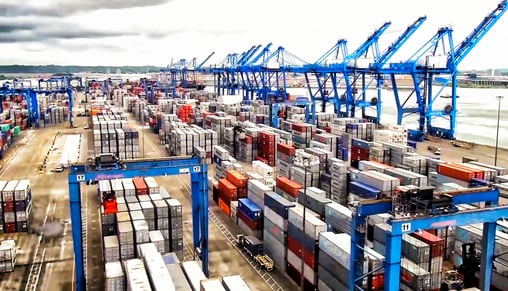
The cost overruns and supply shortages caused by the pandemic have shown that perhaps the supply chain isn't as strong as we thought… What do you think?
«As I mentioned earlier, the supply chain was too perfect—it was very finely tuned. It had an excellent cost-optimization system.
The lack of safety margins has meant that any disruption has caused major problems, especially in the container sector, which is one of the sectors most affected by the pandemic precisely because of the adjustment I just mentioned.»
There's a lot of talk about the digitization of the supply chain as an unstoppable trend… How is it applied in the port and maritime sector of the supply chain?
«The ddigitization The system has changed completely. There are two clear examples: a major German cruise line keeps crew on its ships because it would look “bad” to sail without a crew, but it’s not really necessary.
Everything a crew controls—course, heading, engine and oil temperatures, etc.—in short, all engine operations—can be transmitted by radio and monitored centrally on the ground.
In the case of the shipping by sea, The containers are also highly digitized. Each one is geolocated, so its location is known at all times: when it leaves a location, whether it is full or empty, the cargo it contains, which port it is headed for, and so on.
In addition, with this digitization, container movements are greatly reduced, by doing this a much more efficient process.
Without digitization, all of this would have been completely impossible. What’s more, these processes could easily be fully automated, although the trend is toward a hybrid, semi-automated model.«
Traditionally, the sea has been synonymous with trade, new routes, and economic expansion. Does it still play a major role in the freight transportation sector as a whole?
«The Shipping is efficient and inexpensive. And it also has something really great—it offers net added value. Anyone who has a tomato plant knows that when the plant starts producing tomatoes—no matter how small it is—you can’t consume everything it produces. Thanks to a distribution system like the one provided by maritime transport, those tomatoes can reach any part of the world. Something that would otherwise end up in the trash is transformed into an opportunity to feed other people.
In this regard, the Maritime transport generates wealth. Producers are able to benefit from their surplus production, and this system also allows them to launch specialized production processes that yield a huge increase in output; consumers, in turn, gain access to products that would otherwise be out of their reach if this distribution system did not exist.
There are few activities that generate wealth for both consumers and producers. This is one of the most important and significant characteristics of maritime transport. Furthermore, its impact on the cost of transportation is very small compared to production and distribution costs.«
Finally, we’ll take a closer look at sustainability… How does this affect the maritime and port sector, and what can we expect to see in the coming years?
«In the world of transportation, the most environmentally effective option, CO2 emissions, whether measured in metric tons per kilometer transported or any other metric we use, there is simply no comparison to transporting goods by ship. Ships are undoubtedly the most efficient mode of transportation available.
While there is always room for improvement, and that is precisely the direction in which the new fuels such as liquefied natural gas, that has zero sulfur emissions, with very low emissions.
From an environmental standpoint, andMaritime transport is the least polluting and many measures are being taken to make it even less so.
Interestingly, nuclear energy originated from the search for an alternative to marine fuel. On a ship, it is important to have a large storage capacity, which is lost if one has to rely on wood, coal, or oil as fuel. It was precisely in the search for a fuel that would not take up space that nuclear energy was born.«
From Structuralia We appreciate a José Luis Almazán Thank you for the opportunity to speak with you and learn your perspective on these current issues that are so relevant to the civil engineering and transportation sector. We encourage you to share your thoughts on this interview!