
Strategies for a Company's Internal and External Growth
The goal of any business will always be to find new ways to stay relevant in the market. That is why strategies for a company's internal and external growth are essential to achieving the expected results.
In the following article, we will discuss the different types of strategies and their characteristics, with the aim of exploring the topic in greater depth.
What does the internal and external growth of a company refer to?
Growth strategies refer to the set of plans and actions carried out within a business with the goal of increasing its market share and gaining a competitive advantage, which translates into higher sales and revenue.
These are divided into two types, which we will discuss below:
Internal growth strategies:
These are the actions that are carried out within the same company, for example, opening new branches, increasing manufacturing capacity, or investing in fixed assets. Implementing technologies is simpler.
External Growth Strategies:
We refer to this type of growth when a company chooses to build partnerships o acquire another company that will help her improve her overall ability. Generally, there is a high initial investment, but this is offset by the cost savings resulting from the division of certain tasks, such as supply chains.
5 Growth Strategies
Now that you know the types of a company's internal and external growth, let's list and describe some of the most important ones, which can be implemented in any business:
1. Market penetration strategies.
This falls under internal growth, which aims to increase sales among existing customers and attract new ones through marketing and product promotion.
2. Market Development Strategy:
The goal is to position our products in different markets; based on the aforementioned strategy, a subcategory of internationalization:
-
- Direct Investment Strategies. It involves acquiring new locations during the expansion.
- Joint-venture strategies. This refers to a business alliance with another company operating in the market the company is about to enter.
-
Franchise Strategies. The business model is shared so that an investor can implement it.
3. Product Development Strategy:
-
As the name suggests, it focuses on improving or modifying the products or services offered, based on consumer feedback. It should be noted that the necessary resources will be required.
4. Horizontal Merger Strategy:
-
This occurs when one company acquires another that operates in the same market and offers the same type of products or services. An example of this strategy was when Citigroup acquired Banamex’s operations in Mexico.
5. Vertical Merger Strategy:
-
In line with the previous strategy, this type of strategy seeks to acquire companies that operate at a different point in the production chain, as in the case of Coca-Cola, which tends to acquire companies that bottle and package its products.

Source: static.wixstatic
One tool that can be very helpful in deciding on the strategy that best suits the company's circumstances is the Ansoff Matrix, created in 1957, which takes two variables (products and markets) into account for its implementation.
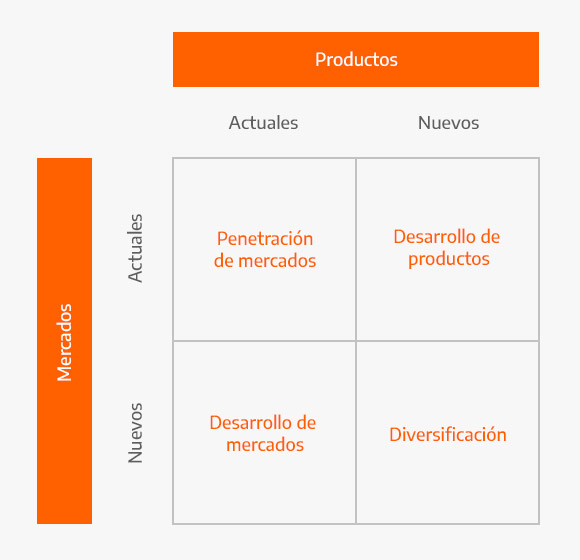 Source: economic encyclopedia
With the implementation of the strategy With the right growth strategy, you can take your business to the next level. This requires a structured plan and a leader who can set the course to follow. That’s why at Structuralia we offer a wide range of master’s programs to support your professional development, such as, MBA in Business Administration and Management of Engineering and Construction Projects, endorsed by the San Antonio Catholic University of Murcia.