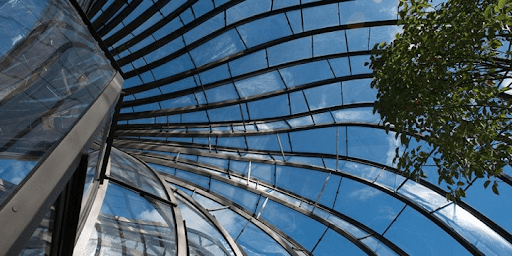
Today we know the lightweight structures as a constructive application that minimizes the structure’s dead weight. Their use has become widespread in roofing for large, unsupported spaces (such as the roofs of some sports stadiums), temporary structures (such as concert tents), and in architectural design projects, but do we understand how they work and their most common applications?
Introduction to Lightweight Structures
The lightweight structures They are made of steel or aluminum bars, although in some cases they may be made of wood, giving the structure a more natural appearance in its surroundings. Their design is based on a precise spatial structure of members that resist tension and compression, with the necessary stiffness, and are connected to one another by joints that resist moments, shear, or bending.
His major advantage It is the minimal amount of material required and the fact that prefabricated components can be used, which simplifies assembly, enabling the creation of efficient buildings thanks to energy savings and providing economic and environmental benefits.
Depending on the desired durability and/or aesthetic, the designer can choose from the various types: very lightweight structures without curvature, structures with curvature, foldable structures, and lightweight structures without welding.
Lightweight Structures: Their Most Notable Applications
The geodesic dome
Richard Buckminster, a 20th-century architect and designer, revolutionized the field of engineering through the development of the geodesic dome, first designed in 1922 by Walter Bauersfeld. A lightweight structure composed of aluminum tubes and a vinyl covering, 4.2 meters high, capable of supporting heavy loads without the need for a foundation thanks to its hemispherical geometry, formed by the joining of lightweight triangular components that are easily assembled and allow for large-span roofs without intermediate supports.
%20(1).jpg)
Example of a geodesic dome
The ratio of resistance to the amount of material required made this a structure with a wide range of applications because of their functional advantages. That is why his work earned the recognition of U.S. authorities and spurred the rise of lightweight structures during the second half of the 20th century, leading to the creation of numerous geodesic domes around the world.
Dome of the Olympic Stadium in Munich
As we continue our overview of the most influential figures in the field of lightweight structures, we cannot overlook Frei Otto, founder of the renowned ILEK (Institute for Lightweight Structures) in Stuttgart in 1964, who, along with Richard Buckminster and Frank Gehry, are the leading exponents of organic shapes.
Otto could be considered the foremost authority on textile architecture, especially in lightweight tensile and membrane structures. Taking advantage of the benefits offered by lightweight structures, he created significant works throughout his career, based on organic, natural, and functional forms. Among these, the dome of the Munich Olympic Stadium, as a fine example of lightweight construction in textile architecture.
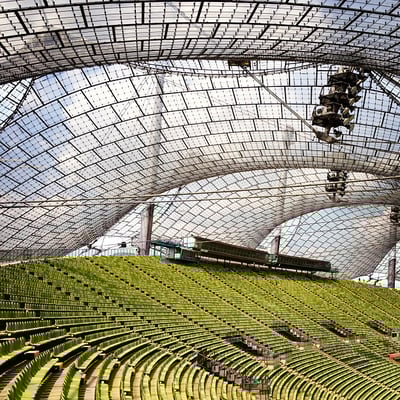
Canopies of the Munich Olympic Stadium
The rise of textile architecture as an architectural resource over the past few decades has been closely linked to the use of fabrics as a structural element. In addition to being a material with very low weight, high strength, and flexibility, it has a good light transmission coefficient and allows for natural lighting of the structure without requiring the use of glass and the increased loads that this entails, thereby making it possible to the use of lightweight structures, with all the benefits that come with it.
Olympic Fish Pavilion, Barcelona
Speaking of the most contemporary of these figures is Frank Gehry, an architect recognized worldwide for his organic architecture. This construction method, which uses lightweight metal structures combined with lightweight metals and laminated wood, aims to create integrated, free-form designs that seek harmony with the environment, moving away from the use of heavy blocks that clash with the landscape. Among his most representative works is the Olympic Fish Pavilion in Barcelona, which combines ecology and art.

Conclusion
When deciding which structure to use for the construction of certain buildings or architectural elements where structural strength is not as critical, Lightweight structures offer greater design possibilities and are clearly superior in terms of cost and construction speed to similar structures built with concrete or steel beams.