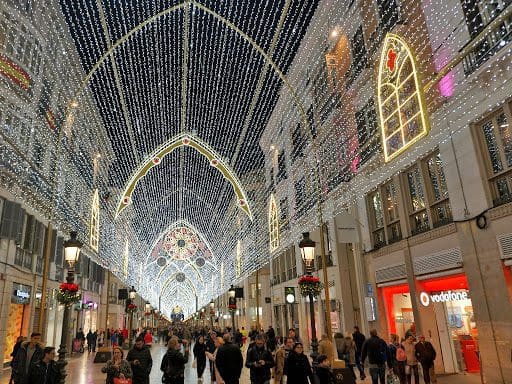
Nowadays, it's rare to find a city that isn't lit up with lights in December to celebrate Christmas. To a greater or lesser extent, all cities—and even small towns—decorate for Christmas.
This tradition, which has been taking place for several decades, serves as a tourist attraction for cities, which is why we have seen an increase in the budget allocated to Christmas lighting in recent years.
However, do we know when and how this tradition began? Below, we’ll explore how the idea of lighting up our homes and cities during this time of year came about and how it has evolved over time.
The History of Christmas Lights
To understand the history of Christmas lights, we must first explain the tradition of celebrating this time of year by putting up Christmas trees in homes.
This tradition began in the mid-18th century in upper-class German homes, where decorative items such as candles and small lanterns were later added to light up the Christmas tree.
However, it wasn't until 1882 that the first electrically lit tree appeared. It was the creation of Edward H. Johnson, an inventor associated with Thomas Edison, who developed special colored light bulbs to illuminate the tree.
However, because of their high price—which made them unaffordable for most people—it wasn't until the 1930s that they began to be replaced by the candles that had been in use.
Finally, it was starting in the second half of the last century that Christmas lights began to be used in a variety of ways; they can now be found in homes, stores, streets, and buildings throughout the city.
How can we reduce the environmental impact of Christmas lights?
In the previous post We looked at some ideas for reducing the environmental impact caused during this time of year by increased energy consumption, which, according to data from Red Eléctrica de España, is around 28%.
Consequently, in recent years, efforts have been made to reduce the amount of electricity consumed by Christmas lights in cities, in order to lower the energy footprint they generate. This is being achieved thanks to the increased share of renewable energy in the energy mix and improvements in the efficiency of the light bulbs used in the lighting.
It is in this latter case that significant improvements are being achieved thanks to LED technology. These bulbs consume 75% less energy than energy-efficient bulbs, and their lifespan is up to 25 times longer.
The only drawback of LED bulbs is their cost, which is about twice that of a standard bulb. However, even though the initial outlay is higher, the significant difference in energy savings between the two makes LED technology more cost-effective in the long run.
In short, Christmas lights are a major tourist attraction in cities, but we must strike a balance so that their environmental impact is as minimal as possible, and the only way to achieve this is through the use of renewable energy and new technologies.
If your New Year’s resolution is to further your education, enrolling in the Master’s in Renewable Energy and Energy Efficiency will give you the knowledge you need to take part in the many renewable energy projects on the horizon. Don’t wait any longer—request more information!