When we talk about force in the fields of engineering, construction, and building, we are referring to a measure of the intensity of interaction between one object and another or others. However, there are different types of forces and situations that require us to learn how to calculate them in order to achieve optimal results. In the following paragraphs, we’ll discuss them and, specifically, the concentrated or localized force and its differences with the distributed force, explaining its applications and how it is calculated.
Types of Force
Forces are present in all activities and elements, and we must understand their different types in order to more specific and precise projects. Below is a classification based on various criteria.
Based on duration
We can distinguish the fixed or permanent forces and variable or intermittent forces. Fixed loads are always present in structures, and these loads must support the structures at all times—as is the case, for example, with the weight of a building. Variable loads, such as wind or snow, may appear or disappear depending on the external conditions of the structure in question.
Depending on how they operate
On the one hand, we have the static forces, in which the intensity or direction of their action does not change or changes only slightly, as is the case with a ship's tonnage; on the other hand, there are the dynamic forces, which do change in value, location, or direction—as happens, for example, during earthquakes or sudden impacts.
Depending on their distribution across the structure
The volume forces act on every particle in the body, just as gravitational or magnetic forces do. Those of surface area, on the other hand, occur only on the body's periphery due to contact with other elements. Surface reactions, in turn, can be classified according to their distribution in distributed and concentrated. These will be discussed in more detail later.
Depending on the nature of the force relative to the structure
This group is divided into two sections. The action forces are all the external forces acting on a body that attempt to displace or alter it. The reaction forces They belong to the second group, and are those in which the body's own structure responds to actions to maintain balance. Newton's third law is very helpful for understanding these concepts.
What is a concentrated force?
When two bodies come into direct contact, a force is generated. Understanding what concentrated forces are is essential for designing, for example, beams. However, in this regard, it is also essential to understand the concept of distributed forces.

A concentrated force is one that acts at a certain point of the body. They are also called ideal, because they do not actually exist, although they are indispensable for mathematical calculations.
Calculation of a concentrated force
It's important to know that A distributed force can be represented by a concentrated force. In other words, we can perform the necessary calculations to convert one force into another, so that all the forces exerting pressure on a body are replaced by a single force acting at a single point. In fact, in the case of weights, the point at which the force acts is generally considered to be the center of gravity.
With these concepts clear, when performing the calculations, we must take into account the length or body surface area and distribution pattern with respect to the mass present. When determining it, we would need to take the following into account.
- Regular Shapes: defined area · the distribution with respect to length.
- Irregular shapes: exactly the same as with regular shapes.
- If the body has no distinct shape: We would have to use integrals.
Let's look at an example. In this case, consider a body with a regular shape for which we want to find its equivalent: suppose we have an object 3 m long on which a force of 20 kN/m is distributed uniformly along its entire length.
- F = q · l; the area of the rectangle would be calculated as the base times the height.
- F (concentrated) = 20 kN/m × 3 m = 60 kN
How do you calculate loads in the opposite direction?
If, for example, we have a rectangular shape, a trapezoidal shape, and, finally, a triangular shape with different directions of distributed load, the formula would remain the same. In other words, we would take into account the area of each shape, but Not all charges would be positive. We would have to subtract the ones traveling in the opposite direction from the ones traveling in the normal direction.
What is distributed force?
Unlike concentrated forces, distributed forces act over the entire surface of the body… Or, in the most extreme case, along a straight line.
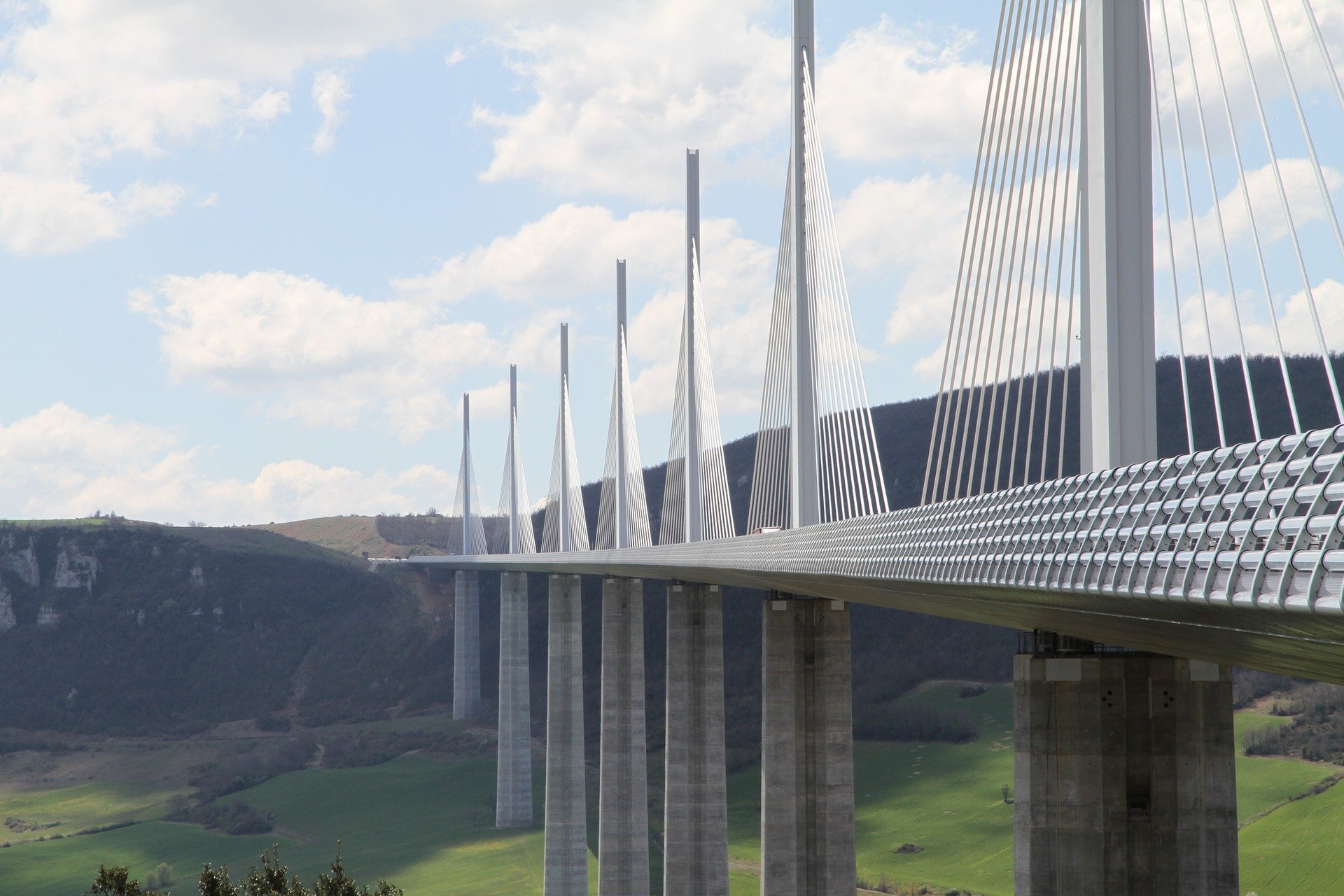
It has been mathematically proven, and there is a law that describes the distribution of forces; therefore, this distribution can be calculated, such that A real force is not a concentrated force, but a distributed one. This is because if, for example, we were to place a weight on a surface, that force would not act on just one point, but on every point on the surface.
What are internal forces?
Internal forces are those that are transmitted from particle to particle within a body. They result from external forces and are responsible for a material breaks. The distribution of internal force across a cross-section is called stress, and if this stress exceeds a material's strength, the object will break.
There are many types of forces, and we must take them all into account to carry out high-quality building, engineering, or construction projects. One of the experts' goals is to design structures so that they can withstand loads without breaking. That is why it is so important to know how to find the concentrated force. However, it will also be necessary to determine the internal forces in any cross-section of a body, such as axial or shear forces.
From Structuralia We want to help professionals acquire the necessary knowledge in this field and others of similar interest. That is why, at our school, we offer Master's degrees in engineering very useful for continuing your education after completing higher education and learning how to calculate concentrated forces.