
Pursuing a master's degree is very common among college students these days. After all, it's a tool that allows you to stand out from the rest given the fierce competition in the job market that our society faces.
Sometimes, the master's program has a certain character supplementary and mandatory a college degree, which is required to practice the profession. However, in most cases, these higher education programs tend to specialization, providing more specific and in-depth knowledge than what was acquired in the previous stage. This is, without a doubt, the first consideration students must address when choosing a graduate program.

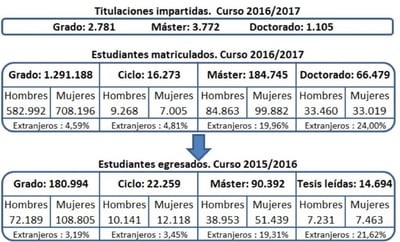
The number and quality of these graduate programs have grown exponentially in recent years, making it a daunting task to find the one that best meets a student’s expectations. According to the Ministry of Education, in Spain alone, the following number of students have enrolled this year more than 180,000 students in a master's program, a figure very similar to the number of students who graduated the previous academic year. This shows that the majority of Undergraduate students in their second cycle choose their degree program immediately after completing their bachelor's degree, with little professional experience or knowledge of the market to guide that decision.
It might be advisable (especially when there are no concrete job prospects in sight) to brief professional immersion in the field that brings the student the greatest satisfaction, so that they can acquire new skills that will enable them to make the difficult decision about which graduate program to pursue. Since, in many cases, it is impossible to achieve this, we’re going to offer some general recommendations to make the task easier for you.
What is my field of study?
You should keep your educational background firmly in mind. Although it may seem obvious, understanding your educational limitations and potential will help guide your choice and motivate you not to drop out of the course prematurely.
Which option is best for me?
Until just a few years ago, this question had one indisputable answer: in-person training. These days, it is increasingly common to find online master's programs that have been shown to improve academic performance for those taking the courses, while also reducing the number of hours needed to understand and internalize those same concepts.

What are my career goals?
This will be a key factor and will strongly influence your final decision. Understanding how the job market is evolving and which sectors are on the rise will be crucial to successfully choosing a graduate program. With that in mind, we strongly recommend that you stay tuned to our Twitter account, where we post daily updates on the latest news related to our industry.
Which universities are the most prestigious?
In a field like ours, there are many universities specializing in engineering, industry, energy, or architecture that offer high-quality education. In this case, we recommend that you take a look at this article, in which we analyze the most notable ones: How can I finance it?
Similarly, there are organizations and institutions that, in their efforts to promote and defend quality education, subsidize graduate studies with substantial grants and scholarships. In our specific case, we collaborate with organizations such as the Organization of American States (OAS), the Pan American Association of Educational Credit Institutions (APICE), as well as with various universities, such as the Catholic University of San Antonio in Murcia.
We hope these words have helped you make—or at least guide you in making—this difficult decision that will shape your future as a professional. Finally, we’d like to invite you to explore our extensive catalog of master’s and graduate programs, where you’re sure to find one that will help you achieve success.