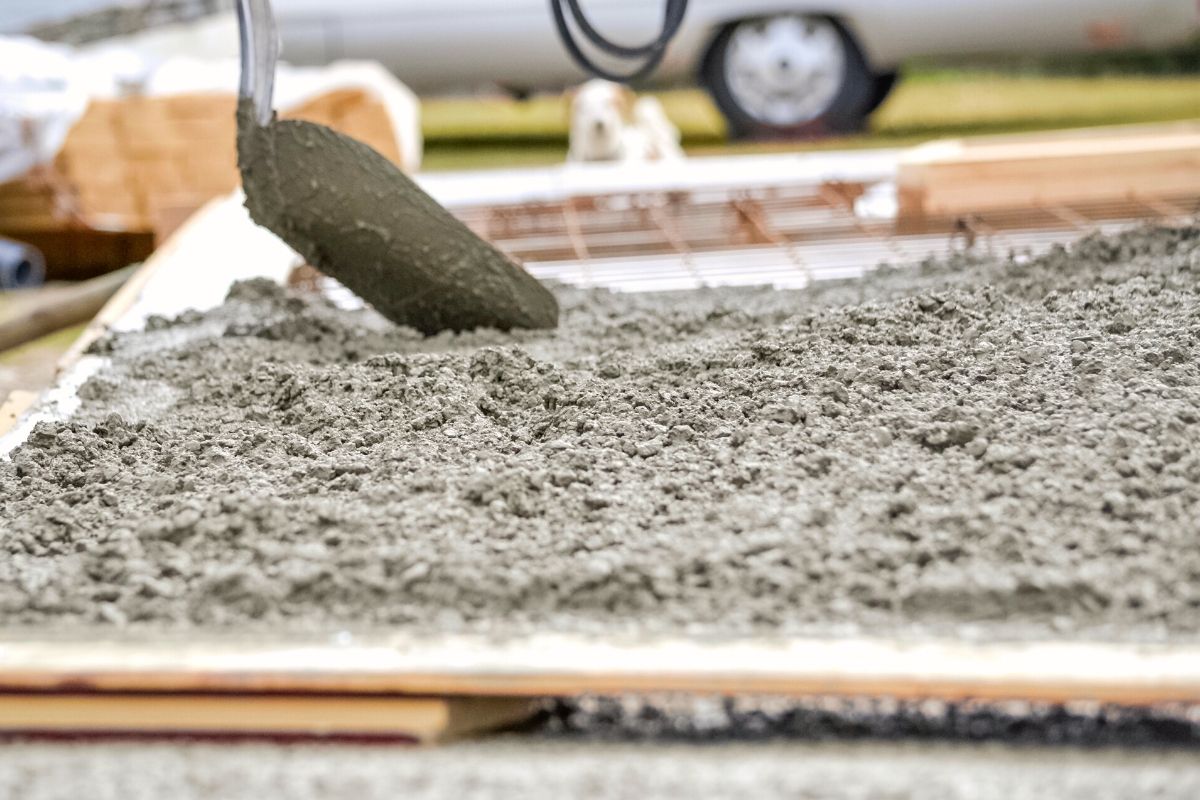
The concrete It has a couple of additional properties besides its lightness that are worth knowing about, such as the lightweight concrete.
As a follow-up to our series of articles on the different types of concrete used in the construction industry, we previously discussed the self-compacting concrete, and the additives containing polypropylene fibers; this time, we've decided to talk about the lightweight concrete. Which, as its name suggests, is a type of concrete manufactured in such a way that express as the ratio of weight to volume in order to reduce the static loads on a structure or the weight of a structural member.
To be classified as a lightweight concrete, the material must reach a weight of iless than 2,000 kg/m3 and greater than 1,200 kg/m3, use a proportion of lightweight aggregate, demonstrate a minimum strength of 15 or 20 megapascals depending on the type of mixture, and finally, achieve a a density that can range from about 300 to 200 kilograms per cubic meter. Unless it falls within these limits, concrete cannot be called “lightweight,” since outside of these limits, Too much mechanical strength is sacrificed from the concrete and becomes unusable.
How is lightweight concrete made?
As we have already mentioned, this is a type of concrete that belongs to the broad family of concrete varieties commonly used in construction. This type of concrete, unlike conventional concrete does not use gravel in the mixture, but rather replaces it with arlita or perita, which are much lighter aggregates due to their porosity. This results in a much more porous mixture that not only makes the concrete lighter but also gives it properties of sound and thermal insulation.
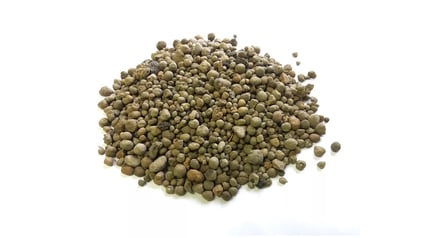 Expanded clay aggregate for concrete. arlita.es
In addition to replacing the gravel in the mixture, there are 3 Ways to Make Lightweight Concrete:
1. Removing the fine particles from the mixture:
This method aims to eliminate or reduce the amount of sand in the mixture, so that the spaces or pores previously occupied by the sand are replaced by microbubbles of air, thereby producing lightweight concrete even when using traditional aggregates such as gravel.
2. Low-density lightweight aggregates:
The goal is to add aggregates to the mixture—which can be natural or artificial but much lighter than gravel (such as pozzolan, lapilli, volcanic tuff; or expanded glass, vermiculite, expanded shale, sintered shale, and sintered clay), with a particle size ranging from 10 to 20 mm. It is important to note that these types of aggregates absorb more water, and many tend to float within the mixture; therefore, these types of concrete require more intensive compaction.
3. Adding gas bubbles:
This type of concrete is known as cellular concrete and is divided into two categories: sparkling and carbonated beverages. In the foamed Bubbles are formed within the mixture by adding a foaming agent, while the carbonated They achieve this through an additive that creates gas bubbles inside the concrete by reacting chemically with the cement.
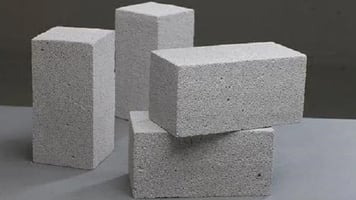 Aerated concrete blocks. engg
Properties of lightweight concrete
Clearly, the most important advantage that lightweight concrete has over ordinary concrete is to reduce the weight of the material relative to its volume. But thanks to the process used to produce this type of concrete—and its various types of aggregates—the concrete gains several additional features which make it even more versatile.
The porosity Lightweight concrete makes it a material that is significantly more permeable to water than regular concrete, which can be very useful—if used correctly—for certain types of applications in outdoor flooring. On the other hand, the air that can become trapped in its pores allows it to provides the material with insulating properties against the transfer of heat and noise, which is much higher than that of traditional concrete.
Applications of lightweight concrete
Thanks to the material's properties, it has become a type of concrete widely used in civil construction at various levels. On the one hand, it's great for building lighter structures with a low static load, which, thanks to this, It can result in significant cost savings in terms of the amount of rebar used in the reinforcement of structural elements; it is also used for screeds on floor slabs, filling trenches, on some facades, roofs, the restoration of historic buildings, and even to create decorative elements.
Thanks to the permeability provided by its high porosity, it is widely used as finishing work on terraces and rooftops, where the underside has been previously waterproofed, or, failing that, where it comes into direct contact with the ground and the permeability of the material helps with water drainage.
So we can conclude that this type of concrete mix has very interesting properties beyond its weight-to-volume ratio. Lightweight concrete, along with self-compacting concrete, are mixtures that are very easy to prepare on-site, and therefore, are among the most widely used, thanks to its advantages over ordinary concrete.