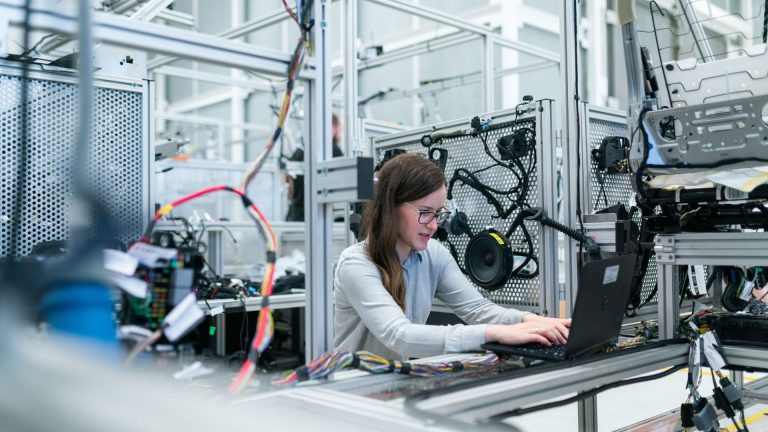
A company uses AI tools to automate tasks, improve planning, or analyze thousands of data points from a project in seconds. The The technology works, but an unexpected problem arises: The team doesn't know how to incorporate it into their daily work. That is one of the biggest challenges we face today. The adoption of AI in engineering is advancing faster than many organizations' ability to adapt job profiles and develop new skills.
The question is no longer whether artificial intelligence will transform engineering, but how it will affect professionals and what skills they will need to remain competitive.
Why Artificial Intelligence Is Transforming Engineering
The AI is changing processes which, until recently, relied exclusively on manual analysis or repetitive tasks. Its impact goes beyond simply automating activities: it changes the way projects are designed, planned, and managed.
Among the main areas of transformation are:
- Automation of Technical Processes
- Advanced Data Analysis
- Project Optimization
- Accelerating Innovation
For example, a system can analyze thousands of variables within an infrastructure, detect patterns, and suggest improvements in a matter of seconds. This saves time and allows for more informed decision-making.
The Main Applications of AI in Engineering Sectors
| Sector | Typical application | Impact |
| Infrastructure and Construction | Incident Prediction and Planning | Fewer errors and delays |
| Energy | Optimizing Consumption | Greater efficiency |
| Industry | Automation and Predictive Maintenance | Cost Reduction |
| Transportation | Intelligent Management and Simulation | Improved mobility |
The Use of AI in Architecture, Engineering, and Construction (AEC)
Artificial intelligence in civil engineering within companies and AI for construction make it possible to analyze risks, optimize planning, and anticipate problems during project execution.
The combination between BIM and predictive algorithms It is improving the design and management of complex projects.
AI in the Energy Sector and the Energy Transition
The AI in the Energy Sector It helps optimize networks, forecast demand, and improve energy resource management.
In the renewable energy sector, it also facilitates predictive analytics and smart infrastructure operations.
The Use of Artificial Intelligence in Industry and Manufacturing
The AI in Manufacturing and AI in Industrial Automation are promoting more efficient models.
Predictive maintenance and advanced automation help reduce incidents and optimize resources.
The Use of AI in Transportation and Mobility
The AI in Transportation improves routes, analyzes traffic, and optimizes logistics operations.
In smart mobility, These tools make it possible to process large volumes of information in real time.
How AI Is Changing Career Paths in Engineering
AI isn't replacing engineers; it's transforming their work.
Many repetitive or low-value-added tasks can be automated, while the demand is growing for professionals capable of interpreting data, working with digital tools, and making strategic decisions.
This is leading to a shift from the traditional technical role toward profiles that combine engineering and technology to a greater extent.
New In-Demand Roles in AI Engineering
Technological transformation is creating new specializations.
Engineers specializing in applied AI
An AI engineer adapts solutions and algorithms to specific problems in industrial sectors or technical staff.
Data engineers and data analysts
These profiles transform large volumes of information into useful knowledge for projects and operations.
Automation Experts
Automation will continue to gain ground in many sectors and will require specialists capable of integrating processes and technologies.
Hybrid profiles (engineering + technology)
One of the most significant changes is the rise of roles that combine technical skills with digital capabilities.
It can be helpful to incorporate interactive career path maps or technical profile comparison tools, especially for visualizing new career paths.
The Talent Gap: The Big Challenge for Companies
The integration of AI is creating a paradox: Technology is advancing, but the supply of specialized talent is not keeping pace.
Many companies are finding it difficult to fill technical positions related to data, automation, or artificial intelligence. Added to this is the competition for digital talent and the need to upgrade existing equipment.
The shortage of qualified professionals has become one of the main obstacles to accelerating transformation projects.
Key Skills in the Age of AI
Traditional technical skills remain important, but they are no longer sufficient on their own.
Organizations are looking for professionals who can combine:
- Analytical Thinking
- Data Interpretation
- Digital Skills
- Interdisciplinary work
- Adaptability
The ability to learn and keep knowledge up to date will become increasingly important in the coming years.
The Role of Training in the Adoption of AI in the Workplace
Technology only makes a difference when people know how to use it properly.
The AI training for the company's engineering teams It enables the development of internal capabilities and accelerates technology adoption.
In addition, it helps reduce resistance and facilitates the integration of new tools into real-world processes.
How to Design an Effective AI Training Plan for Engineering Teams
AI training yields better results when it addresses specific needs.
Identifying Needs
The first step is to identify what capabilities the organization actually needs.
Prioritizing Use Cases
Not all applications have the same impact. It is important to identify specific opportunities.
Applied Technical Training
Machine learning training for corporate infrastructure or specialized programs should focus on real-world applications.
Impact Measurement
Ongoing evaluation makes it possible to identify areas for improvement and adjust strategies.
The Risks of Failing to Adapt to AI in Engineering Roles
Failure to adapt no longer simply means falling behind technologically.
Companies that delay the implementation of artificial intelligence capabilities may lose their competitive edge, see their capacity for innovation diminish, and face greater difficulties in attracting specialized talent.
Why the Future of Engineering and Artificial Intelligence in Business It will not depend solely on the available technology, but rather of the the ability to develop people who are prepared to use it.