
The digital industries These are companies that have incorporated advanced technology into all their production, administrative, and commercial processes.
To remain competitive In this new era, companies must be able to quickly change their models y business strategies to keep up with technological advances and changing customer demands.
Digital transformation can help companies achieve this objective, by enabling them to make significant changes to their operational and business processes, in addition to the increased exchange speed information through technological tools such as social media platforms.
In this article, we'll look at how a company can begin taking steps to take advantage of to the fullest extent possible technology from the digitization.

What are digital industries?
The first thing we need to know is that when we talk about digital industries, we are referring to companies that have managed to optimize their processes by applying the digital technology in their various areas, such as management, operations, administration, purchasing, sales, marketing, customer service, and other areas in which they operate. Companies that have introduced advanced technology into their businesses fall under the definition of Industry 4.0.
Steps Toward Digital Transformation
For companies to become digital enterprises, it is essential that they follow a few steps:
-
Run a diagnostic assessment of your company: Begin with a business analysis to determine, among other things, how processes are carried out, identify the company’s strengths and weaknesses, and study the market in which it operates.
- Develop a digital strategy: To develop an effective digital strategy, the first thing you need to be clear about is the objectives the goals of this digitization effort, in order to implement the technological advancements that best meet the business's needs.
- Train employees: Human capital is fundamental within a company. Fostering a culture of technology among employees is essential for successful digital transformation. In this regard, it is necessary to have a continuing education program so that staff can keep up with technological advances. Employees with more experience in this area can be a great help in this process.
- Attracting Digital Talent: It is necessary to have the assistance of employees and professionals trained in technology who promote and maintain the company's digital transformation process. These could include data analysts, digital marketing professionals, cybersecurity experts, content developers, or any other roles as needed, depending on the type of business.
- Integrating New Technologies: All tasks across the various administrative and operational departments must be automated. The company also needs to create a strong and robust website using SEO to build an online presence.
- Making decisions based on new technologies: This is a step that could be taken in the medium term, as the company gradually implements a suite of technologies that enable better communication, which will help facilitate more timely decision-making.
-
Improve communication channels with customers: Customer relationships must be optimized by using new channels to promote services and products. The use of platforms such as social media and the implementation of a digital marketing strategy are essential to achieving this improvement.
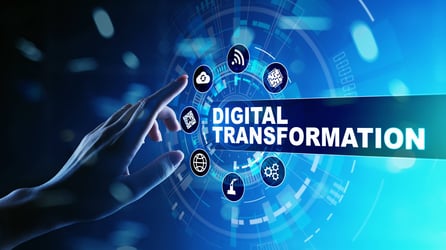 Digital Transformation. Source: actionsdata.com
What technologies contribute to digital transformation?
Companies that wish to become digital enterprises can rely on the following technologies:
-
Cloud Connectivity: This refers to the use of processing power and storage space on remote servers, which allows users to connect to applications and services to share resources and information.
- Artificial Intelligence (IA): It is a branch of computer science that uses combinations of algorithms to create intelligent machines capable of performing tasks that normally require human intelligence.
- Robotics: It is the one that draws on the fields of mechanical engineering, electrical engineering, and computer science for the construction systems or automated devices capable of performing a task that normally requires physical strength or dexterity.
- Big Data: This term is used to describe the vast amount of digital information generated every day and stored in the form of structured and unstructured datasets, such as text, audio, video, images, and other similar types of data.
- Cybersecurity. It refers to the protection of computer networks against unauthorized access, damage, or interference. This definition makes it clear that the cybersecurity It's not just about avoid not only that hackers gain access to your computer system, but also includes protect their data and systems.
- Business Intelligence (BI): Business intelligence, as it would be translated into Spanish, is a collection of technologies, tools, and processes designed to help organizations to make sense of the data they have and use it to improve their business strategies and from marketing.
-
Digital Marketing: This refers to the use of digital channels—such as the internet, mobile apps, social media platforms, and search engines—to promote a product or service.

Reasons for Companies to Transform Themselves into Digital Industries
Among the many reasons or benefits Among the benefits that digitization offers businesses, we can list the following:
- Organizational streamlining.
- Improved understanding of workflows.
- Cost reduction.
- Increased staff efficiency and productivity.
- Increased customer acquisition.
- New business opportunities.
- Promoting competitive advantages in the market.
- Improvement in Customer Satisfaction
- Automation of manual tasks.
- Improved decision-making.
- Continuous measurement of process performance.
- Ease of data collection.
- Process agility.
- Greater responsiveness.
- Decentralization of jobs.
Companies must evolve and adapt to the constant changes we are experiencing today. Becoming digital industries By applying cutting-edge technologies to all of its work, communication, and advertising processes, it will enable them to be more competitive in order to to remain in such a rapidly changing market.