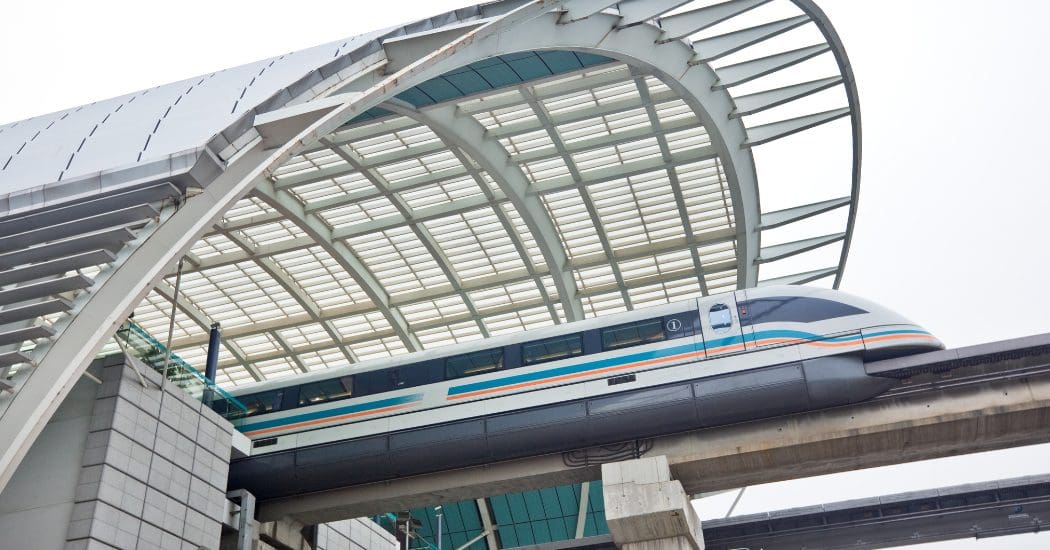
Transportation has always been a key driver of human progress, and the search for faster, more efficient, and more sustainable methods is ongoing. Along this path, the magnetic levitation is emerging as a technology that promises to transform the way we get around. From the high-speed trains current to the ambitious projects of vacuum tubes at hypersonic speeds, the magnetic levitation It is the cornerstone of a more connected and efficient future for transportation.
Thanks to research in materials physics, superconductors, and propulsion systems, we can now glimpse a transportation system where friction is a thing of the past. This article will explore the science behind the magnetic levitation, explaining how this technology is becoming the key to the future of transportation, with a special focus on the maglev trains (from English, magnetic levitation) and the concepts of hypersonic tunnels.
The Science of Magnetic Levitation: The Principle of Frictionless Movement
The purpose of the magnetic levitation is to eliminate physical contact between the vehicle and the road, drastically reducing friction and allowing for much higher speeds with less energy consumption. The friction between the wheel and the rail disappears, but the train must still overcome air resistance as it moves forward.
The rules on which the magnetic levitation are listed in the principles of electromagnetism. It is based on the ability of magnetic fields to repel or attract one another, generating a lifting force that raises the vehicle above the track. There are primarily two types of systems magnetic levitation:
- Electromagnetic (EMS): It uses electromagnets on the train that wrap around the track from below. These magnets are drawn toward the underside of the track, lifting the train. It requires an active control system to maintain a constant distance between the train and the track.
- Electrodynamics (EDS): It uses superconducting magnets on the train that induce electric currents in coils in the track as the train moves. These currents generate magnetic fields that repel the train's magnets, causing the magnetic levitation. This system is inherently more stable once the train reaches a certain speed.
Both approaches provide the essential framework for contactless propulsion, paving the way for very high speeds.
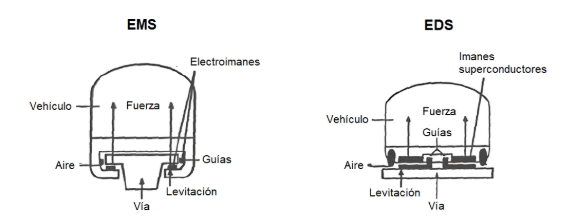
Illustration 1: Differences between EMS and EDS. Adapted from the article by Rose, Petersen, and Leung: “Implementation of Cargo MagLev in the United States”
Principles of Magnetic Levitation
To understand how the magnetic levitation, we must understand the underlying physical principles:
- Magnetism and Magnetic Fields: the basis of the magnetic levitation lies in the interaction of magnetic fields. A magnetic field is a region around a magnet or an electric current where magnetic forces are exerted.
- Electromagnets: They are temporary magnets created by winding a wire around a ferromagnetic core and passing an electric current through the wire. The strength of the magnetic field can be controlled by varying the current. In EMS systems, these electromagnets are used to generate the attractive force necessary for levitation.
- Electromagnetic induction (Faraday's Law): This principle states that a changing magnetic field (such as the one generated when a magnet moves near a conductor) induces an electric current in that conductor. This current, in turn, generates its own magnetic field that opposes the original change. In EDS systems, the train’s superconducting magnets, as they move, induce currents (called eddy currents) in the coils in the track, creating a repulsive magnetic field that lifts the train.
- Superconductivity: When certain materials are cooled below a critical temperature, they lose all electrical resistance and become superconductors. One property of superconductors is the Meissner effect, whereby they completely expel magnetic fields from their interior. This makes them ideal for the magnetic levitation in EDS systems, since they can generate very strong and stable magnetic fields without energy loss.
- Linear propulsion: the magnetic levitation It provides lift, but forward motion is achieved by a linear motor. This works similarly to a rotary electric motor, but “unwound.” The coils on the track act as the stator, and the magnets on the train act as the rotor, generating a moving magnetic field that pushes or pulls the train along the track.
These principles, combined with advanced control systems, enable this type of train to operate.
Basic Concepts in the Design of Magnetic Levitation Systems
To understand how the magnetic levitation When it comes to transportation, it is necessary to familiarize yourself with a few concepts:
- Lift and Propulsion: the magnetic levitation is responsible for raising the train. As we have already mentioned, propulsion is provided by a linear motor.
- Vacuum and Air Resistance: At very high speeds, air resistance becomes the main obstacle. The proposed solution for hypersonic systems is the vacuum tubes, where air is extracted to minimize this drag, allowing vehicles to reach theoretical speeds exceeding 1,000 km/h.
- Stability and control: Keeping the train centered and at a constant height above the track is very important. Advanced control systems, often supported by artificial intelligence, are essential for ensuring the vehicle's dynamic stability at all times.
- Infrastructure and Costs: the construction of roads for maglev trains and, even more so, of vacuum tubes, requires a considerable initial investment. This has been the main obstacle preventing its more widespread use, as maglev trains are currently found only in China and Japan.
Will they be the transportation revolution?
The magnetic levitation It not only promises amazing speeds, but also a environmental impact reduced. By eliminating mechanical friction, wear on parts and particle emissions are minimized. In addition, the energy consumption may be significantly lower compared to the high-speed trains conventional, especially if renewable energy sources are integrated. The maglev trains and future systems in vacuum tubes represent a qualitative leap toward more sustainable transportation.
Conclusion
The magnetic levitation It is a complex process that lies at the heart of what may be the next generation of transportation. The design of a system Based on this technology, it should enable us to achieve unprecedented speeds with maximum safety and efficiency. To achieve this, engineers have a certain degree of freedom, always within the framework of research and development of new solutions. In this way, we can use different elements and concepts to optimize the design of infrastructure and vehicles, making transportation faster and cleaner.
If you're interested in the railroad industry, we invite you to check out ourMaster's Degree in the Design, Construction, and Maintenance of Infrastructure and Facilities for Railroad Lines, a specialized training program that has had a significant impact on the industry.