
Without a doubt, new technologies have been responsible for the significant progress not only in the business world but also in scientific and educational contexts. If we pause for just a moment to consider its contributions to the development of the modern world, we can highlight, for example, how 5G has brought about an unimaginable transformation in telecommunications and in the edge computing, providing better solutions in various specialties. Both the drones, the Big Data such as the Smart Cities are part of the latest trends in technology; now more than ever, it is the right time to develop all the necessary skills in these fields. In the following article, we highlight the ranking of the most relevant courses in new technologies that companies can use to strengthen themselves and become more competitive.
1. Programming with Python
«Sorry, you don't have any experience with Python...» This may be one of the most common obstacles you'll encounter in various job postings or when starting a major project. This programming language programming It is one of the most widely used languages today in projects ranging from simple to highly complex. It is primarily an agile, fast, open-source language that is easy to learn and has a wide range of applications, such as app and video game development. Learning to program in Python It's possible for any professional—it's not just for computer science experts. With just one click, you can see some other reasons why you should learn to code in Python.
How Can You Help Your Company with Python?
Courses such as PHAROS’s “Programming with Python” allow students to learn the basics of the language, control structures, data structures, and specific syntactic elements across its 8 modules. The course offers a total of 100 training hours during which participants, among other things, quickly acquire knowledge such as:
- Modifying and Using Variables
- Control Elements
- Lists, tuples, and dictionaries
- Writing to and Reading from a Text File
- Features
- Programming with Processing's graphical interface
The course has been developed by experts in engineering and technology who are responsible for IT and software development projects using Python. It explains the various concepts in a straightforward manner through theory and hands-on exercises to ensure full understanding, thereby strengthening students' skills.
2. Drones and Their Applications in Civil Engineering
Have you ever wondered what drones are used for? Just as you might have guessed, they have many more applications than taking videos and photos. These gliders have also brought about major benefits in civil engineering, contributing to the development and improvement of processes in construction and engineering projects that companies are increasingly using: infrastructure inspection and safety, occupational health, tasks using drones equipped with thermal cameras, surveying, etc.
To highlight the importance of drones in civil engineering, the Energy Foundation of the Community of Madrid, In a joint study with several universities, it states that The use of drones on construction sites allows for quick and accurate monitoring of construction progress, whether for taking project measurements or for visually monitoring the status of the construction for later analysis.
How Can You Get Started with Drones in Civil Engineering?
Employees at any company can benefit from specialized courses that teach them how to master these drones and put them to work for their companies. The course on drones and their applications in Civil Engineering from PHAROS offers those most interested the opportunity to learn about fundamental topics such as types of flights, operational applications of drones, electromagnetic radiation, types of sensors, or the Drone Regulations in Spain in a total of 10 modules. Over the course of 50 training hours, participants will be able to study key topics such as:
- Remote Sensing Using Drones
- Sensors on board a drone
- Digital Image Processing
- Integration with geographic information systems
- Thermal Applications
- LIDAR Applications
This training program was developed by experts in the geosciences and practicing professionals such as GEODIM, who introduce the most important concepts in a very practical and visual way.It covers the subject matter with academic content, audiovisual materials, and case studies to ensure students learn effectively.
3. Introduction Cybersecurity
Information is power, but… what can companies do to prevent an attack on their most important asset? There are several questions about what it is cybersecurity, or how it works. Countless organizations and companies have suffered cyberattacks since the emergence of new technologies. But more than these organizations, it is really people—whether employees, business owners, or everyday internet users—who are vulnerable to the loss of valuable information, which can even lead to identity theft. Ransomware, or the infamous Phishing These are some of the practices that are currently affecting individuals and organizations, which has led to the emergence of companies that specialize in
Thus, the goal of cybersecurity is to protect people and work toward the information security. A closer look at some of the ways phishing spreads and the types of information it targets can be seen in the following infographic:
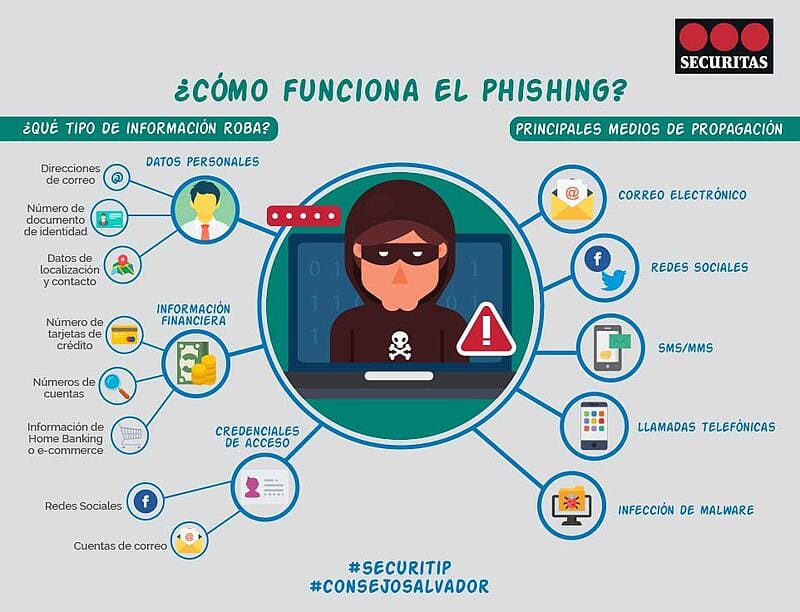
Source: elconsejosalvador.com
What can companies do to protect themselves from cyberattacks?
It’s no secret that now more than ever, companies are offering cybersecurity-related jobs, given the new trends emerging from cybercrime. As a result, they need professionals with cybersecurity expertise who can help reduce the risk levels of data breach that affect the entire organization. In this regard, PHAROS has the course on Introduction to Cybersecurity, 45 hours of expert training in which students, through the 6 modules and other components, learn about:
- Computer Security and Information Security
- Phishing and Identity Theft
- Ransomware, Malware, and Data Breaches
- Preventive Plans
- Contingency Plans and Business Continuity Plan
This course has been developed by experts in the field of information security who clearly and precisely explain the technical aspects from start to finish, using real-world examples to help participants fully understand how to respond to situations that require sound and efficient decision-making in the event of a cyberattack and how to develop effective action plans.

4. Fundamentals of Business Intelligence
What is business intelligence? It is the business intelligence and basically consists of the use of specialized digital software designed as a management information system. Given the intense demands of the competitive environment, it is truly important to use tools that enable executives to know how to make important decisions. It is therefore necessary to automate operational processes using information and metrics that provide a clear picture of the current situation, enabling strategic decision-making. This crucial task requires sufficient data that is not only high-quality but, fundamentally, relevant—and that can be analyzed to generate competitive advantages.
To conduct a detailed analysis of a company’s situation, it is necessary to implement steps such as identifying a problem, understanding the current market reality, forecasting and setting goals, ensuring that all company members work together toward a common objective, and finally, making a decision. This involves the use of information flows detailed and structured products accompanied by services such as QlickView y Power BI to obtain dashboards that, with a comprehensive view of the business, help develop ideas, identify trends, and facilitate the decision-making process.
A better way to teach some of the features of services like Power The BI is shown below:
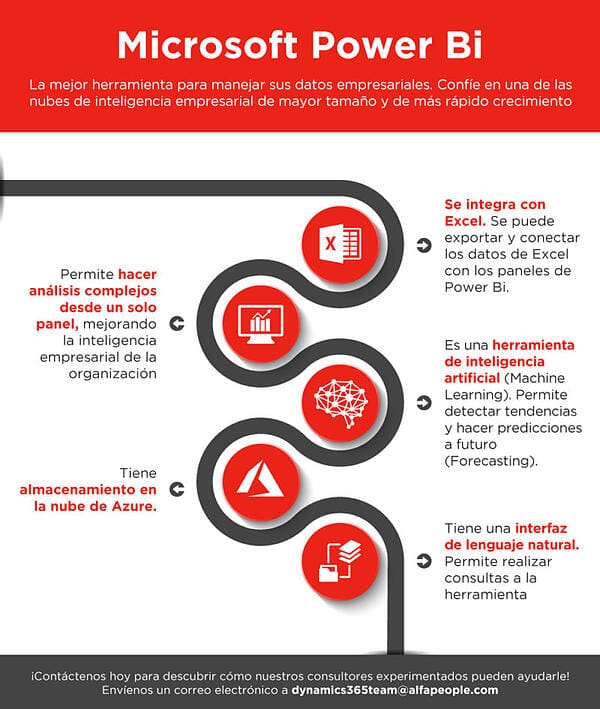
Source: alfapeople.com/
If you want to be a great manager in Business Intelligence, you must learn:
That's right—the days when mastering Excel was enough to get the job done are long gone. Now, business intelligence allows us to streamline processes more effectively. The best way to master this skill is through training. Specifically, PHAROS offers courses such as Fundamentals of Business Intelligence where you'll learn how to make effective and efficient decisions, including QuickView and Power BI, where you'll learn, among other things, how to work in Power BI, create charts and hierarchical groups, integrate data flows, organize information, and build dashboards. In short, the main topics covered in this course include:
- Trends in Information Use
- BI Environment
- Roles Involved in Business Intelligence: BBusiness Analyst, Data Scientist, Data Analyst, Data Architect, Data Engineer, and Database Administrator
- Teporting Tools
- The Theory and Practice of a Scorecard
Through four modules, students will spend 40 hours learning from professionals with extensive experience in data analytics and BI, who will concisely explain how to apply specialized reporting tools for business intelligence. You’ll study real-world business projects and develop solutions for situations that require analytical skills. There are many success stories that can help you understand why you should pursue training in Business Intelligence.
5. Dynamo + Python
Programming? I just want to model a building! Beyond creating interior or architectural designs, it's important to master programming languages that help streamline processes and save time. Dynamo It is an essential tool for professionals and companies involved in BIM, software such as REVIT It is essential for creating projects using BIM and can be complemented by Dynamo. There is some resistance to learning programming, as people tend to think it involves a lot of technical and mathematical aspects… but nothing could be further from the truth. Furthermore, it is vitally important if you want to be more effective in carrying out complex projects.
This is how languages like Python and Dynamo complement each other to speed up development, solve problems, and reduce the burden of debugging in 3D modeling for engineering and construction. Python develops code using the programming language, while Dynamo creates a visual programming workflow that helps simplify complex tasks involving 3D geometry through algorithms. In Autodesk’s words: «Dynamo is a graphical programming interface that allows you to customize the workflow for construction data.». Are you still wondering why you should learn Dynamo? In this simple video, you'll see why:
The future of businesses lies in programming and optimization
Great—we've already seen why it's important for your company to have professionals who are experts in programming and 3D software. At PHAROS, the engineering Lifelong Learning Service, we offer the course on Dynamo + Python where, through hands-on practice, you can learn how to work with Python and integrate it into the Dynamo environment by combining technical and practical knowledge. Additionally, the course covers the use of Python scripts, how to combine variables, and how to reference data. These are among the other main topics covered in this course.
- Flow Control
- Methods and Functions
- Dictionaries. Tuples
- External libraries.
- Revit Nodes
- Append and Extend Lists
- Logical operators: AND, OR, NOT
Over the course of 50 hours, participants in this 5-module course, alongside experts in architecture, programming, and 3D software, will gradually learn about the main modeling tools and different ways of collaborative work and the creation of BIM models using topographic sensors, through the data interpretation and its variables through practical exercises. This will enable employees at any organization to contribute effectively to the development of high-quality infrastructure, minimizing time and achieving better results.
In summary, Python programming, drones in civil engineering, an introduction to cybersecurity, the fundamentals of business intelligence, and Dynamo + Python are some of the essential courses that professionals need to take to stay up to date and add more value to their companies.
At PHAROS, we offer these and more than 700 courses that will help you get the most out of your employees. Contact us directly at and we’ll provide you with comprehensive advice on how we can help your company achieve its goals and objectives.

Sources: