
How can you assess the level of agility and identify the tools needed to implement agile organizational structures? Find out with the Agile models for businesses.
Are there any rules or guidelines that determine how organizations should operate? Any methodologies such as Scrum o Agile Which one stands out above the rest? The truth is, there’s no single answer. This article will share the insights contributed at one of the most recent events through PHAROS y Structuralia in collaboration with the specialist María Elena Provensal in which he introduced key elements for identifying companies’ current context and their level of agility, as well as tools for implementing organizational structures with agile management, which will be discussed on this occasion.
How agile is my company?
María Elena, an industrial engineer, international expert in digital transformation, and innovation business developer, began her presentation by sharing with participants a practical tool for assessing the level of agility in companies. The tool she presented includes five variables measured on a scale of 1 to 5:
- Organizational Effectiveness: Is the company prioritizing the bottom line, or is it focused on the approach, methods, and process for carrying out projects?
- Customer Focus: Does the company take care of its external stakeholders (customers, suppliers), or is the well-being of its internal stakeholders (employees, shareholders, directors) more important?.
- Control: Does the company's system operate in work environments characterized by strict discipline and adherence to rules and regulations, or, on the contrary, in low-pressure, flexible work environments?
- Accessibility: Is there little opportunity to propose new ideas at work, or is the company open to hearing innovative proposals that could help the business?
- Management Philosophy: Does the organization place greater importance on the employees who are part of a project, or do productive work and the results achieved take precedence over the employees?
The Spectrum of Organizational Agility
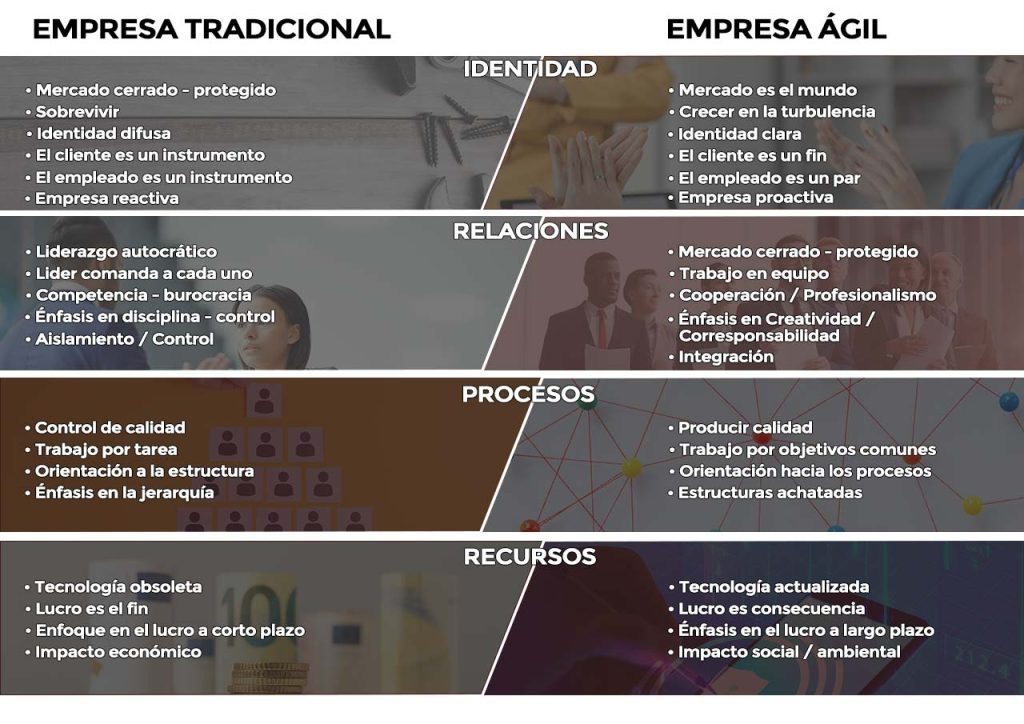
The specialist also shared her perspective on agility in companies, which we have illustrated in the following diagram:
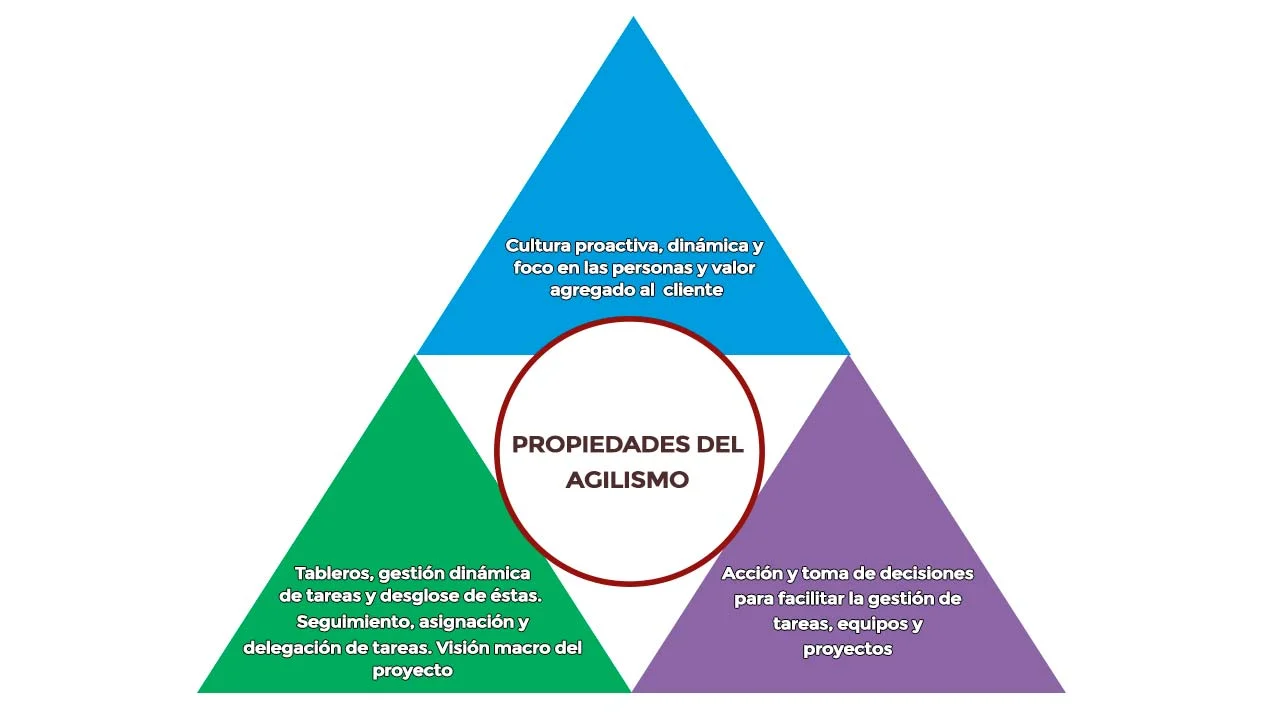
In practice, the goal of agile management is not to move too quickly through a work process; on the contrary, it focuses primarily on effectiveness and the ability to respond to the change.
What Is the Reality for Businesses?
In any type of company, regardless of industry or size, it is very common to encounter challenges such as those listed below:
Numerous meetings and agreements were made regarding the execution of a project, but upon its completion, the work carried out did not follow the planned or agreed-upon process.
Falling behind on trends and having little time to act.
An excessive workload and too many responsibilities prevent professionals from efficiently meeting expectations, which in most cases hinders innovation.
Despite the quality of the professionals who work for a company, it is often difficult to bring out their full potential due to the company's structural systems.
Another common factor is that the company's priorities are not aligned; this also affects how professionals carry out their work in relation to the goal to be achieved.
Digital tools that fall into disuse but are nevertheless required by the organization.



Apply Trending Management Models
The webinar presented five trending management models that companies can implement in line with their unique philosophy.
OKR (Objectives and Key Results)
Key Points:
- Medium-term objectives with achievable, measurable, and manageable outcomes. It is important to develop the innovation.
- Quarterly, adjustable goals that are agreed upon with the team and include specific tasks to be carried out during the process.
- Setting goals that are dynamic y flexible.
- The team takes ownership of the objectives that have been designed and works together to develop them.
HOLOCRACY
Focused on clearly defining the roles of each member of the organization, where the professional is the top priority—in stark contrast to a system of hierarchy. Its main features include:
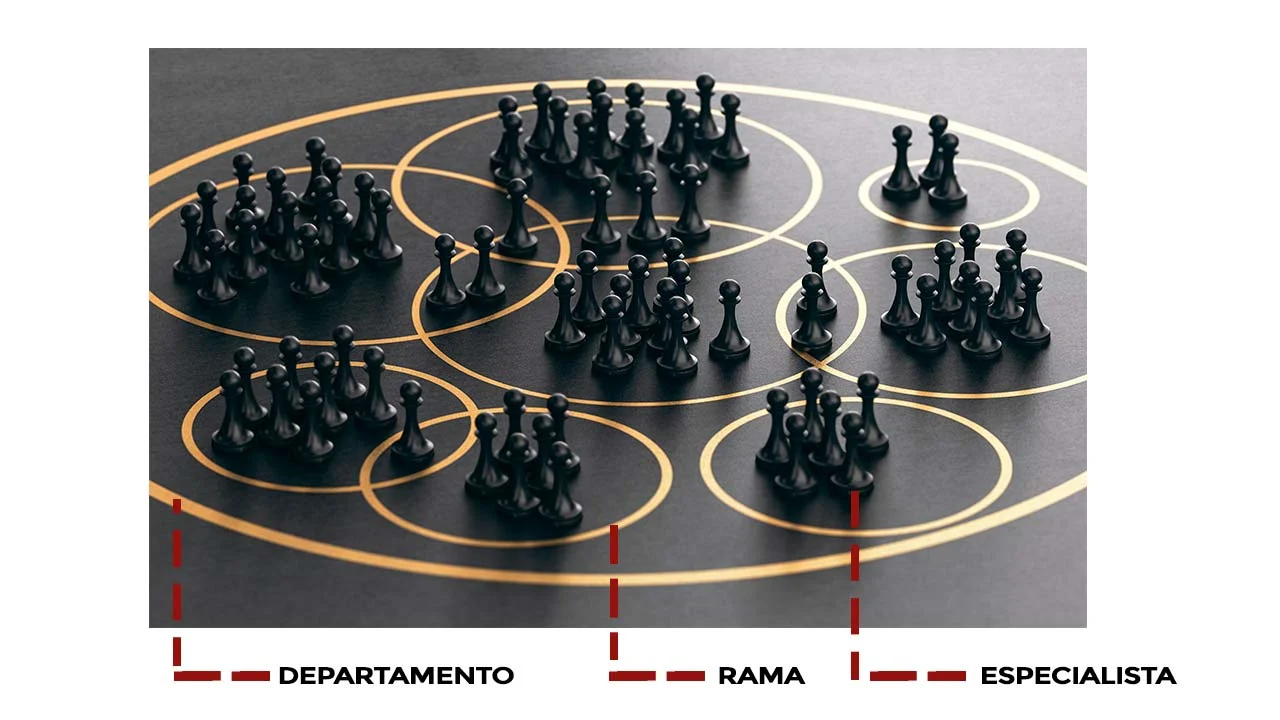
- Clear identification of the departments that make up a company, the specific division in which the role is performed, and the specialist who plays a specific role within a team.
- It is a self-managed modelthat promotes authentic individuals and values each person within the group in which they work.
- Multidisciplinary teams that are self-organized to carry out tasks in a decentralized and where there is potential for transformation and adding value to the company, including changes at the organizational level.
- Interdependent and jointly accountable work groups.
- Organizing teams into circles rather than hierarchies, which results in dynamic and well-organized roles.
- Stress isn't a problem—it's an opportunity.
AN AMBIDEXTROUS MODEL FOR ORGANIZATIONAL MANAGEMENT
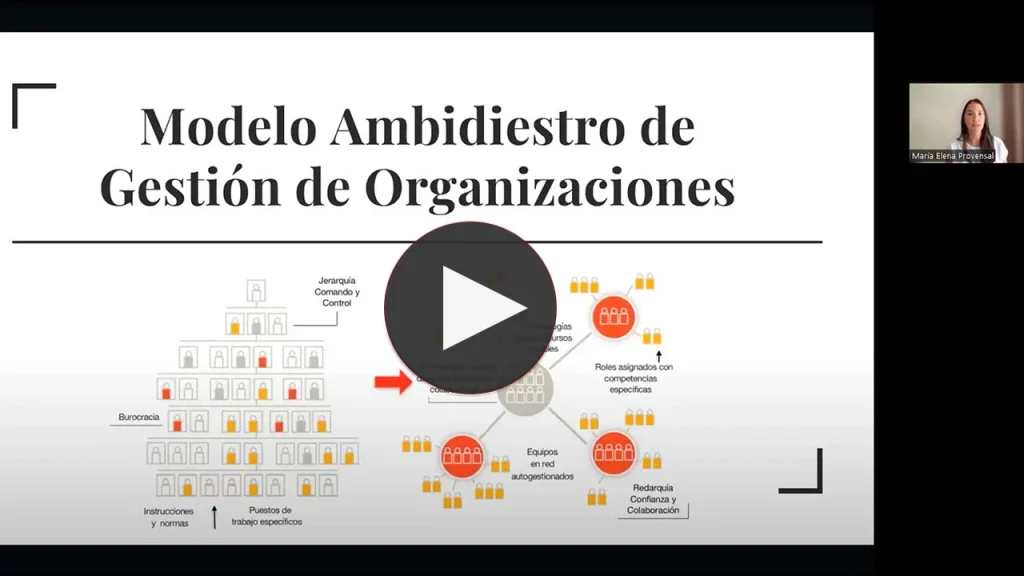
This model suggests a combination of a organizational model hierarchical and holacracy. In this model, hierarchy and bureaucracy are eliminated, while practices such as agile and circular methodologies, role definition, self-organization, and delegation of responsibilities are implemented. Its main characteristics include:
- Strategic Agility.
- A combination of execution and innovation.
- Redarchy: as a collaborative and decentralized structure, where teams have greater autonomy to make decisions and work together.
In addition, there are three types of ambidexterity that stand out, and María Elena directly illustrates how each one works, the contexts in which they occur, and the challenges involved, using a practical matrix. This specific excerpt can be found in the full video of this webinar, which we invite you to watch.
ORGANIZATIONAL LIFE CYCLE MODEL
During the presentation, this system was also discussed in relation to a company’s maturity level based on its current stage: the entrepreneurial phase, the formalized stage, or the expansion phase. With that in mind, where do you think your company stands according to the following framework?
Adapted from «The Transformative Spirit” by Jair Moggi & Daniel Burkhar
THE INNOVATION HEXAGON MODEL AND THE EXPONENTIAL ORGANIZATIONS MODEL
The model of the Innovation Hexagon characterized by prioritizing processes of creation and systemic change, as well as the evaluation of possible scenarios, just like the model of the exponential organizations The presentation covered approaches that combine creative and organizational elements, aiming to achieve exponential impact through technology across every aspect of the company, and highlighted their key contributions within an organization. At this point, the case of Spotify was presented as a real-world example, making it clear to attendees how the company has developed its culture through agile methodology; this, along with the last two models discussed, can be viewed in the full recording of the webinar.
Fill in your information to access the full recording of the webinar: «Organizational Structures for Agile Management in the Workplace»
In Structuralia We are committed to organizational development, which is why we regularly create new webinars developed by experts in digital transformation and human resources, covering the most relevant topics based on current trends for human resources managers and training specialists in the engineering, construction, energy, and infrastructure industries. In this way, professionals have access to the most up-to-date tools to support the growth, development, and transformation of their companies, enabling them to adapt to the demands of today’s business models.
If you want to know how PHAROS We can help you and provide comprehensive solutions for your employees' professional development through our comprehensive professional training service. You can sign up here. More than 1,100 specialized courses created by more than 550 active experts, with more than 120 companies already participating.