

Human Resources has the ability to lead the development of its professionals and serves as a partner in the technological advancements at companies such as Netflix.
Human Resources is at the heart of corporate development and transformation; its core lies in people, and it is the duty of HR professionals to both adapt and innovate within companies to meet the needs of today’s employees.
How can technology affect the processes of attraction, selection, withholding and other crucial activities (training plans) carried out by human resources professionals? This is one of the biggest challenges companies face in managing their resources effectively.
This question was addressed at one of the most recent events organized by PHAROS: «Why Should Human Resources Be Like Netflix? Key Pillars of Human Resources for Optimal Business Performance» developed by the expert Pilar Llácer Centeno who has more than 20 years of experience in human resources and corporate culture, in addition to working as a strategic consultant in the fields of education, employment, digital transformation, and sustainability.
The expert emphatically pointed out that, at present, technology generates mistrust and reluctance within companies; however, it is an ally that human resources can rely on and integrate into their systems and activities, putting it to work to foster the organization’s growth.
The session featured three key moments, which are described in greater detail below:
The Three Certainties About the Future of Work That Have a Direct Impact on the Present State of Human Resources
- First certainty: Human Resources has a negative attitude toward technology, as Pilar has observed throughout her extensive experience. However, ignoring its existence or the benefits it provides means cutting oneself off from reality. It is increasingly essential to adopt a mindset and digital literacy that enable companies to innovate, reinvent themselves, and implement modern human resources practices.
- Second certainty: the difficulty of implementing the telework in its entirety. It depends heavily on the specific sector to which each company belongs; although there is a strong trend toward adopting this work model in companies, the truth is that Human Resources cannot guarantee its applicability in all cases. For example, organizations focused on industrial sectors (engineering, construction, energy, infrastructure) where professionals must be physically present on-site. Even so, a revealing finding is that the unforeseen circumstances caused by the COVID-19 pandemic and the implementation of remote work resulted in employees being just as productive—or even more so—than when they were physically present at their workplaces. Human Resources managers have learned from this experience, and it is now a tool they can use to offer greater value in the processes of recruitment, onboarding, and people management within companies.
- Third certainty: To learn more about this topic, we invite you to watch the full recording of the webinar.
What prevents companies and human resources professionals from adopting innovative proposals?
Two major effects may result from the three certainties outlined above, thereby driving innovation within companies:
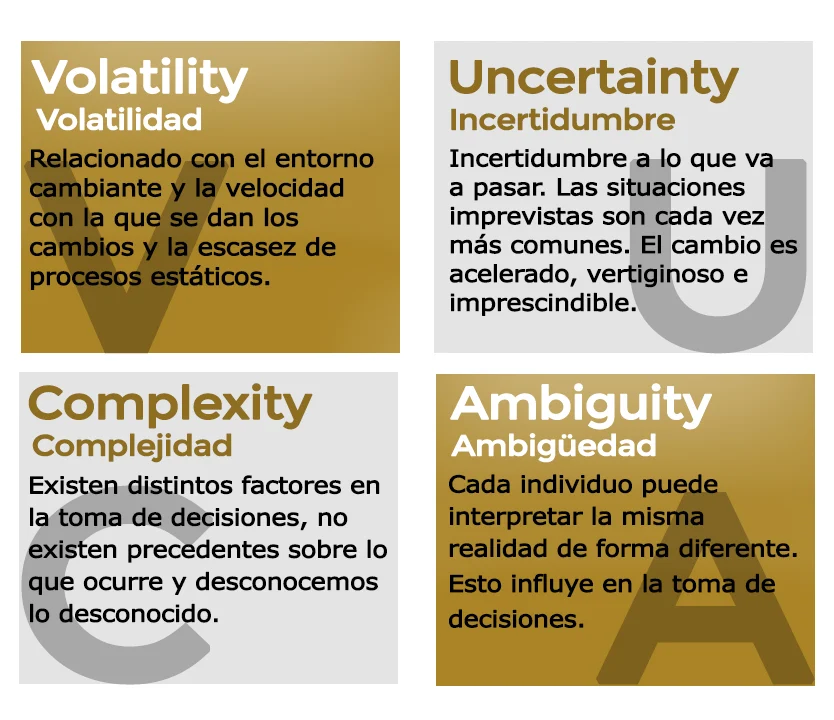
- VUCA Environment: For human resources managers, the speed at which changes are occurring in the industry as a result of technology is certainly undeniable. This is when the VUCA environment This becomes more apparent in potentially ambiguous or uncertain situations. The implementation of technology within any company may be influenced by the diversity of professionals on its staff, especially when the workforce includes people from different generations. A practical example: some professionals benefit from and take advantage of measures such as remote work, while others do not have this option because they perform different types of work.
- Three speeds: The reality of each company and its evolution are shaped by the specific circumstances it faces at any given time. Large companies are best positioned to undertake significant changes, as they have the financial resources and solid structures to implement improvements or changes more quickly. In contrast, small and medium-sized enterprises must prioritize the development, management, and optimization of human resources through careful, measured steps.
Netflix, a Model for Human Resources
In the words of Pilar Llácer: «N»Netflix is a perfect example of what human resources departments should be like—they should have a thorough understanding of their workforce so they can offer personalized value propositions tailored to each employee's needs.". Based on his experience and philosophy, he identifies four key factors for implementing changes in Human Resources that can be replicated using this content platform:
- Anticipating future developments: It is up to Human Resources to manage the talent within its team while taking into account the business’s strategic direction in order to adapt to market needs. It is responsible for helping employees acquire digital skills through ongoing comprehensive training services To meet the industry's demands, this provides employees with opportunities for professional growth and internal promotions.
- Knowing how to make an impact and exert influence: the leadership and influence needed to guide the company’s talent toward a common goal. Skills such as creativity and originality in communication thus become two crucial factors in achieving the desired objectives.
Staff Management and Continuous Development by Human Resources
The need to implement business transformations is a fact, and that is where human resources professionals play a key role within the organization. It is their responsibility to ensure optimal employee performance, to serve as leaders, and to contribute to the company’s growth. Part of this involves ensuring that employees have the right tools to acquire highly specialized skills in the industry, enabling them to develop the capabilities needed to take on large-scale projects and gain access to better career opportunities within the company itself.
PHAROS, the lifelong learning service Sructuralia offers human resources and training managers a comprehensive continuing education service for their staff through a catalog of more than 900 courses highly specialized, offering the opportunity to seek personalized advice from more than 550 experts, and where more than 110,000 professionals are already training every day. What are you waiting for? Find out more!
Fill in your information to access the full replay of the event: «Why Should Human Resources Be Like Netflix?»