
The concrete test specimens are a very important part of construction In this article, we'll explain why.
What are concrete test specimens, and what are they used for?
Most, if not all, of the structural elements of buildings constructed over the past 70 years are made of concrete, and this will continue to be the case for a long time to come. Beyond highlighting the importance and widespread use of this material, this tells us that The material has very good mechanical properties; and to determine these mechanical properties precisely, laboratory tests are conducted using concrete test specimens.
Because it is used so widely, concrete is subject to strict controls regarding its properties and the factors that affect them, as it is an indispensable material in structures of all kinds It is essential to verify that it is functioning properly to ensure the safety of the people who live in and use the buildings. This is known as cConcrete Quality Control and it is planned that and regulated by each country's administrative authorities and building codes.
Concrete Quality Control
That is the name given to the ultimate goal of a series of control tests, the purpose of which is to verify that the characteristics of quality, strength, and durability of the concrete are those specified in the previously prepared design calculations. The characteristics that the concrete must meet are specified in the technical specifications corresponding to each technical standard and include the following criteria:
- Compressive Strength
- Consistency
- Maximum aggregate size
- Type of environment to which it will be exposed
- Requirements Regarding Additives
- Tensile Strength
- Absorption
- Specific gravity
- Permeability and Wear
All of these characteristics must be met by every production batch of the material; this is known as product unit, that is, the amount of concrete produced in a single batch. That is why it is so important that, for each unit of product, the following be performed: concrete test specimens, which are used to conduct the studies relevant to the various tests.
Concrete test specimens
The criteria mentioned above are verified through various material strength tests, which are conducted on concrete test specimens, which are simply cylindrical samples of the material. They must be an accurate representation of the product unit, or the concrete production batch, so they must be carried out in a specific and standardized manner.
It is recommended to consult the technical standards of each country, but in general, test specimens should be cylindrical. 15 cm in diameter by 30 cm high, or 15 cm by 15 cm; or even 10 cm by 10 cm for high-strength concrete.
How to Make a Concrete Test Specimen
First, we need to make sure we have an e-enough space and under controlled conditions To ensure that the concrete's setting process is not affected, a cylindrical mold capable of being hermetically sealed is then prepared, which will contain the exhibit of the concrete mix to be subjected to the relevant tests, poured into the mold in three layers.
Each layer of batter is about 10 cm thick, and once it's in the pan, you should shake 25 times Each layer is compacted with a metal rod to ensure it is properly compacted and to release any air bubbles trapped inside the mixture. Once the three layers of the concrete sample are complete, it is tapped a few 10 times the mold with a hammer, for the same purpose as the rod.
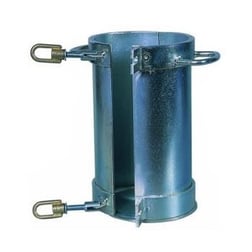
Formwork mold for concrete test specimens. comercturro
Curing and Preservation of a Concrete Test Specimen
Finally, you must wait 24 hours Before removing the mold and labeling the sample with its code, date, and expected strength, the test specimens are allowed to cure while completely submerged in drinking water. While submerged, they must maintain a temperature between 20 and 2 °C for the purpose of obtaining a relative humidity of 95 %. It is worth noting that it is also possible to achieve these results using specialized cameras.
By law, the contractor is responsible for ensuring stable conditions and for monitoring the concrete test specimens. In other words, the test specimens must be kept out of direct sunlight, protected from impacts or unexpected loads, and shielded from the wind until immediately before the test is conducted.
Types of Tests on Concrete Specimens
Compression Test
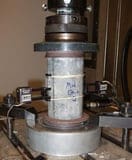
This is a destructive test that determines the compressive strength of the concrete from which the test specimen is made; it is performed on cylindrical test specimens measuring 15 × 30 cm, 28 days after the specimen has set. It consists of apply a constant and progressively increasing load until the breaking point is reached or plastic deformation of concrete.
Flexural Tensile Test
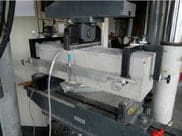
It is made from prismatic test specimens with a square cross-section, with a length not exceeding four or five times the side length of a face; it is also a destructive test. It consists of simulate the mechanical stresses in a beam holding the test tube horizontally over four points of support, two near the center at the top and two at the ends at the bottom; this is how the axial tensile strength is determined.
Indirect Tensile Test
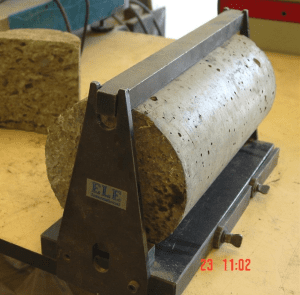
In this case, The cylindrical test tube is placed horizontally inside a press that will apply a compressive force, just as in the compression test, but on the side faces of the cylinder. Force is applied to two diametrically opposite generatrices of the specimen, and the tensile strength is determined at the point of fracture.
We can conclude that concrete test specimens are an indispensable element for obtain information about the materials used in each building, in addition to helping us understand its mechanical properties, it helps detect damage to concrete early on, thereby preventing disasters. If you’re interested in learning more about materials and their properties, we invite you to browse the syllabus for the master’s programs in engineering and construction available on Structuralia.