The mass production Product distribution is essential to the global economy, and here we highlight the most significant trends in the sector.
Mass Production and New Industry Trends
Mass Production, despite being a fairly well-known concept today, represented a powerful idea that has transformed not only the industry but also society as a whole. From the manufacturing from automobiles and electronic devices to the production of food and consumer products, mass production It has left an indelible mark on history and on our daily lives.
To fully understand the magnitude of its impact, it is crucial to explore its historical roots: In the 19th century, artisanal production and small-scale manufacturing were the norm, and Each item was made by hand, which resulted in high costs and long production times. However, all of this changed with the advent of mass production, brought about by the Industrial Revolution, and thanks to visionaries such as Henry Ford y Frederick Winslow Taylor They began applying principles of efficiency and standardization in manufacturing that are now the norm.
Mass Production Systems
When we explore production systems, we find a variety of approaches, each with its own characteristics and applications. These systems evolved throughout industrial history and adapted to the the changing needs of society and the economy. Among the most notable systems are: the piece-rate production system, the batch production system, the continuous-flow production system, and, of course, the mass production system.
1. Labor-Based Production (Artisanal)
In the early days, production was based on craftsmanship, where Each product was manufactured individually by a highly skilled craftsman. This system was slow and costly, but it allowed for a great attention to detail and extreme customization.
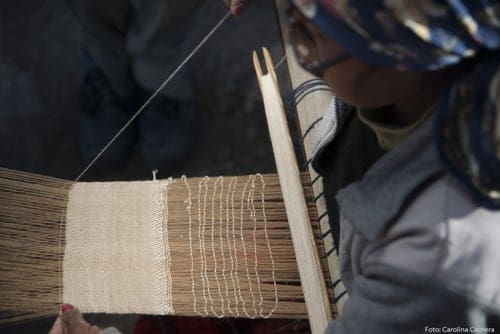
Photograph of a worker engaged in the artisanal textile production process, the polar opposite of mass production. Carolina Cabrera for ElPucara
2. Batch Production
As demand grew, the batch production system was adopted. Under this approach, the following were produced: several identical products in a batch before moving on to the next one. Although this improved efficiency Compared to labor-based production, it still had limitations in terms of efficiency and costs.
3. Continuous Flow Production
With continuous-flow production, manufacturing was organized sequentially, where Each workstation was interconnected, and the product moved from one stage to the next without interruption. This system, used in industries such as the automotive industry, allowed for greater efficiency, but still involved certain limitations in terms of customization and flexibility.
4. Mass Production
Mass production represents a crucial development in manufacturing. It is characterized by the standardization and large-scale production of identical products. Here, specialized machinery and the assembly line play a key role, enabling the rapid production of low-cost products, where the key is constant repetition and high production speed. This not only reduces costs, but also ensures that products are available in sufficient quantities to meet the growing demands of modern society.
The main difference between mass production and other systems lies in scale and standardization. While the previous systems allow for a certain degree of customization and limited production, mass production aims to create identical products in large quantities. This has had a profound impact on the availability and accessibility of a wide variety of products in our daily lives, from cars to electronic devices.
Trends in Mass Production
Mass production, despite its historical success, It is not immune to the ongoing evolution of technology, changing market demands, and growing environmental concerns. As we move further into the 21st century, several trends are shaping the way mass production is conceived and carried out:
1. Automation and Advanced Robotics
Automation is at the heart of modern mass production, Smart factories are using robots and advanced control systems to increase efficiency and reduce human error. This not only speeds up production but also improves the quality and consistency of the products.
2. Mass Customization
Although traditional mass production is based on standardization, Demand for personalized products is growing. The technology of additive manufacturing (such as the 3D printing) enables the large-scale production of unique products, opening up new possibilities for mass customization.
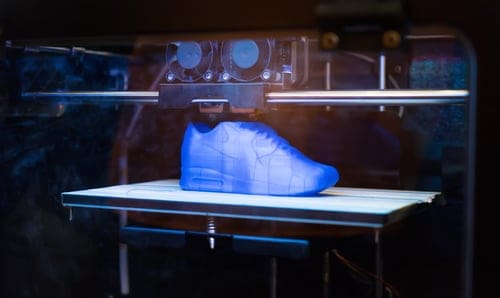
An illustrative image showing how customization works in mass production using a 3D printer. Hablemosdeempresas.com
3. Green Production and Sustainability
Growing environmental awareness is driving significant changes in mass production. Companies are seeking to reduce their carbon footprint by adopting more sustainable practices, such as using recyclable materials and optimizing processes to minimize waste.
4. Information Technology and Industry 4.0
The interconnection of systems and real-time data collection are driving Industry 4.0. This enables more efficient production management, data-driven decision-making, and the ability to anticipate and resolve problems before they affect production.
5. Ethics and Social Responsibility
Consumers are paying more attention to Ethics and Social Responsibility of companies. This is leading to a greater transparency in the supply chain and the adoption of ethical standards in mass production.
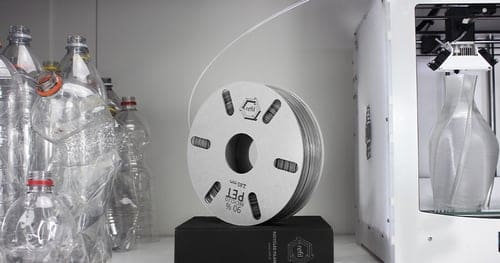
The use of filament made from recycled bottles as a sustainable option in the mass production of products. Renewi.com
Although mass production is a concept that has been around for many years, since its inception it has transformed the way we live and the global economy, and it continues to evolve, adapting to the new challenges of the digital age and Industry 4.0. This means that it has been and continues to be a major source of jobs and the foundation of many companies worldwide, and as engineers in this sector, it is important to stay up to date on new trends in mass production; and an important tool for keeping us current as professionals is continuing education, such as that offered by Structuralia, of the highest caliber and taught by the industry’s leading professionals.