The bridge is the first piece of infrastructure designed by humankind, the result of the need to span a gap, and thus shorten routes or create new ones. It can be said that the invention of the bridge is also the invention of structural engineering, since—even though it may seem like a simple task to us today—safely spanning a gap and supporting the loads that pass over it requires a great deal of ingenuity. Over time, this ingenuity was refined, as were the materials, and the Armadura Bridge.
The first truss bridges date back to the 1820s, making them among the oldest types of large-scale bridges in the United States. Most of them were primarily wooden structures and were designed to carry heavy wagons, until the the railroad became the most popular mode of transportation (between 1880 and 1890) and it was necessary to construct the structures of these bridges out of steel. This makes them responsible, to a certain extent, for many of the business connections between major American cities, which would not have been possible without these bridges.
Architect Ithiel Town is remembered for patenting the “Town Lattice” (a lattice structure), which consists simply of slender structural elements crisscrossed diagonally, allowing significant loads to be supported with less material. Together with Theodore Burr, who, by combining a truss of the Palladian Using an arch, they achieved one of the strongest structural designs of the era; they were responsible for greatly boosting the construction of truss bridges throughout North America between the late 21st century and the early 20th century.
How to Identify a Truss Bridge
They are a type of bridge that is fairly easy to identify, since almost all of them follow a very basic principle: Truss bridges are based on the Geometric stability of a triangle, which is why we’ll see this pattern repeated along the large trusses that support the horizontal plane spanning the bathroom, the Trusses are the defining feature of this type of bridge, since using relatively small amounts of material makes it possible to support very heavy loads; in fact, this type of bridge is well-suited for military applications where it is necessary to support heavy loads quickly and with minimal materials.
How a Truss Bridge Works
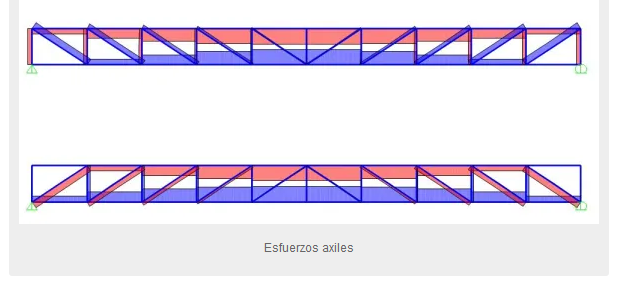
These are individual elements that intersect with one another, forming mainly triangles, «secured” by an upper and a lower chord. The diagonal and vertical members of a truss are subjected to axial tensile or compressive forces, while the upper and lower tie members function as parts of a single simply supported beam, with the upper member under compression and the lower member under tension.
Types of Reinforced Concrete Bridges
Within the category of truss bridges, we can identify several types, which differ from one another mainly in terms of the type of truss or framework that support the bridge. These are the main types of truss bridges:
1. Pratt Truss
This type of truss has been used in bridges since the days when they were built of wood, and has become the most common type of bridge in use today. They are easily recognized by the “V” shapes formed by the diagonal members as they extend from the midpoint of the truss, indicating that their diagonal members are under compression.
2. Howe Truss
This type of truss bridge is very similar in appearance to a Pratt truss; in fact, its mechanical behavior is quite similar as well. However, unlike a Pratt truss, in a Howe truss the diagonal members form an “A” shape extending from the midpoint of the structural member, which means that The diagonal members of the reinforcement are subjected to tensile stress.. This is slightly better suited to account for any buckling that may occur in the horizontal bars connecting the reinforcement.
3. Warren Truss
This particular type of bridge is commonly found in covered structures that use the Warren truss design. This design is easily recognizable because the diagonal members form equilateral triangles when connected to the lower and upper chords. Many variations can be found by adding vertical members, such as the subdivided, double, and quadrilateral Warren trusses.
4. Pendants
This is the most distinctive type of truss bridge, since it can be found with any of the types of trusses mentioned above, but with the difference that these beams or trusses are suspended by straps. These cables are connected to tall towers located at the ends or along the length of the bridge, which serve as giant pillars.
The Most Interesting Arch Bridges
1. Ikitsuki Bridge
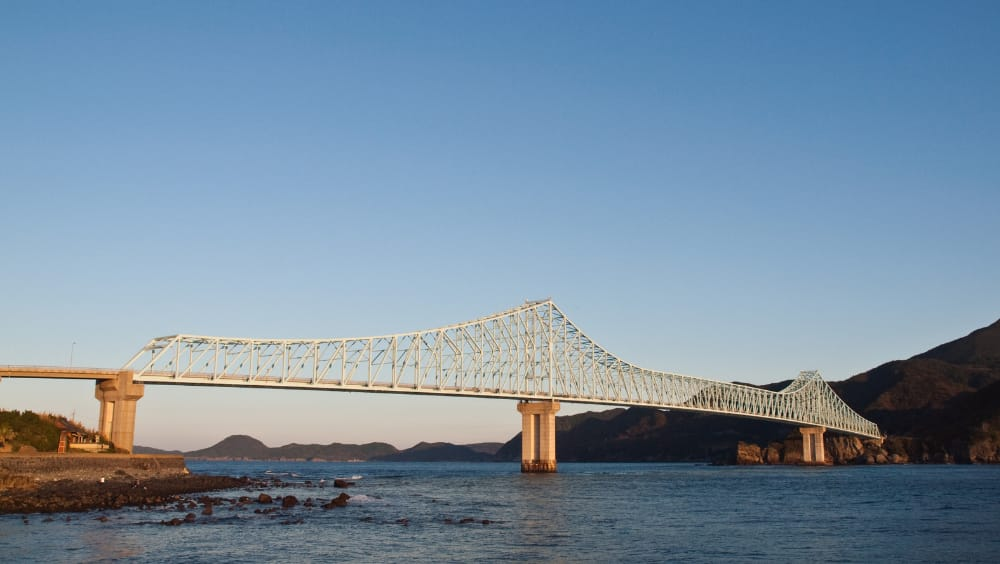
It connects Ikitsuki to Hirado Island and is one of the longest truss bridges in the world (two 200-meter spans at either end and a central span of 400 meters). The trusses that make up this bridge adapt in shape and size according to the forces acting on them to the forces acting on them at each point, resulting in the unique shape we see in the image and making the most of the material involved.
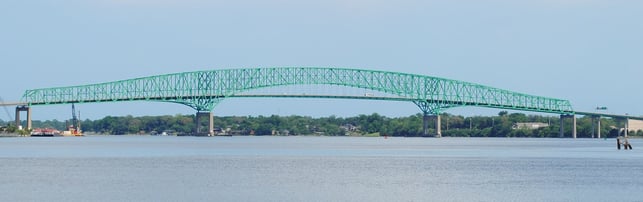
2. Hart Bridge
This interesting bridge was built in Jacksonville, Florida, in 1967; it cost $8.83 million when it was completed in 1967 and is 1,172 meters long. It is an example of a truss bridge with a cantilevered section. A key bridge for relieving traffic congestion in downtown Jacksonville, and an example of the potential of truss bridges and the distances they can span.
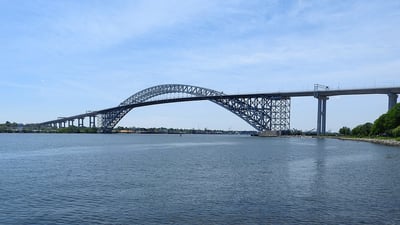
3. Bayonne Bridge
This is the sixth-longest steel arch bridge in the world, offering an interesting take on truss bridge engineering by combining the most efficient geometric shapes for structures: the arch and the triangle (the trusses of the arch). It was designed by Othmar Ammann and architect Cass Gilbert to be completed in 2017.
We can see how very simple ideas can be transformed into ingenious and efficient solutions to the same problem—in this case, spanning a gap with a bridge. If you’re interested in ingenious and efficient structural solutions, we recommend checking out the master’s programs offered by Structuralia, particularly those in Structural Analysis and Design.