Learn about What an encoder is, what types there are, and what they're used for its various forms.
What is an encoder? And what types are there?
In the vast world of electrical and electronic engineering, there are essential components that play a crucial role but often remain in the shadows of obscurity. Among these hidden gems are encoders—devices that, although generally little known, play a fundamental role in various industrial applications. In this article, we will explore in detail What is an encoder?, its importance in the field of electrical engineering, and its types.
Throughout history, advances in technology have led to a boom in the development of encoders. From their beginnings as relatively simple mechanical devices to the versions more sophisticated and high-precision that we have today, these small but powerful components have evolved to meet the growing demands of electrical engineering. With the advent of the digital electronics, encoders have reached a new level of intelligence and versatility, enabling a real-time feedback which has driven significant advances in industrial automation, robotics, position control systems, and more.
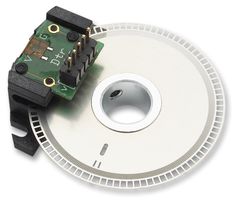
An example of an optical encoder. Farnell.com
What is an encoder?
Technically speaking, an encoder is an electromechanical or electronic device used to convert mechanical motion—whether rotary or linear—into digital or analog electrical signals. These ingenious devices allow us to measure and control rotational or linear movements with remarkable precision, which has revolutionized the way we interact with modern technology.
The technology behind encoders has advanced considerably, evolving from mechanical systems with rotating discs and electrical contacts to highly precise optical and magnetic encoders. Furthermore, the advent of digital encoders has enabled higher resolution and more efficient communication with electronic systems and computers, which has driven a countless applications in the industrial and automation sectors.
Types of Encoders
To fully understand the impact and versatility of encoders in electrical engineering, it is essential to explore the dThe different types of encoders available on the market. Each type has its own unique characteristics and applications that make them suitable for a wide range of industrial and technological uses. Here, we'll take a closer look at the four main types Types of encoders: optical, magnetic, capacitive, and inductive.
1. Optical encoders
They are known for their precision and extremely high resolution. They use the light transmission using an encoded disc to detect changes in position. These discs generally contain patterns with slots or marks, and light is projected onto them, generating electrical signals proportional to the angular or linear displacement. Optical encoders They are ideal for applications that require highly accurate measurements, such as in high-precision machinery, medical equipment, high-resolution printers, and critical positioning systems.
2. Magnetic encoders
They use magnetic fields to measure movement. These encoders can be classified into two main types:
- Absolute Magnetic Encoders: They use uniquely arranged magnets to provide a unique signal for each position, enabling accurate measurement even after a power loss.
- Incremental Magnetic Encoders: They use variations in magnetic fields to generate incremental pulses, providing information about relative displacement.
Magnetic encoders They are particularly well-suited for harsh environments and demanding industrial applications, since they are resistant to dirt, dust, and moisture.
3. Capacitive encoders
They take advantage of the changes in the capacitance between two plates, one of which is in motion, to determine the position. These encoders are highly precise and can achieve exceptional resolutions. They are suitable for applications that require highly accurate measurement and where direct mechanical contact is not permitted, such as in nanotechnology, metrology, and high-precision motion control systems.
4. Inductive encoders
They use coils and electromagnetic fields to detect changes in the position of the shaft or the object. They are known for their durability and ability to withstand harsh environmental conditions. Inductive encoders They are widely used in industrial applications such as position control systems, heavy machinery, industrial motors, and motion control systems in general.
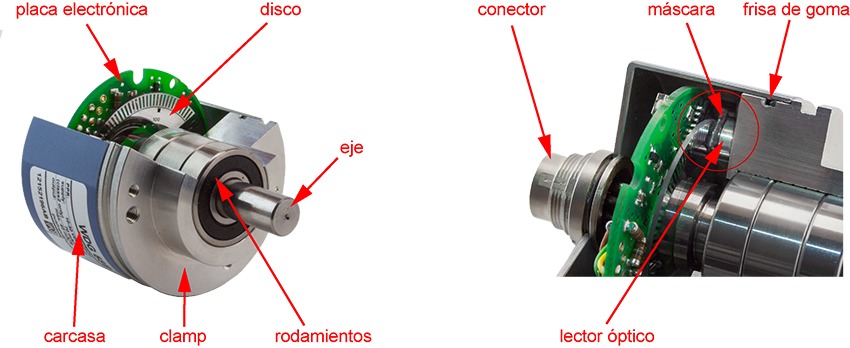
Explanatory section on an encoder. Contaval.es
In conclusion, the various types of encoders offer solutions tailored to the specific needs of each application. From the high precision and resolution of the optical encoders including the sturdiness and durability of the magnetic encoders, including the non-contact precision of the capacitive encoders and the durability of the inductive encoders, these devices have transformed the way we interact with modern technology. For a professional in the field, It is essential to understand the characteristics and advantages of each type of encoder to select the best option based on the requirements of each project and thereby contribute to the continued advancement of electrical engineering.