Since the 1970s, it has become increasingly important to know how a steam locomotive works for the purpose of its modernization, regarding the rise in oil prices.
A machine on wheels that pulls a train's cars and is powered by steam, electricity, or an internal combustion engine is called a locomotive.
The first steam locomotive was built by the engineer Richard Trevithick of England in 1803. The Rocket was the first locomotive which had a multi-tube boiler with 25 copper pipes that increased the fire's draft, manufactured in 1829 by George Stephenson together with her son Robert Stephenson.
Until the mid-20th century, locomotives served as the predominant form traction for the railroads. At that time, they were replaced by more modern locomotives: diesel and electric ones.
What Is a Locomotive and How Does It Work?
The locomotive is a cast-iron machine which has a kind of water-fed boiler that moves or pulls the cars of the railroad. The steam coming from that large boiler is expelled through valves that open alternating motion of two pistons which in turn move connecting rods that turn the wheels. Steam locomotives have to be refilled with water every so often, since without it the system would not work.
The first locomotives used pumps driven by piston motion; later, steam injectors were used, and some machines use turbo pumps. The most common arrangement was to have two independent systems to supply water to the boiler.
Indian Railways locomotives have 16 cylinders in a V configuration (V16), except for some of the lower-powered models, such as the WDG5, which has a V20 engine, and the WDM2, which has only 12 cylinders.
Steam Locomotives are used for special or tourist services, they are not currently in regular service. Since the 1970s, the steam locomotives have been purposefully modernized due to rising oil prices.
Types of Locomotives and How They Work
There are different types of locomotives, and their main distinguishing feature is the type of fuel they use. Currently, the three most commonly used types are diesel locomotives, diesel-electric locomotives, and electric locomotives. But how does a modern locomotive work?.
1. Steam locomotive
Equipped with boilers that use coal, wood o oil to heat the water and to produce steam. It is that same steam that powers the pistons that turn the wheels. The first locomotive steam used in the commercial sector was used in 1812. This type of locomotive was commonly used until 1950, when it fell out of use and was replaced by other types of locomotives.
2. The Diesel Locomotive
This type of locomotive is powered by an internal-combustion diesel engine. The first locomotive in this series appeared in Switzerland in 1912. At first, those who wanted to learn how a locomotive works saw how this type was a commercial failure And although a couple more attempts were made to relaunch it, World War I thwarted this process.
Hermann Lemp, designed the device that enables the electrical transmission of the power from the engine to the wheels. Following this resounding success, the experiments continued in the United States. It was found that this type of locomotive required less maintenance and were less harmful to the environment. In the Latest News Continues as it is one of the most widely used devices.
3. Sludge locomotive or drone
It's a locomotive without a motor in addition to a locomotive diesel-electric. This locomotive offers additional power traction and braking. The procedure applies to traction motors operating on the main locomotive.
4. The Atomic-Electric Locomotive
Before learning about the risks and consequences of using atomic energy, this type of locomotive was invented in the the 1950s. It had a 200-metric-ton reactor vessel lined with 1.5 meters of lead. Today, it has been unused for any purpose.
5. The Electric Locomotive
Whether through the air or via a third lane, a electric locomotive. In the year 1890 The first model in this line was patented by Jean Jacques Heilmann, but it wasn't until 1893. One of its most striking features is its greater efficiency and the lower costs operational. With regard to its environmental impact, this type of locomotive is much less polluting than steam and diesel locomotives.
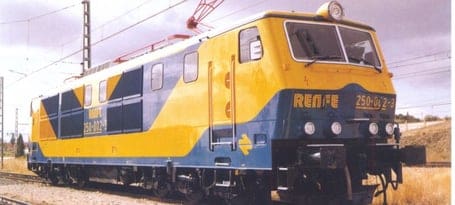
Electric locomotive. Source: caf.net/es
6. Another type of electric locomotive
This La model was manufactured in 1920 but it wasn't until 1930 which was marketed. It was used until 1973 When the oil crisis occurred, however today per day low usage. This gas locomotive has gas turbine which activates the electric generator and an alternator that simultaneously powers the traction motors.
7. The Hybrid Locomotive
This type of locomotive began to appear in early 20th century. Its main feature is that its rechargeable storage on board with battery, which also includes power supplies electric and an electric motor. The interesting format of regenerative braking This is another of its benefits: in this process, kinetic energy is ultimately converted into braking energy.
8. The Diesel-Steam Hybrid Locomotive
The high costs The choice of fuel for this locomotive led countries such as Russia, Italy y Kingdom United have ceased their efforts to use it. The locomotive diesel hybrid– The steam system was experimental and could use either boiler steam or diesel fuel in its piston engine.
9. The fuel-cell electric locomotive (Hydrail)
Of the most recent. It works by hydrogen which is transformed into mechanical energy. The first mention of this locomotive was in 2002 in Val-d’Or, Quebec.
It is a very new type of locomotive. Few places have this type of railroad, with Kaohsiung, Taiwan, being a notable example. It runs on hydrogen and transform the chemical energy of hydrogen in mechanical energy. Some countries also have GG20B Rail Power locomotives that originally ran on diesel but have been converted to hydrogen.
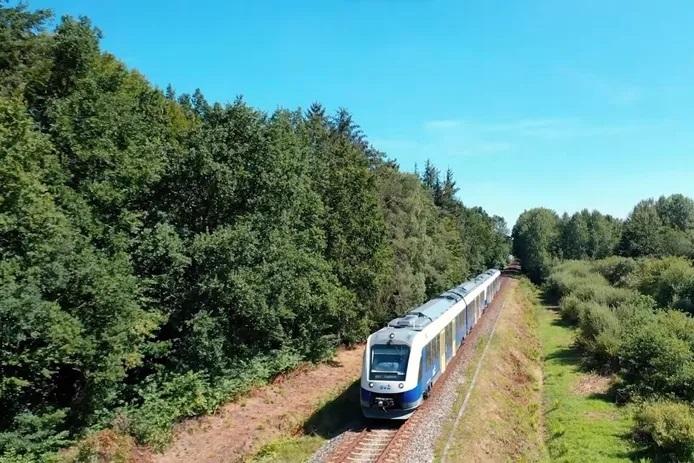
Hydrogen train. Source: motor.es
As can be seen, locomotives, with their large capacity, have facilitated the efficient transport of significant quantities of various types of goods over long distances. Although they travel great distances, operating costs are quite low, and among other advantages, they have a low accident rate.
During the Industrial Revolution, railroads had a significant impact, and the construction of the railroad network also fueled demand for coal and steel.
Now that you know what a locomotive is and how it works, we’d like to invite you to enroll in our new Master’s program in the Design, Construction, and Maintenance of Railroad Infrastructure and Facilities, where you can delve deeper into this fascinating world of railways.