
Discussion: Innovative work methodologies implemented by HR managers in companies and the development of female talent in engineering.
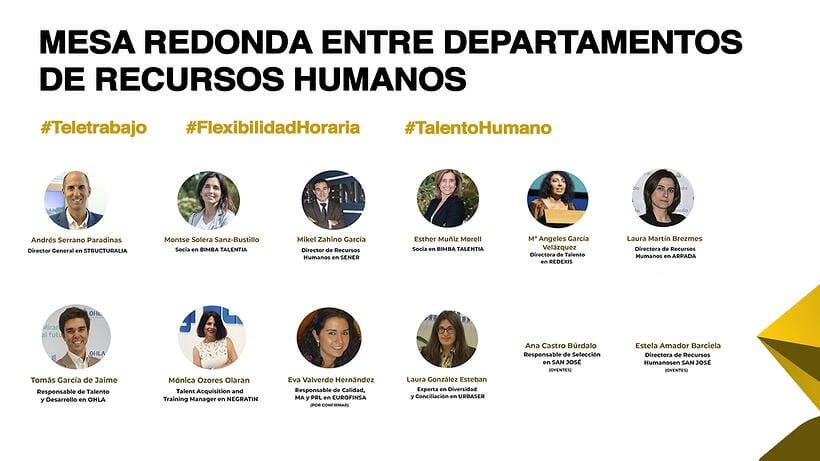
Last June 22, STRUCTURALIA organized a panel discussion, to which he invited the the Human Resources departments of PHAROS's clients. The purpose of the roundtable discussion was to debate three issues that have become particularly relevant in recent years:
- Telework
- Flexible hours
- Women's Talent
It was a truly productive day during which participants shared a variety of highly interesting experiences and discussed ideas that are currently being implemented in companies within the sector. The following are the The 3 main parts of the debate which highlights some of the experiences and practices implemented by human resources professionals.
Telework
Mikel Zahino (Director of Human Resources at Sener):
Mikel begins by offering some thoughts: “A few years ago, at Sener, we didn’t mind having people from other countries join our meetings online, yet it was almost unthinkable to imagine that employees in Spain wouldn’t be available in person.”. Over time, it has gradually fostered a culture that is more focused on results achieved rather than on the number of hours spent working on-site.
But, on the other hand, working from home can be so efficient that Innovation and creativity may be lost along the way, due to a lack of opportunity and willingness to engage in more open conversations and meetings. For this reason, Sener currently offers its employees the option to fulfill, on a weekly basis, a a specified number of % classroom hours, allowing them to choose the days that work best for them through a simple platform that managers can access. Of course, this applies to everyone in the organization, and executives are the first to want to lead by example.
Isn't there a risk that some employees won't work from home with a sense of responsibility and dedication? There might be a few, but they're certainly the exception. “Let’s stop regulating the exception; let’s regulate for the vast majority, assuming that employees are honest in their work.”.
Teleworking is also a necessity in the talent search. Companies are trying to adapt to the market and find talent wherever it may be, since it is difficult to find certain types of candidates.
Mª Ángeles García Velázquez (Director of Talent at Redexis):
The situation at Redexis is similar to that at Sener: employees can also choose to work remotely for up to two days a week, and—as a new option—one full day and four afternoons, excluding Mondays and Fridays.
Mª Angeles told us about some aspects related to the challenge of the occupational safety and health of employees when they work from home. Among other things, the occupational safety and health department asks employees to send photos of their workstations so it can check and confirm that working conditions are optimal. There is also a cybersecurity challenge, For these positions, employees must complete specific training on the subject.
Redexis has embraced remote work, and in addition to the remote work days specified in the appendix, employees are entitled to up to 10 additional days of remote work per year.
At Redexis, we rely on employees to use these flexibility tools responsibly, while keeping in mind that the “Going to work is always better than working from home” .
Flexible hours
Tomás García de Jaime (Head of Talent and Development at OHLA)
Tomás cites as a success story the fact that at OHLA’s headquarters (since business and geographic factors vary depending on the collective bargaining agreement), the company has chosen to offer flexible hours as an employee benefit, specifically 2.5 hours of flexible work hours (start-end) with a minimum of 30 minutes for lunch and a compressed workday, which has resulted in a higher productivity, less stress, and greater talent retention (which is so hard for them).
They are currently analyzing the global situation and adjusting their flexibility measures, taking into account the competitive landscape and always listening to their employees.
Laura Martín Brezmes (Director of Human Resources at Arpada)
Laura discusses a pioneering project among many construction companies that is proving to be a great success so far, even though it is still in the pilot phase. To achieve this, they first had to distinguish between work in the Technical Office and on-site/production work.
For them, it was very difficult to retain and attract talent, since it was very hard for people working on-site to balance their work and personal lives, so they’ve adopted a “Flexible Construction Project” model that prioritizes coordination and teamwork. Everything is now in the cloud, so anyone can see the status of the project, the work that has been completed, and what remains to be done.
Overall, the participants in this pilot project have gained confidence, and their satisfaction and sense of belonging have improved.

Women's Talent
Montse Solera / Esther Muñiz (Partners at Bimba Talentia)
Our society and our companies in general (and more specifically those in the construction, energy, infrastructure, and industrial sectors) are characterized by the lack of female role models.
Montse told us about some of the initiatives that could help bring about change in the future:
- Initiatives to create STEM careers among girls and teenage girls and thereby increase the number of women in technical fields. (See Inspiring Girls)
- Create plans specifically for women within companies
- Review your own corporate culture
- Design programs with measurable, achievable, and rewarded goals
- Listen to the staff and improve communication
- Promote the equal pay
- Work at special offers to employees, on fair and equitable terms
- Design programs for Mentoring
- Do Networking people with potential
- Develop recognition plans
Andrés Serrano Paradinas (CEO of Structuralia)
STEM is a a traditionally male-dominated sector (engineering, energy, and technology), and we have to deal with the specific challenges posed by their quantitative data (10–15% engineering students in the 1990s and 25–30% engineering students today).
- In the late 1990s, between 10 and 15 of the civil engineering students at the UPM were women. This means that today, among civil engineers aspiring to become executives In companies in this sector, only 10–15% of applicants are women.
- Currently, 29% of the civil engineering students at the UPM are women (see ireport). Among ICAI engineers, 21% are women today (see report). The data is very similar in other engineering fields. In other words, in 25 years, among engineers with enough experience to be managers, only 25% will be women.
The discussion was a great experience for all attendees, who gained insight into the perspectives of each company from their own point of view. At Structuralia and PHAROS, we organize forums for discussion that serve as platforms for sharing ideas, best practices, and insights, as well as planning events focused on economic and educational trends in the engineering sector.