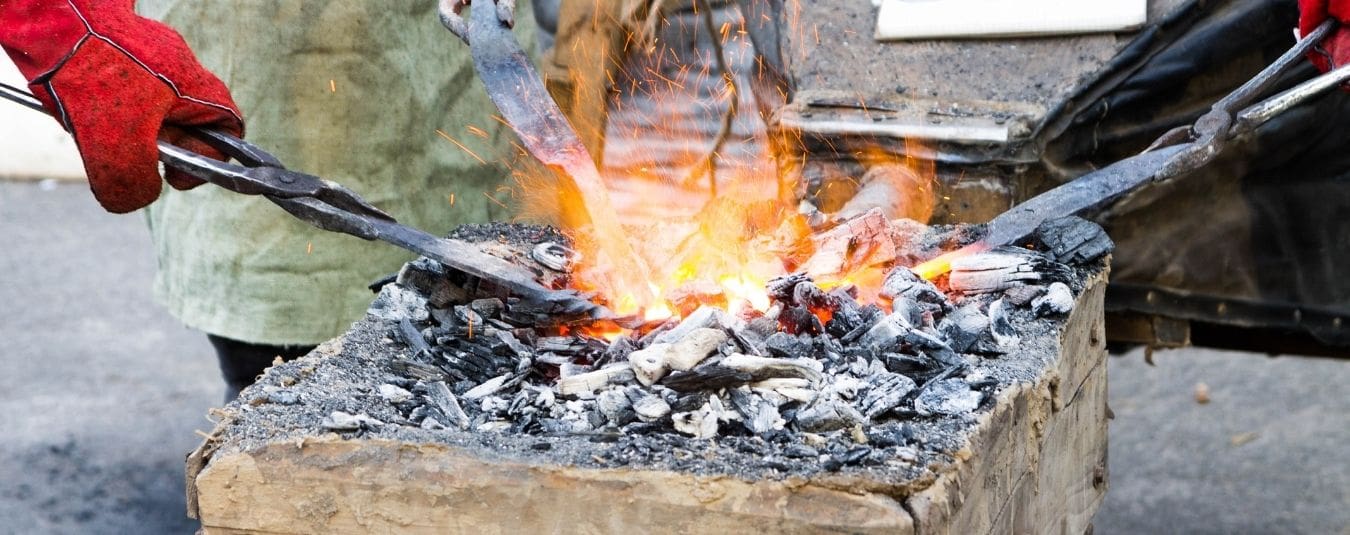
The heat treatments for hardening These are processes designed to achieve maximum hardness in a metallic material, typically steel. To do this, the material is heated to high temperatures in a controlled manner and then rapidly cooled.
Thanks to tempering, the internal structure of the material can be modified to achieve greater durability, wear resistance, and the ability to withstand high impact forces.
In this article, we'll look at What is tempering?, its main stages, the Types of tempering the most commonly used ones and their applications in engineering and construction.
What is tempering?
Have you ever wondered why the blade of a sword or knife is so strong? The answer lies in an industrial process called temper, a type of heat treatment which makes the metal incredibly hard and strong.
In technical terms, if we ask ourselves What is tempering?, we are referring to a process that is primarily used for steel and ferrous alloys. It involves heating the material to temperatures ranging from 750 °C and 1300 °C, keep it within that range, and then cool it in a controlled manner using water, oil, or air, depending on the steel's characteristics. This rapid change alters its internal structure, giving it new properties.
When Steel is tempered, it becomes harder, more wear-resistant, and capable of withstanding impacts or intense stress without breaking. For this reason, hardening is used on parts that require high durability, such as tools, gears, or blades.
Types of tempering
Types of heat treatment can be classified in various ways, depending on the depth of hardening, the heating process, or the cooling medium.
Based on the depth of hardening:
- Surface hardening: It hardens only the outer layer of the part, leaving the core softer and more flexible. It is applied using techniques such as induction hardening or flame hardening. Example: blades or gears that require a hard surface but a more ductile interior.
- Deep or full tempering: It affects the entire part, hardening both the surface and the core. It is used in shafts, spindles, or tools that require high strength throughout their entire structure.
Depending on the heating process:
- Induction hardening: It uses electromagnetic fields to heat only the surface of the part. It is fast, efficient, and widely used in the automotive industry.
- Vacuum-Furnace Hardening: Heats the parts in a vacuum oven, which prevents oxidation and improves the quality of the material.
- Flame hardening: a traditional method in which a direct flame is applied to the surface. Although it is less precise, it is still used in repairs or manual processes.
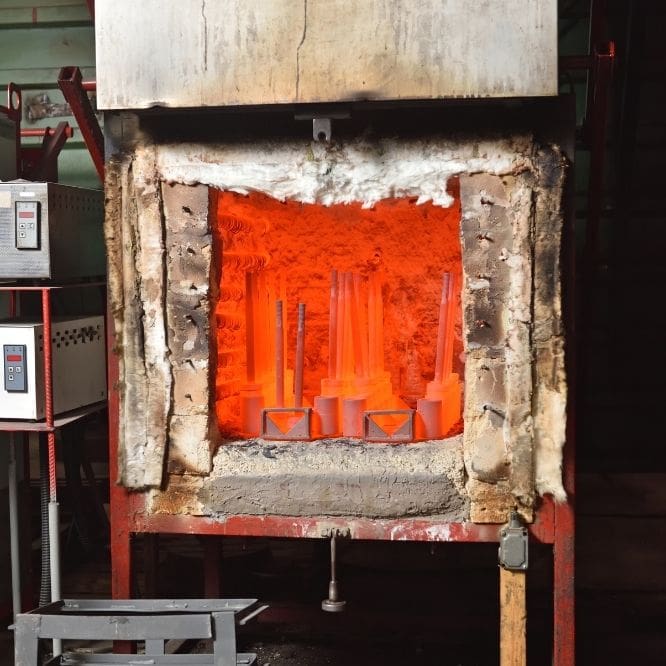
Vacuum-Furnace Hardening
Depending on the cooling medium:
- Direct tempering: The workpiece is immediately cooled in water, oil, or salt from the austenitizing temperature. This is the most common method for tempering steel.
- Isothermal Tempering (Austempering): The workpiece is cooled in a salt bath to a temperature at which bainite forms, resulting in hardness combined with greater toughness.
- Step Quenching (Martempering): First, it is quenched in salt until martensite is about to form, and then air-cooled. This reduces internal stresses and the risk of cracks.
What are the stages of heat treatment for hardening?
We can identify two major stages, namely:
1. Warm-up
This is the first step in the heat treatment process, during which we will raise the temperature of the steel until the formation of the austenite, that is, the rearrangement of the iron and carbon atoms that make it up. It is at this point of austenite stability that we will continue the cooling process to achieve the desired results.
Some factors that influence the thermal processes involved in hardening are:
- Thickness of the workpiece. The heating time will vary depending on the size.
- Type of steel, since each has a different chemical composition.
- Grain thickness. It affects the critical speed.
- Cooling medium. One that provides a velocity greater than the critical velocity.
- Internal tensions.
It is recommended that raise the temperature little by little to avoid overexertion.
2. Cooling
Once we have reached the phase of stability, the next step is the steel cooling. This process is carried out through a cooling medium, which could be:
The choice of the most appropriate medium for continuing this stage will depend on the composition of the material to be tempered. That is why it is usually determined through tests y analysis of the parts under specific conditions.
In turn, there are international organizations, such as the American Iron and Steel Institute or the SAE Society of Automotive Engineers, which provide standardized information on the hardening conditions of certain materials.
Some general rules to keep in mind when heat-treating steels with certain properties are:
- Carbon steels that are 5 mm thick, and low-alloy steels thicker than 25 mm, must be quenched in water at a temperature between 15 and 20 °C, without exceeding 30 °C.
- For high-alloy steels with cross-sections less than 5 mm, oil at a temperature between 30 and 60 °C should be used as a cooling medium.
- Very high-alloy steels are air-hardened.
On the other hand, the hardening rate It's important. Higher speed will result in a structure martensitic (the hardest of the austenite transformation components); conversely, at lower speeds, the following are obtained: microstructures, such as bainite or fine pearlite.
Applications of tempering
The heat treatments for hardening They ensure that the materials can withstand torsional loads o impact forces for long periods without deforming, so it can be used to manufacture various parts:
- Gears.
- Axes.
- Cams.
- Spindles.
- Universal joint.
- Construction cranes.
In short, the heat treatments for hardening They are very useful when maximum hardness is required in a material; through this process, we achieve greater durability and parts capable of withstanding high impact forces.
If this topic has piqued your interest and you'd like to explore it further, from Structuralia You can continue your professional development and acquire the necessary knowledge through the Master’s Degree in Structural Analysis and Design, where you’ll learn everything related to the composition of materials and make decisions about their best uses and applications.