How to Tell the depth of a water well It is the best way to monitor the well's efficiency and assess the condition of the pumping equipment.
Knowing the depth of a well is an ideal way to optimize its use. In fact, groundwater wells require a monitoring constant monitoring to ensure that the liquid is delivered in the required quality and quantity. In addition to physicochemical and bacteriological measurements, a key parameter is measuring the water level. For this reason, How to Determine the Depth of a Water Well It becomes essential, as it helps us understand the behavior of the well and the pumping equipment.
The Importance of Water Well Levels
Accurate measurement, recording, and analysis of data make it possible to identify preventive when the well needs maintenance. The more deteriorated the casing is, the greater the buildup of scale and the less water can enter the well, causing water levels to drop. This means less pumping efficiency y costs higher electricity bills.
On the other hand, the level measurement and flow rate also provides information on the status of the pumping system and its efficiency. If wear is detected before a failure occurs, it will be possible to avoid enormous repair costs and loss of productivity in the case of industrial facilities. Therefore, it is essential to check the water level to prevent disruptions to the water supply.

How to Determine the Depth of a Water Well
The water level can be measured at two different times:
- Static Level. This measurement is taken when The well is inactive., that is, with the pump turned off at least one hour before taking the measurement.
- Dynamic Level. This parameter is measured using the live bomb This makes it possible to determine the groundwater level while the flow is being pumped.

Observation Tools and Methods
Direct measurement of groundwater levels can be performed using operational instruments manual or automatic continuous recording.
Hand Tools
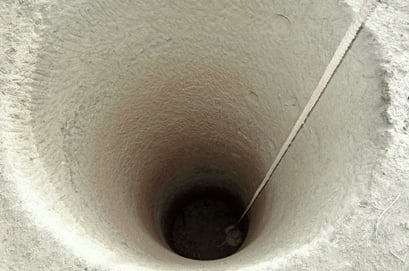
The most common one involves to suspend a linear object and heavy, like a flexible steel cable, extending from a specific point on the surface to a point below the groundwater level.
To determine the depth of a water well, you pull out the cable and subtract the length of the submerged portion of the total. Based on this principle, some instruments have been equipped with a braking mechanism that activates upon contact with water, significantly reducing the error to 0.5 cm. There is also the system of double electrode, which includes two small electrodes in a unit measuring 10 to 20 cm in length located at the end of the cable.
Automatic instruments
Currently, we use different types of automatic recorders to measure water levels. To ensure optimal performance, this equipment must have the following characteristics:
-
- Ease of installation.
- Ability to measure linear and temporal variations in the groundwater level at different rates.
- Measuring different conditions.
Furthermore, experience has shown that the analog recorder powered by float It is one of the most suitable options. In fact, in some projects, equipment has been designed to measure level variations using capacitance probes, pressure transducers, strain gauges, sound sensors, and high-frequency wave reflection techniques.
To summarize, how can you determine the depth of a well? water is an essential method for ensuring the optimal performance from the well and reduce costs. To do this, the readings from the static levels o dynamic from the wells using various measuring instruments such as handheld probes o automatic instruments which also provide continuous readings.
Discover the knowledge you need to add value to urban transformation projects.
With our Master's Degree in Structural Analysis and Design from Structuralia It is possible to acquire the knowledge required for this field and other sectors, such as construction, infrastructure, energy, and engineering.